



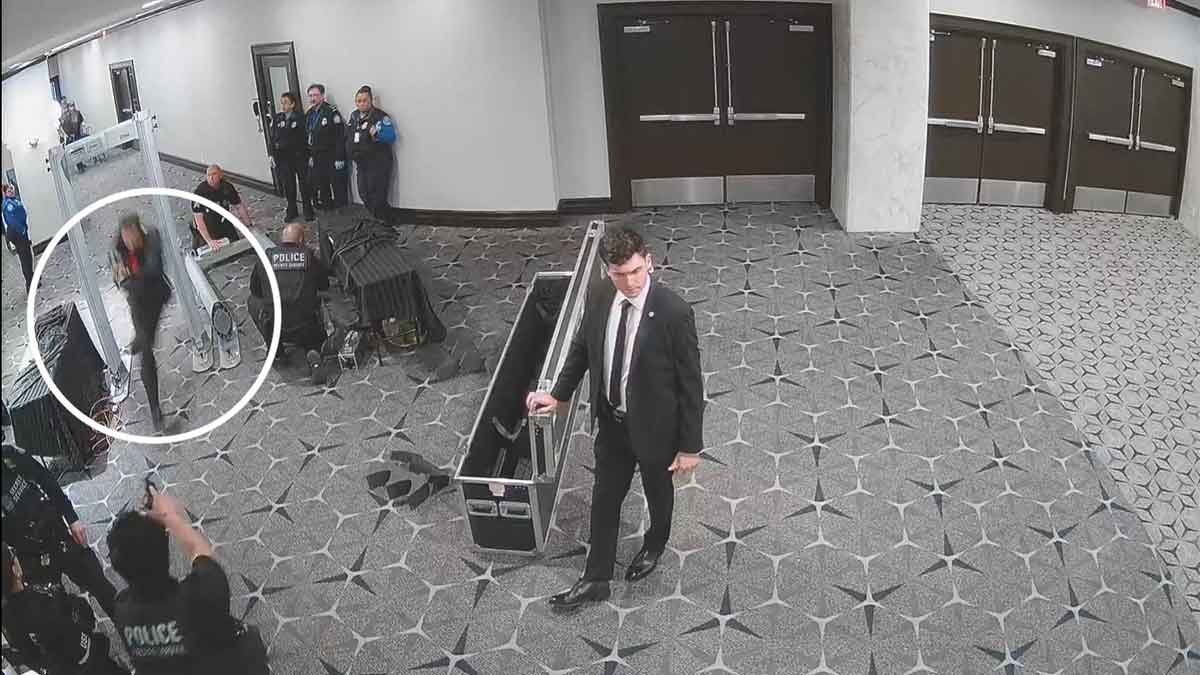
When I attended the White House Correspondents’ Association (WHCA) dinner in 2018, President Donald Trump gave it a miss. Nothing personal between us. Just that the presidential skin, though younger, was even thinner than it is now. In fact, Trump did not attend any WHCA dinner during his first term, unwilling to exchange champagne toasts with networks that he regularly slammed and sued.
In the event, the 2018 dinner was a disappointment. The comedian Michelle Wolf laboured through a series of weak and incestuous Beltway barbs that invoked a few reluctant smiles. Sarah Huckabee Sanders, Trump’s long-forgotten spokeswoman and the main White House attendee, could barely twitch her lips when Wolf aimed an off-colour swipe at her. But that’s American humour for you; no wonder that King Charles recently had them reeling in the aisles with what were, honestly speaking, passable public school level quips.
2026, too, would have been similarly forgettable, notwithstanding that Trump was attending for the first time. But it will be remembered for the wrong reasons: a gunman rushing a magnetometer one floor above and a hundred Fed agents away from the president; FBI chief Kash Patel doing his usual deer-caught-in-the-headlights act, only this time under a table; the Veep getting whisked away before POTUS, and guests carrying away unopened bottles of wine as they were being evacuated, some after comparing labels. Or it may be remembered as the disastrous dinner that paved the way for Trump’s gold-plated ballroom.
All this proves that Mr Zeitgeist is sick. Violently nauseous, vomit-inducing sick. That is why 2,600 journalists in formal evening dress could walk nonchalantly past anti-war protestors standing in the rain and pretend to celebrate the First Amendment and Freedom of the Press with the man whose support has been crucial in the killing of hundreds of their professional brethren in Gaza, the West Bank and Lebanon.
The indifference may arise from the fact that these victims are not actually of their own tribe. Not a Jamal Khashoggi of The Washington Post, whose murder caused a US-Saudi rift. Not the CNN team manhandled by an IDF unit when covering settler violence in the West Bank: the IDF unit was promptly suspended and then relocated. The victims are only ordinary, brave—and largely non-white—men and women in press jackets, documenting unpalatable truths.
The Committee to Protect Journalists (CPJ), a non-profit, independent organisation headquartered in New York, concludes that Gaza and subsequent conflict has been the worst for journalists since CPJ began collecting data in 1992.
262 journalists—large majority of them Palestinians in Gaza—have been killed, another 174 injured and over a hundred imprisoned. At least 64 were deliberately targeted because of their work, including through Israeli drone attacks, most recently Al Jazeera’s correspondent Mohammed Washah in April 2026. In comparison, the accepted figures for journalist fatalities during World War II and Vietnam were 69 and 63, respectively. There has been little evidence to prove the claims that these journalists were performing military roles. Their power lies in their on-the-spot reporting that challenges official discourse. Their targeting is of a piece with the broader effort that controls access, unleashes influencers and strangles or purchases free media. In international humanitarian law, such targeting of bona fide journalists constitutes a war crime and yet it continues with impunity.
The WHCA could have covered itself in glory had they the courage to cancel the dinner in protest against the media killings. But the Washington Beltway is insulated from war crimes and addicted to anaemic jokes. So they dine on.
And no significant protest from the Indian media either, not even on World Press Freedom Day. Is that a strategic silence?
The author was India’s high commissioner to the UK and ambassador to the United States.
