



I read of the death of Prashant Tamang with immense sadness. A police constable, who sang in the Kolkata police orchestra, Tamang managed to audition for the third season of Indian Idol only because his superior, Zulfiquar Hasan, special additional commissioner of police, sanctioned leave. He went on to win the nationwide competition.
My husband, Niret Alva, was executive producer of Indian Idol at the time, and we were all genuinely excited about how reality television was democratising access across India—giving ordinary people with extraordinary talent a chance to “go to Mumbai” and build better lives for themselves. In the early 2000s, Niret produced a slew of reality shows—Indian Idol, Roadies, Fame Gurukul—that helped shine the spotlight on young people who would later become superstars, from Ayushmann Khurrana to Arijit Chakraborty.
Over the years our enthusiasm faded. Talent hunts began to focus less on talent and more on drama, politics, manipulation and faked fights. But in those early seasons, there was something pure and beautiful about reality TV: the reverence for music, the tough love of the judges, the intensity of the contestants’ effort, the camaraderie of the production crew.
Once, when Niret and I were on a Pepsi ad shoot in Venice with Shah Rukh Khan and Farah Khan (who judged Indian Idol 1 and 2) they described a familiar dynamic. “The best part of a location shoot,” they said, “is late at night, when everybody—regardless of designation—gathers in someone’s room, drinks, chats and turn-by-turn tells a joke, or recites a poem, enacts a dialogue or sings. Everyone applauds, or boos, good-naturedly. It is like family.”
When Bollywood insiders get teary-eyed and say Bollywood is their family, they aren’t bullshitting, they really mean it. There’s tremendous affection there. It’s toxic of course—but which family isn’t a little bit toxic?
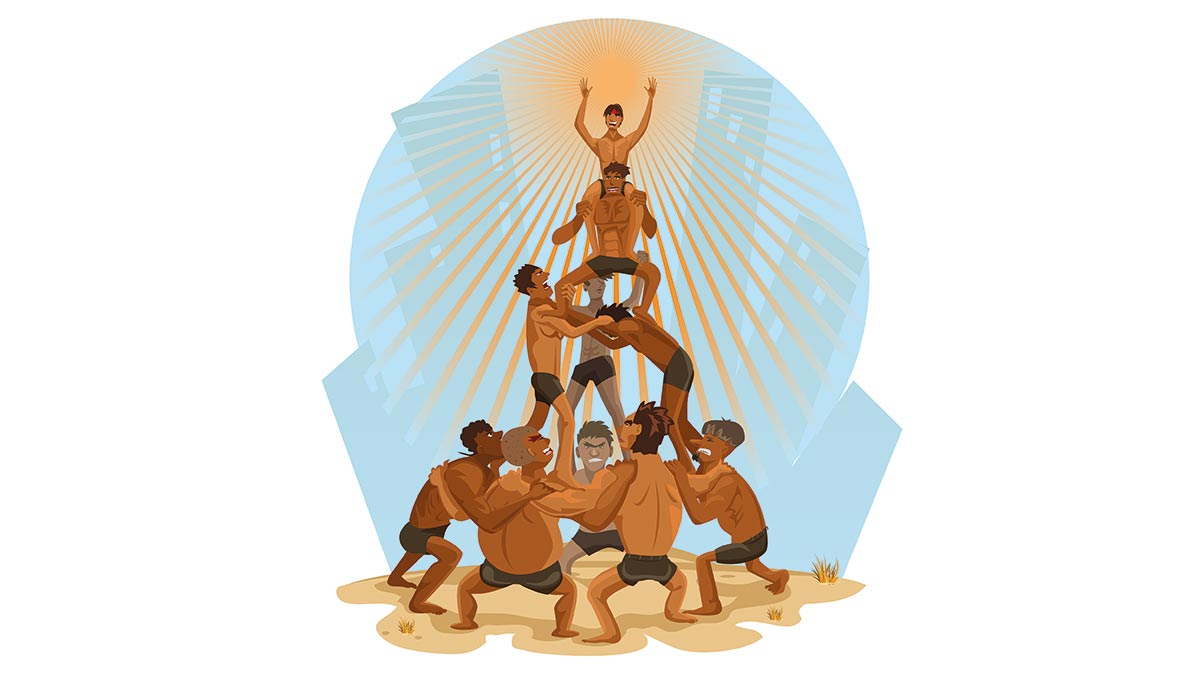
And that’s what all of us are seeking, isn’t it—a feeling of belonging, a sense of having found one’s place in the world, and the people who are one’s tribe? One’s found family, if you will. Clubs like the Delhi Gymkhana or the Golf Club, old school and college networks like Doon and Stephen’s, MNC management cadres (think Unilever, Nestle, etc.) are the elite’s found family. A place where they feel safe and accepted, hanging out with people who they feel will come through in case of a crisis.
But what of the not-so-elite? In a time of economic and political uncertainty, with unemployment rampant and pornography available on tap—literally—where can they get their sense of belonging today? Trade unions? Too weak. The Ambedkarite movements? Not accessible to all. The Indian Army? Too dangerous. Bollywood or cricket fandom? Too online.
The bald fact is that the one institution consistently rewarding young people with a sense of dignified, stable community is hindutva. Join their cadres and you are immediately morally elevated. You belong to a superior civilisation. You are a part of a narrative that has historical importance; you become visible in national discourse, you are a part of a privileged, powerful network, with feet on the ground and with a clearly defined line demarcating insiders and outsiders.
I suspect this is why non-elite youth are thronging the shakhas—not because they love Lord Ram or Mother India, but because hindutva today is functioning like a mass, democratised Gymkhana Club—offering non-elite Hindus symbolic membership, dignity, and civilisational standing in a society where elite institutions and status networks remain structurally inaccessible.
The need of the hour is to provide talented ambitious youngsters a healthier, more wholesome alternative.
editor@theweek.in
