



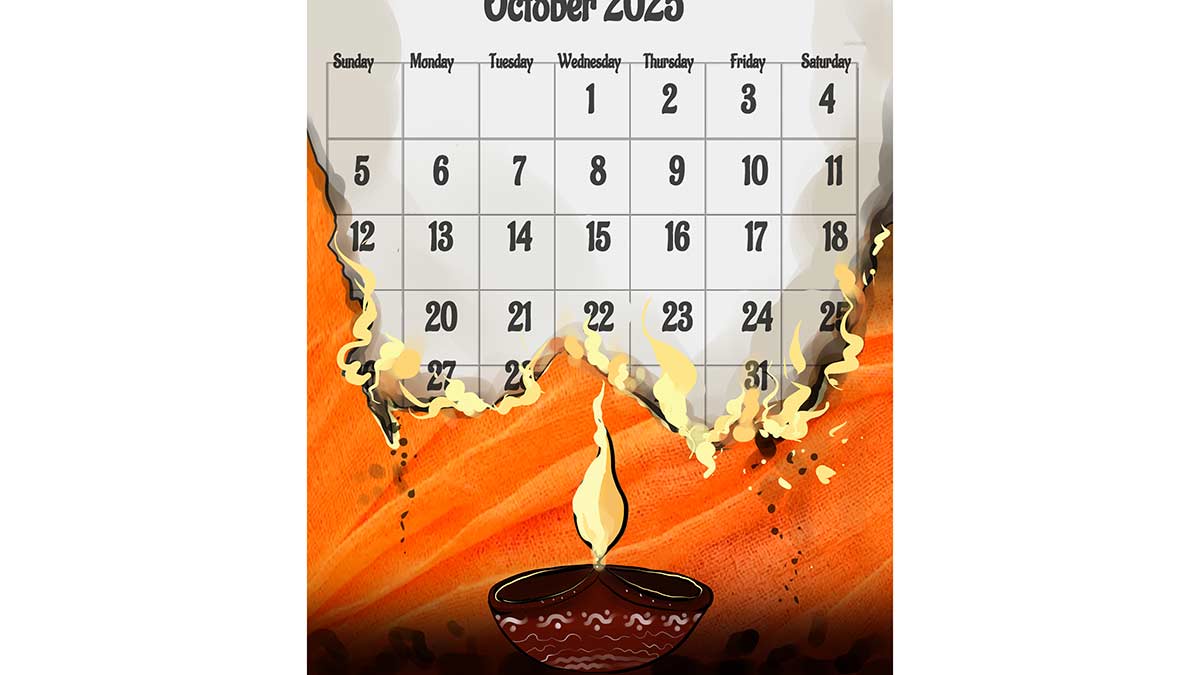
The assiduousness with which right-wingers fan the embers of religious differences in our country would put street-side bhutta-wallas to shame. Like, they literally never give it a rest—not even during the holiday season. In fact, especially during the holiday season.
I woke up the morning after Diwali to find 1) Francesca Orsini, a renowned scholar of Hindi, has been stopped from entering the country despite a valid visa. 2)
An ‘organic groundswell’ has arisen across the nation, asking for Diwali to be declared a week-long celebration and public holiday.
Orsini’s work, The Hindi Public Sphere 1920–1940: Language and Literature in the Age of Nationalism, examines the constructed separation of Hindi and Urdu.
Her research demonstrates that during the colonial period, the British linguists, ever faithful to their policy of divide and rule, deliberately pried apart two closely mingled languages, associating Hindi with Hindus, and Urdu with Muslims. She further points out that in Awadh’s historically multilingual literary culture, Persian, Awadhi and Braj flourished alongside Hindi and Urdu in cheerful coexistence. This directly contradicts the hindutva brigade’s narrative of a monolithic, pure, Hindi-speaking Hindu identity.
Orsini is the fourth international scholar to be denied entry despite a valid visa. Such malevolence for scholars is, perhaps, understandable in a country where our leaders scurry out of recording studios (the latest being Prashant Kishor) when questioned about their degrees.
Now, let’s unpack the ‘groundswell’ calling for a week-long, government-mandated Diwali break, which could be created by doing away with ‘less desired’ public holidays such as Gandhi Jayanti, Labour Day, Easter (which falls on a Sunday, but why bother with logic?), Ambedkar Jayanti, Muharram or Bakrid.
The first logic on offer for this move is that “people will be able to go home and be with their families”. But, doing away with secular holidays disrespects the spirit of our democracy, the father of our Constitution and the father of our nation—all in one go. The reality is that across our gloriously multicultural land, people celebrate Pongal, Onam, Bihu, Durga Puja, Ratha Yatra, Ganesh Chaturthi, Gurpurab, the Eids, Christmas, Nowruz, etc; with full on fervour. Most workplaces deal with this by offering optional days-off, and people opt for offs on the days that are significant to their particular faith, which is a good system because there’s always somebody from another faith to man the desks, and ensure work continues.
Schools, on the other hand, traditionally give about seven-to-ten days off in October, not because they are obsessed with Ravana-felling as such, but because Dussehra provides a neat mid-point between summer and winter.
The second logic on offer is an eternal right-wing favourite for temples, statues and the abrogation of Article 370—that this ‘will boost the tourism industry’. To back this claim we are being told that Diwali hotel bookings are at a record high this year. I suspect this has less to do with fervour around Lord Ram’s homecoming, and more to the fact that Diwali fell early this year—before high-season rates kicked in.
Which brings me to my final point—Diwali moves around a lot. If we let it dictate our annual week-long break, it won’t be long before the tail starts wagging the dog. Soon, the hindutva herd will demand that we abandon the “evil, Sonia-Gandhi-and-Italy-tainted” Gregorian calendar and switch to the Samvat. After that, our work schedules, flight timings and even the IPL fixtures will be ‘subject to the appearance of the moon’.
editor@theweek.in
