



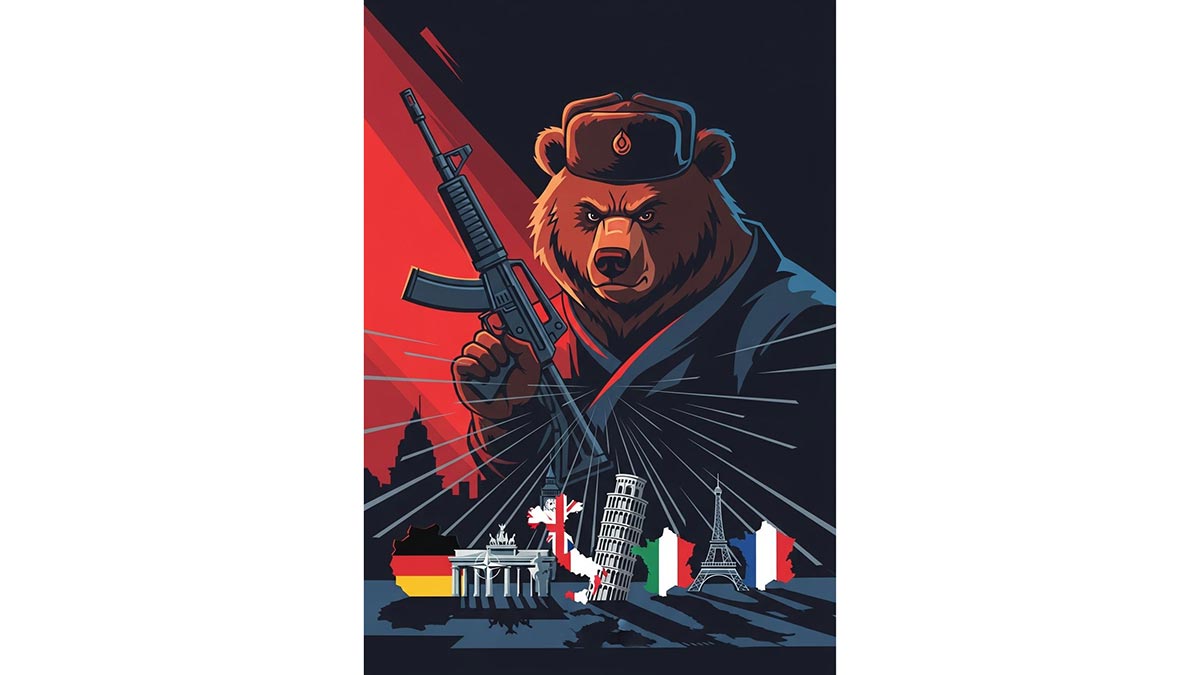
Like day and night, New Year is a time of bright optimism and dark prophecies—often about the same issue. The promise of AI bringing prosperity competes with the peril of AI enslaving humanity. Miracle cures are here, but they are no match for malignant variants. Rule of law prevails but flails like a toothless old crone against scams, lobbies and leaders. Peace prospects shine in Ukraine, but dark questions arise about a new, destructive war looming in Europe. Predicts German security expert Hanna Notte, “Europe risks a self-fulfilling prophecy over the Russian threat.”
European leaders predict an imminent Russian attack on a NATO country. Warns Mark Rutte, secretary general, “We are Russia’s next target. [We] must be prepared for the scale of war our grandparents or great-grandparents endured.” Richard Knighton, the UK’s defence chief, urged British youth to prepare for war should Russia attack Britain. Germany’s defence minister Boris Pistorius invoked the nostalgia of a tranquil bygone era, “We already had our last summer of peace.”
Cold War jargon resurrects from the European deep freeze: Revanchist Russia, Red Scare, Bolsheviks, Broken Arrow—all zigzag low and loose but fail to hit target: the European public. So far, they are unimpressed by the scaremongering. The euphoric European propaganda, early in the Ukraine war, convinced people that Ukraine was winning and Russia losing, with its clunky tanks squashed like dead toads on a highway. Public perception solidified that the Russian military is no match for NATO—proclaimed the most powerful military alliance in world history. To pivot now and believe that Russia is a well-equipped mortal enemy is a big ask. Besides, Russian attacks aren’t new. Their hybrid war in Europe is decades old.
But predictions of full-fledged war legitimise the ongoing rearming of Europe’s military-industrial complex, which contributed to much destruction during the World Wars, and which had shrunk thereafter as Europe invested in infrastructure and public welfare. Military spending is now accelerating, especially in Germany, Italy, Britain and France. While GDP figures swell, citizens face funding cuts to municipalities, safety, health care programmes and reel under an affordability crisis—aggravated by the Ukraine war.
Europe’s rising war rhetoric is triggered by worry—about Russia and an unreliable US: Donald Trump’s relationship with Vladimir Putin, his impatience to end the Ukraine war, his public condemnation of Europe’s liberal governments and praise for Europe’s “patriotic” far right. It bothers liberal Europe that the increasingly popular, pro-Kremlin far-right groups’ narrative that Russia has a right to defend itself against NATO enlargement is gaining mainstream momentum.
Russia, frequently, unfurls its brutality and perfidy. Yet, events from the 19th century onwards show a pattern of European disdain for Russia’s security concerns. Russia is seen as “revanchist”—a vengeful, expansionist power under Tsarist, Soviet and post-USSR regimes. Independent western scholars say the problem is not Russian ideology, but Europe’s refusal to recognise Russia as a legitimate, equal security actor. Europe’s Russophobia stems partly from Russia’s huge landmass sprawled across Europe and Asia. Size matters. Further Russian expansion is unacceptable, so it must be contained. That was western strategy. It still is.
History repeats. Prophecies come true. From Greek myths to Star Wars, in legend and in life, the cruel irony is that the very actions taken—like rearmament—to avoid self-fulfilling prophecies, lead to its unfolding. An apt New Year resolution is to stop repeating the ancient Roman dictum: “If you want peace, prepare for war.” History shows preparation, like self-fulfilling prophecies, invariably leads exactly to what it wishes to avoid—war.
Pratap is an author and journalist.
