



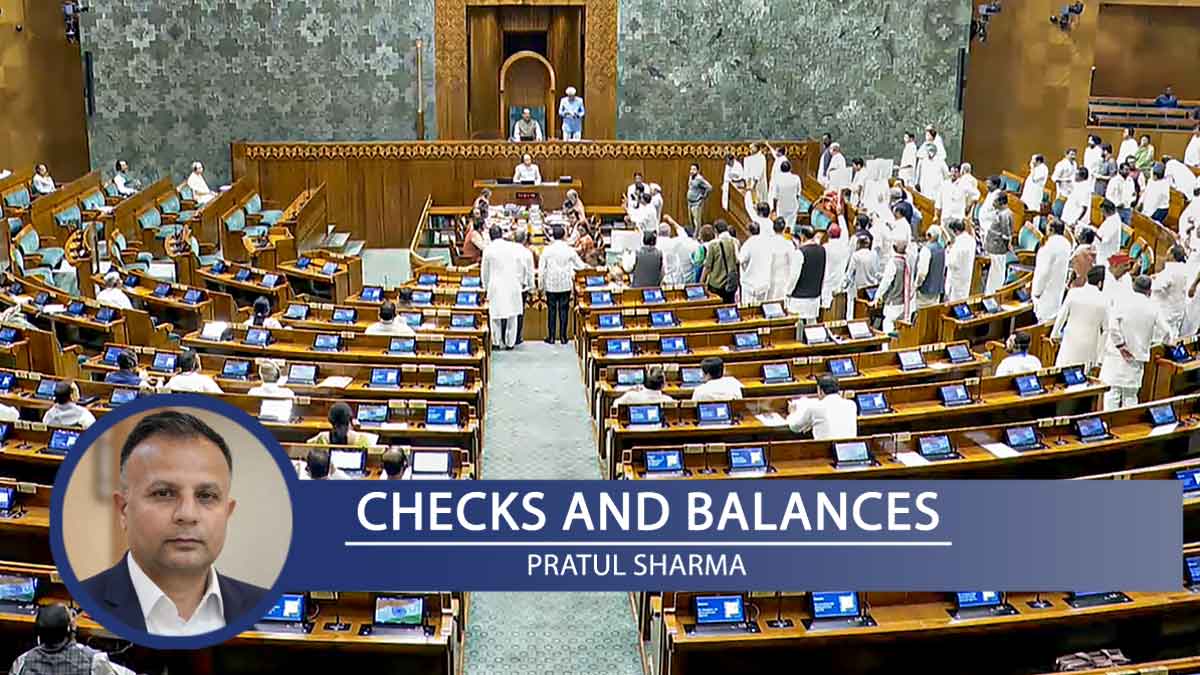
Digital initiatives, including artificial intelligence, are beginning to change how legislatures work. It is becoming easier to research archives, and many legislatures are moving toward becoming paper-free. Real-time AI translation tools allow MPs to speak in their own languages and be understood instantly. This could make Parliament more accessible and inclusive.
But technology does not solve the main problem.
Despite the speed with which technology is shaping public interactions, Parliament’s core function does not change. It exists to debate laws, question policies, discuss crucial issues, and represent public opinion. These tasks require time and decorum. AI can support Parliament, but it cannot replace sitting days.
In 2023, Parliament functioned for just 62 days. The 17th Lok Sabha (2019-2024) averaged only 55 days a year—the lowest among all full-term Lok Sabhas.
Over the decades, the Lok Sabha has been meeting less and less. In the early years after Independence, Parliament sat frequently: the first Lok Sabha averaged 135 sitting days a year. In 1950 and 1956, it had over 150 sittings. The second and third Lok Sabhas averaged 116 and 117 days. From the 1980s onward, the number fell below 100 and never recovered.
By the 10th Lok Sabha, the average was 93 days a year. The 14th and 15th Lok Sabhas averaged 66 and 71 days. The 16th Lok Sabha averaged 66 days. State legislatures show the same pattern: on average, Assemblies meet for just 26 days a year, limiting oversight and strengthening executive control.
Fewer sittings mean fewer hours to debate laws, scrutinise decisions, and raise issues of public concern. The last session had scheduled time to debate air pollution, yet it could not be taken up due to fewer sittings and frequent disruptions. Over the years, disruptions as a form of parliamentary statement have further impacted the business transacted and productivity.
Another major casualty of fewer sittings and frequent disruptions is the Question Hour—one of the strongest tools to hold the government accountable and get answers. Opposition parties often demand the suspension of Question Hour to discuss issues they deem important. Once lost, the Question Hour cannot be recovered, even if one devotes more time later to boost productivity percentages. During the 17th Lok Sabha, Question Hour functioned for 60 per cent of scheduled time in Lok Sabha and a mere 52 per cent in Rajya Sabha, according to PRS Legislative Research.
Standing committees, comprising MPs, discuss key bills and issues away from public glare and scrutiny. They serve an important function, but the time taken by them cannot compensate for the number of sittings.
Other democracies have not reduced sittings despite using modern technology. Parliaments in the UK, Canada, and Australia sit between 100 and 150 days a year.
The unspoken argument for fewer sittings is frequent disruptions in the House. Disruptions and protests are not limited to any one party, but being in Opposition gives them a tool to create a louder impact than the spoken, recorded word inside the House.
In 2008, when the UPA was in power, Parliament had only 46 sittings—the lowest, barring 2020 when Covid-19 reduced it to 33 days.
Experts have repeatedly warned against this decline. Committees and constitutional bodies have recommended fixing a minimum number of sitting days. The National Commission to Review the Working of the Constitution suggested at least 120 sitting days for the Lok Sabha and 100 for the Rajya Sabha. Similar recommendations have come from conferences of presiding officers and private members' bills, but these have not gone beyond the discussion stage.
As India completes 75 years as a Republic and marks the Constitution's enforcement, there is a strong case for retaining the relevance of parliamentary functions and debate.
Mandating a minimum of 100 sitting days each calendar year would reduce executive discretion and strengthen Parliament’s role as the primary forum for debate and accountability. But that would require a consensus from both the treasury benches and the Opposition.
Elections are a spectacle to watch, where crores flow and MPs get elected. But they have little to showcase to the public in terms of parliamentary debates. There is a strong case for rescuing the relevance of Parliament in the age of AI and social media. Good debates shape public opinion; leaders are made when they present cogent arguments. Good speeches make it to the history books—the shouting brigades fade away without a trace.
Parliament remains a living institution; it needs more than a new building. Democratic traditions cannot be automated. They must be practised, more often, on the floor of the House.
