


SISIR, SUVENDU, DIBYENDU and Soumendu. The power centre of Bengal politics might be Kolkata, but the Adhikaris of Contai are setting up their own saffron kingdom in Purba Medinipur.
The patriarch, Sisir—a Union minister of state in the Manmohan Singh UPA II government—jumped from the Congress to the Trinamool before joining the BJP in 2021. Dibyendu recently won the Egra seat to enter the assembly and Soumendu won the Contai parliamentary seat in 2024.
But it is the eldest son, Suvendu, who is the star of the Adhikari clan at the moment. The 55-year-old was sworn in as the West Bengal chief minister on May 9—the first from the BJP—and the family could not be prouder. Nor could the neighbours, who crowded outside ‘Shantikunj’, the family’s three-storey ancestral house, on results day. Sisir, Dibyendu and Soumendu live here with their families.

“I have only one advice for him,” says the father. “Utilise natural resources, build industries and give our youth jobs; they should be self-sufficient. We have rivers, hills, the sea, we have intelligentsia, world famous people and educationists. He must sit with various stakeholders, including experienced officials, to build on capital. He has a lot of work to do.”
From his time in Delhi, Sisir knows the interplay between Centre and state, and the importance of a stable relationship. “The Constitution says there should be joint concurrence,” he says. “We have to walk that path or nothing will happen. I have seen big projects. Where will the money come from? The state does not have that kind of money.”
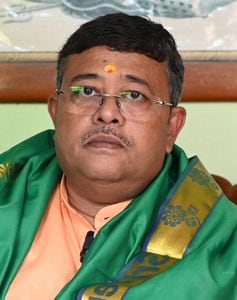 Dibyendu Adhikari
He puts the blame squarely on former chief minister Mamata Banerjee, whom he was close to, like Suvendu, during the Nandigram protests. “She has no calculation or education,” he claims. “She is not a good administrator. She and her family, with some retired government officials, looted West Bengal. In the entire state, industry is nil, employment is nil. In contractual jobs, Rs10,000 is given; nothing happens in that amount.”
Thankfully, he believes Suvendu can course-correct. “As chairman of cooperative banks, including Vidyasagar Central Cooperative bank and Contai Cooperative bank, he recruited many people there,” he says. “He will definitely provide employment. He handled several state departments (as minister) in the past.”
This confidence is shared by Dibyendu, who looks forward to working under the guidance of his elder brother. “Our prime minister, home minister, party president (Nitin Nabin), our newly elected MLAs, they all supported Mr Adhikari,” he says. “A single name was proposed and Amit Shah asked the MLAs to propose another name. No other name came.... He (Suvendu) is the pride for BJP karyakartas, including me. All karyakartas are happy today, and, under our leader Narendra Modi, we will start our journey and achieve our goal (fulfilling promises made in the manifesto).”
Dibyendu, however, draws a line between family and duty. “He is my elder brother, but I can’t interfere in his administration or other duties,” he says, adding that he wants to concentrate on his constituency.
When he was young, Suvendu was deeply into the values of the Ramakrishna Mission—Sisir thought he would become a monk. Suvendu, all of 10, would sit near his father and point out “good” and “bad” people who came to visit.
“I knew he would become big and he did,” says Sisir, pointing to two incidents. Once, during prime minister Indira Gandhi’s visit in 1971, she made Suvendu sit beside her in the helicopter. “I was looking for him; I saw she had taken him and kept him by her side. I asked what happened. She said, ‘I will take him and go, he will become very big.’”
The other was when former Union railways minister A.B.A. Ghani Khan Choudhury made Suvendu sit in his car. “I said his mother would commit suicide if you take him. Barkat da said he would take him and raise him,” he says.
Today, Sisir’s little boy is in charge of Bengal. But he is not alone. He has political experience he can draw from home, a powerful hand guiding him from Delhi and the support of the people who voted for a saffron era in Bengal.
“He will do well,” says Sisir, “he will do the right thing.”