



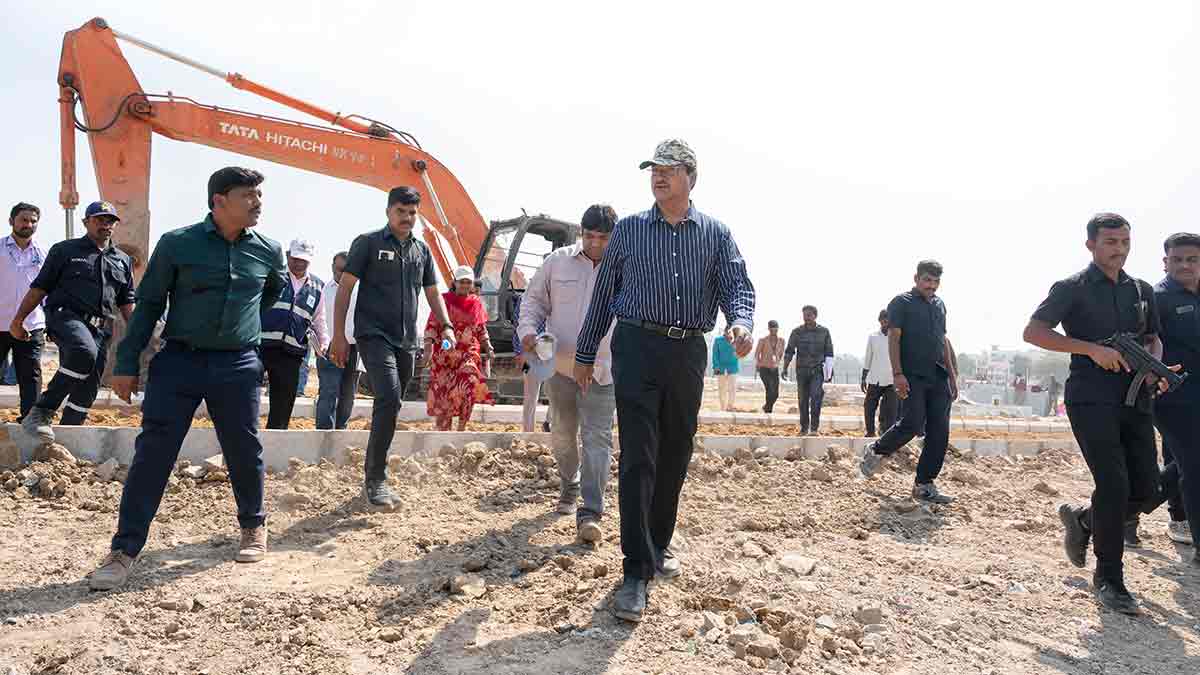
On the morning of April 11, the official media WhatsApp group of HYDRAA, the Hyderabad Disaster Response and Asset Protection Agency, was hyperactive. The group was flooded with copies of court orders, maps and real-time field updates from a land reclamation drive in Ailapur village on the outskirts of Hyderabad. Members were taken aback when they realised the updates were coming from commissioner A.V. Ranganath, who rarely uses this channel to communicate.
At first glance, it seemed like yet another land rescue operation. By noon, however, it was clear that something far more significant was unfolding. In a matter of hours, HYDRAA reclaimed 861 acres of government land, estimated to be worth Rs15,000 crore, from a lawyer, M.A. Mukheem, and his brother, M.A. Azeem. The two had allegedly occupied 1,263 acres and were parcelling it out to tribal communities. A farmhouse and a six-storey building owned by them were demolished during the operation. It was a single day’s work, but it offered a glimpse into how HYDRAA functions.
Chief Minister A. Revanth Reddy established HYDRAA in July 2024 with a clear mandate: to protect public land and lake ecosystems while building advanced disaster response capabilities. The agency has so far reclaimed more than 2,011 acres of lake and public land, estimated to be worth Rs80,000 crore. Its flood prevention initiatives have reduced flooding in parts of Hyderabad.
Ranganath said the shift in Telangana was driven directly by the chief minister. “The CM told me [in the first meeting itself] that lakes and nalas are the most neglected public spaces and the most encroached upon, and asked me to take care of them.” Reporting directly to the chief minister, Ranganath was given the autonomy to build an organisation capable of acting decisively.
He began with a particularly challenging assignment: the restoration of Bum-Rukn-ud-Daula Lake in the Old City. The historic waterbody, built in 1770 by Nawab Rukn-ud-Daula Bahadur, once spread across more than 90 acres. Over time, owing to alleged encroachments, it had shrunk to just 4.5 acres. What remained resembled little more than a cesspool. Younus Pervez, managing director of Vimos Technocrats Private Limited and lead consultant for HYDRAA, recalled the early stages: “The lake was almost closed from all sides. Local politicians had rented out the encroached land to small recycling units, and they opposed the lake’s rejuvenation.” Despite the resistance, the agency pressed ahead. With the backing of the government, the work continued.
Today, the lake spans 18 acres and includes a children’s play area, a public gym and a walking track. Mir Ashfaq Ali Khan, a descendant of Nawab Rukn-ud-Daula, met the chief minister and the commissioner to express the family’s gratitude. He told THE WEEK that he had never imagined the historic lake would be revived.
The Bum-Rukn-ud-Daula project was more than a reclamation exercise; it established a template that HYDRAA has since applied across the city. As Pervez explained, lake encroachments pose dangers that extend far beyond land disputes. Illegal occupants often dump hazardous waste, including biomedical and animal waste, into these areas. Over time, this generates toxic leachate that seeps into groundwater, potentially causing cancer and other serious illnesses. “Most of the time, we don’t realise the risks,” he said.

Once land is reclaimed, it is scientifically contoured, with inlets and outlets restored. Public amenities such as parks, walking tracks, play areas and small food kiosks are then developed. Ranganath said HYDRAA was applying scientific methods to restoration. “We are establishing sewage treatment plants next to every lake to reduce chemical contamination. Once water quality improves, the lake can sustain itself.” For him, lake protection is ultimately about the future. “If we don’t protect them, the lakes could disappear within a few years. Urban flooding will become routine and life will become unsustainable.” Revived lakes also create microclimates, improving public health, biodiversity and local ecosystems, while enhancing lifestyles and even property values.
HYDRAA is currently reviving six lakes, three of which were inaugurated by the chief minister in March. Another 20 are in the pipeline. With a target of restoring 10 lakes a year, Ranganath envisions 200 rejuvenated lakes across Hyderabad within a decade.
HYDRAA’s mandate, however, extends beyond lakes. It has also intervened in cases of land fraud affecting ordinary property owners. In one instance, a realtor allegedly constructed a four-kilometre compound wall, blocking road access to 2,200 plot owners and reducing property values. Following complaints, HYDRAA investigated and subsequently demolished the illegal structure, restoring access and improving connectivity. In another common pattern across Hyderabad, landowners sell plots and later attempt to reclaim ownership using different documentation, leaving genuine buyers trapped in lengthy legal battles. In such cases, HYDRAA steps in to nullify fraudulent claims.
Disaster management, particularly urban flood mitigation, forms HYDRAA’s second major focus. This involves the systematic desilting and clearing of nalas. “Choked nalas and encroached lakes cause urban flooding,” said Ranganath. The results have been tangible. In June 2025, HYDRAA launched a demolition drive at Patny Centre, a commercial shopping hub in Secunderabad, to clear stormwater nala blockages. Illegal commercial structures had reduced the drain’s width from 70 feet to around 15 feet, leading to severe flooding in surrounding colonies. Following Ranganath’s inspection, six encroachments were demolished. Water flow improved, flood risk declined and thousands of residents benefited.
Despite its achievements, HYDRAA has not been free of controversy. In its early phase, it faced criticism for sudden demolitions, sometimes carried out before dawn and with little or no prior notice. Homeowners who had legally invested their life savings saw their houses demolished without surveys or hearings. Several people were displaced, and their stories drew widespread attention. In some instances, the Telangana High Court allowed affected parties to seek compensation. Opposition parties, civil society groups and even some within the ruling establishment raised concerns.
The government has since acknowledged these issues. In January this year, it introduced a revised transferable development rights (TDR) policy, offering displaced property owners tradeable rights that can be sold or used to build additional floor area elsewhere—a market-linked alternative to cash compensation. Owners in flood-affected zones receive rights worth two to three times the area they lost, with those in buffer zones and riverfront areas receiving even more. The policy also requires developers of buildings more than 10 floors to purchase these rights, creating a built-in market. However, whether that market is active enough to meaningfully compensate people who lost their homes—not just commercial assets—remains to be seen. Ranganath said landowners had reportedly recovered around 70 per cent of lost value, though more transactions are needed to verify this.
In less than two years, HYDRAA has made lake protection visible as a civic issue in a city that had largely ignored the disappearance of its waterbodies. It has demonstrated that encroachments, even by politically connected actors, can be reversed. It has linked stormwater drainage to flood risk in the public imagination. And it has begun to confront the social costs of its interventions.
Built to last
The idea that sparked Hyderabad’s most aggressive urban clean-up emerged from an informal gathering. Six months into office, Chief Minister Revanth Reddy (in pic) had a meeting with his close friends, where one challenged him to carve out a legacy beyond his towering predecessors. An environmentalist in the room seized the moment: revive Hyderabad’s dying lakes. Once celebrated as the City of Lakes, Hyderabad had lost a staggering 61 per cent of its lake area over four decades.
Revanth immediately grasped the idea’s potential. Within weeks, he ordered the creation of an Anti-Corruption Bureau-like autonomous structure. On July 19, 2024, HYDRAA was born—not as a bloated new bureaucracy, but by carving out the Greater Hyderabad Municipal Corporation’s existing enforcement, vigilance and disaster management wings and giving them sharper teeth. He handpicked the straight-talking IPS officer A.V. Ranganath to lead the charge.
