



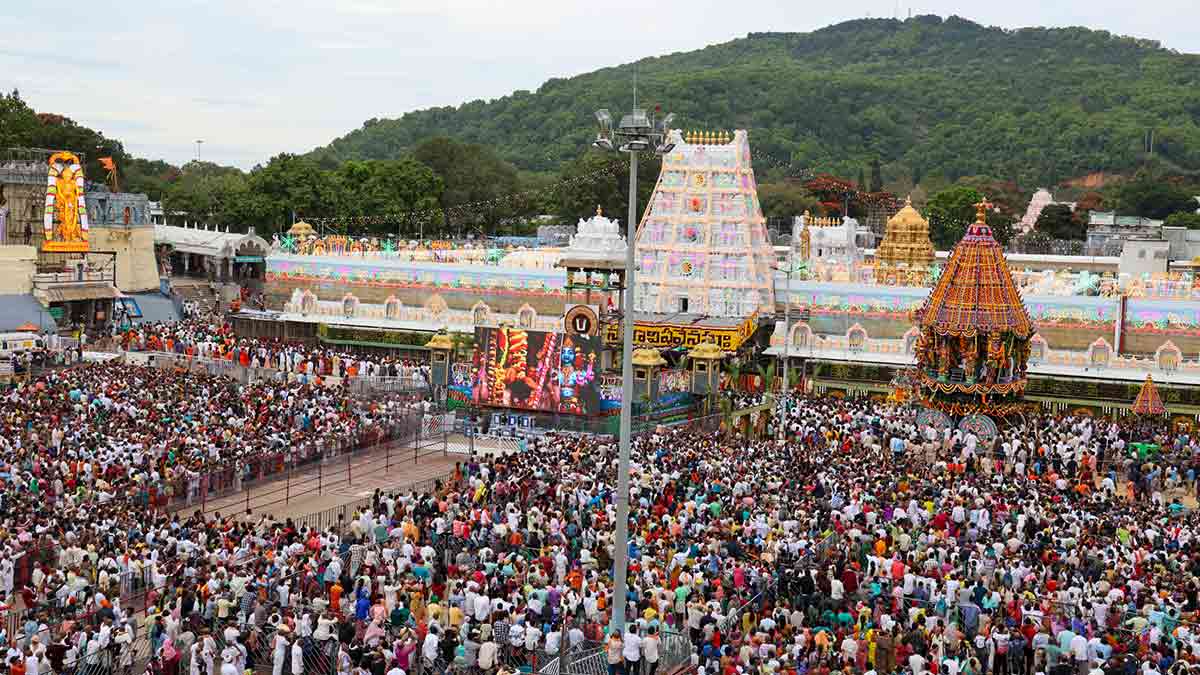
Before dawn breaks over Tirumala’s sacred hills, thousands of barefoot pilgrims are already on the move. Some carry nothing more than a small cloth bundle containing an extra set of clothes. For generations, devotion at the abode of Lord Venkateswara demanded patience and endurance. A darshan could take two hours—or 26. One had to surrender to uncertainty.
Today, something is quietly reshaping this ancient rhythm. Behind a discreet door inside the Vaikuntam Queue Complex, banks of glowing screens track every pause and surge of pilgrim movement. Algorithms predict congestion before it forms. Cameras count heads, flag suspicious behaviour, and trace missing persons. Tirumala, one of the world’s most visited Hindu pilgrimage centres, is now using artificial intelligence to reduce darshan waiting time.
The transformation had its origins thousands of kilometres away in San Francisco, on an October morning in 2024. IT Minister Nara Lokesh was pitching Andhra Pradesh as an investment destination for global tech giants. He also met a group of non-resident Telugu entrepreneurs to explore how AI could be applied to public services. After the meeting, Lokesh asked Jayaprasad Vejendla, a technologist who had spent nearly three decades in the US: could AI be used to improve the darshan experience at Tirumala?
Vejendla had no immediate answer. A few weeks later, a “flash” struck him. Without planning, he booked a ticket to India. “I walked the foothills to reach Tirumala, stood in the queue, waited for hours and had darshan,” he says. “I wanted to feel what devotees feel.”

The experience was revelatory. All pilgrims had the same requirements: darshan, accommodation, food, sanitation, security and medical help. Fewer than 3,000 people lived in Tirumala, but the town hosts between 70,000 and 80,000 pilgrims on ordinary days and more than 1,00,000 on special days. The flows were intense but predictable. If the patterns could be understood, they could be optimised.
After darshan, Vejendla called up Lokesh to share his thoughts. The minister connected him with Ch. Venkaiah Chowdary, the joint executive officer of the Tirumala Tirupati Devasthanams (TTD), the trust that manages the shrine. “Don’t try to implement this by just deploying a team here,” Chowdary told him. “You need to stay here—to understand what actually happens on this sacred hill.”
Vejendla stayed back. The next three days, they visited the queue complexes, kitchens, control rooms, security posts and accommodation blocks. He observed how pilgrims were channelled, where bottlenecks formed, how staff made decisions and how information travelled—or failed to travel—across departments. This immersion gave Vejendla a rough idea that could be developed into an AI-powered technology project.
The core problem, according to Lokesh, was the fragmentation of services. Darshan, accommodation, traffic, health services, sanitation and security were managed through disconnected systems. Each department had its own data, but no single platform brought it all together. Decisions were often reactive, based on experience rather than real-time intelligence. Lokesh knew AI could solve this problem.
Vejendla returned to the US and started working on the technical document of the idea. It took him almost five months. Then came the problem of funding. Despite government support, the funding could take time and he would not have free rein during the implementation. Vejendla immediately proposed to raise Rs30 crore through the philanthropic route. Indian-American businessmen Anurag Jain, Srini Raju, Raju Reddy, Ravi Akireddy, Narasimha Raju Indukuru, Lakshmi Narayana Dronamraju and Srikath Pakala donated Rs20 crore within a few weeks, and it was sufficient to start the project.
On September 7, 2025, an unused compartment inside the Vaikuntam Queue Complex was handed over to Vejendla’s team. Within 16 days, the compartment was transformed into a sleek, AI-enabled Integrated Command and Control Centre (ICCC), now serving as the nerve centre of Tirumala’s pilgrim management. Inside the centre, around 30 workstations operate round the clock. Large screens display colour-coded heat maps of crowd density, real-time compartment-wise darshan wait times, queue occupancy, vehicle movement, CCTV alerts, weather inputs and medical emergencies.
Supported by Nvidia-powered graphics processing units, the AI system ingests live feeds from more than 6,000 cameras across Tirumala. Roughly 300 of these are facial-recognition cameras placed at key entry points to count and track pilgrim movement. Bengaluru-based Kloudspot’s Location Intelligence and Situational Awareness (LISA) platform converts raw video into simple, actionable dashboards—heat maps, people counts and alerts—allowing multiple departments to work on a common interface. The system processes about 3.6 lakh data payloads every minute, handles over 51 crore events daily and can generate about 22,000 crore real-time inferences during peak days.
The Vaikuntam Queue Complexes are at the heart of ICCC operations. While Vaikuntam I caters mainly to paid darshan categories such as Arjita Seva and Special Darshan, Vaikuntham II houses the pilgrims of Sarvadarshan, the free darshan used by the majority of people. Together, they contain over 62 compartments, each capable of holding around 500 devotees. While Vaikuntam I darshans happen smoothly, Sarvadarshan pilgrims have to wait, sometimes more than 24 hours.
To solve this problem, maximum wait time is allocated for the compartments based on their darshan types. For instance, the maximum wait time for Special Darshan compartments is 90 minutes and for Sarvdarshan compartments is eight hours. Once this time is crossed, officials receive alerts to release the pilgrims as early as possible. Thanks to the live monitoring, the Sarvadarshan time has come down to 11 to 13 hours.
The system was stress-tested during the recent 10-day Vaikunta Ekadasi celebrations, which was attended by more than 11 lakh devotees. “The entire TTD team sat at the ICCC, and I could make on-the-spot decisions with the help of live data. We cancelled some of the scheduled darshans to facilitate the overflow of Sarvadarshan pilgrims. Due to these measures, the Sarvadarshan average waiting time came down to nine hours,” says Chowdary.
Movement of the Sarvadarshan pilgrim flow is tracked right from the Alipiri gate (the gateway to Tirumala). Vehicles and people are observed, and their numbers accurately estimated. With the help of the live-tracking, TTD also ensures timely food distribution in the compartments and immediate medical attendance when needed.
The ICCC has not only improved operational efficiency but also strengthened accountability. Vejendla narrates an incident that happened in the initial days of the ICCC. A compartment in the Vaikuntam Queue Complex was kept vacant for more than an hour and a half, even as thousands waited outside. When the ICCC generated an alert, officials called the staff member responsible. He claimed the delay was under 30 minutes. The system provided visual evidence showing otherwise, and the staffer withdrew his claim.
Security, too, has significantly improved. A devotee from Uttar Pradesh was recently troubled by a cab driver after a dispute on Tirumala Ghat Road. Shaken, the man approached the police and filed a complaint, but could only give the last four digits of the car. The police, with the help of the ICCC, traced the car and took the driver into custody in 40 minutes.
The monitoring also helps identify the petty criminals, missing persons and lost luggage, and can flag loitering, pickpocketing and other suspicious behaviour, and match faces against a database of known offenders. Once fully operational, the systems can also identify wanted criminals and generate alerts.
The ICCC currently has 24x7 coverage of the temple town, including human counting and vehicle analytics, and plans to extend the monitoring to laddu counters and accommodation facilities. “This is an evolving project,” Vejendla said, “that would scale up as per requirements.”
