


It took a while for Pradeep, a 63-year-old occultist belonging to the Paniya tribe, to open up to us. When he did, his words carried the weight of generations. Paniyas, he said, are seen as the lowest of the low. “We are seen as people with no abilities, no knowledge,” he said.
The Paniyas are the largest scheduled tribe in Kerala. Their population is concentrated in Wayanad district, with smaller numbers in Kannur, Kozhikode and Malappuram. The community name is believed to have come from the word pani (work); Paniyas were traditionally bonded agricultural labourers. Legally abolished in 1976, the impact of the old system of feudal bondage is still felt. Pradeep, who has been a “spiritual medium” since he was a child, said Paniyas continued to be slaves even after they were freed.
When THE WEEK met him, Pradeep was at a lodge near the ancient Navamukunda temple at Thirunavaya, on the banks of the river Nila in Malappuram district. The name Thirunavaya is said to have been derived from Thiru Nava Yogi—named after the nine yogis who performed sacrificial rituals there. Pradeep, whose tribe follows animistic and indigenous traditions, had come to perform muthanum muthikkum, a form of worship centred on Mother Nature and ancestors, on the same riverbanks that brahminical rituals had dominated for centuries.

He was invited by Swami Abhinava Balanandabhairava, a Sanskrit scholar and monk who was instrumental in organising the Thirunavaya Mahamagha Mahotsavam. Held from January 19 to February 3, the festival presented itself as a Hindu revivalist event and was branded as the “Kerala Kumbh”.
“The Swami came to my home to invite me,” Pradeep said, before proceeding to perform the ritual. Notably, the Mahamagha Mahotsavam—for which spiritual leader Mata Amritanandamayi is the chief patron—is pushing long-marginalised rituals such as muthanum muthikkum to the foreground. These rituals were once dismissed as not sufficiently “holy”, simply because they were practiced by communities deemed unworthy of performing rites or leading prayers.
By mainstreaming such practices, the festival is widening the Hindu fold. Balanandabhairava said the idea was to create an inclusive space where diverse traditions are showcased under the broader framework of tantra.
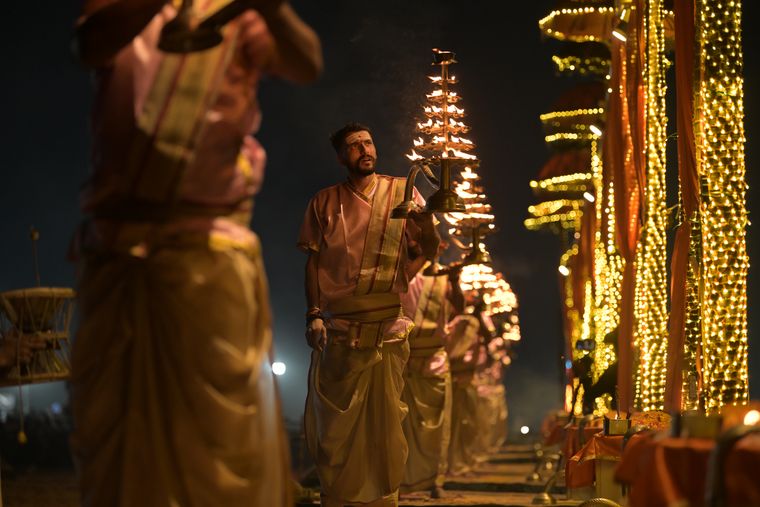 Leading light: A ritual being performed at the festival | Vishnudas K.S.
Since the medieval era, Thirunavaya had hosted Mamankam, a 28-day festival held every 12 years. The festival is rooted in several legends, one of them linking it to Lord Parashurama, who is said to have settled 32 Brahmin families in Kerala after reclaiming land from the sea. Parashurama is said to have performed his first yajna at Thirunavaya. Another legend suggests that Cheran Chenkuttuvan, a local king, witnessed the Kumbh Mela on the banks of the Ganga and sought to recreate it at Thirunavaya, where it came to be known as Mamankam or Maghamasa Mahotsavam.
Over time, Mamankam evolved into a large gathering blending ritual, trade, martial traditions, intellectual contests and folk art. Under the Zamorins of Calicut, it also became a theatre of violent confrontations, as suicide warriors of rival local rulers clashed with the Zamorin’s forces, turning the festival into a convergence of religion, commerce and power. The festival came to an end in 1755 with the decline of the Zamorins, though Thirunavaya remained a sacred site.
There have been efforts to revive Mamankam, including a 1999 reenactment attempt under historian N.M. Namboothiri. Since 2016, river-based rituals such as Nadi Puja have been revived under the leadership of A.K. Sudheer Namboothiri, who was elected as Sabarimala head priest in 2019-2020.
The Mahamagha Mahotsavam inaugurated this year is projected as both the Kerala Kumbh and a revival of the old Mamankam. A key force behind the new festival is a monk from Kerala belonging to the Juna Akhara in Varanasi, Swami Anandavanam Bharati Maharaj. A former communist student leader and media professional, Maharaj was appointed to the leadership position of “mahamandaleshwar”, with special charge of South India, during the Maha Kumbh Mela held in Prayagraj last year.
“The festival’s vision is rooted in today’s social reality,” Maharaj told THE WEEK. “We are focusing on dharmic values, which are steadily disappearing today—from society and social life to administration and public conduct. That is the central concern behind this mela.”
The festival is fashioned as a spiritual cousin of the Kumbh Melas in North India, featuring a Nila aarti modelled on the Ganga aarti in Varanasi. As it neared its conclusion, the daily footfall crossed 3.5 lakh. It was not just spirituality that drew crowds; curiosity driven by social media and the fear of missing out had many youngsters attending the Nila aarti.
As participation rose steadily, prominent figures such as Congress MP Shashi Tharoor sent messages of goodwill. The festival had the visible support of sangh parivar, with senior BJP leaders attending ceremonies and Seva Bharati volunteers managing crowds and logistics.
Critics say the gathering is aimed at consolidating Hindu identity and accumulating political capital for hindutva forces in Kerala. Asked about it, Maharaj said: “Hindutva is the identity of every Hindu. Any dharmic programme naturally strengthens that identity. In that sense, it may influence Hindu political consciousness. But then, everything is political—even this conversation. Every individual carries their own political understanding.”
According to Balanandabhairava, the festival represents the tradition of inclusivity itself. “When we accept food, we never ask who cooked it or what their religion is. We only ask people to serve; we don’t ask their faith,” he said.
The BJP appears pleased by the response that the festival’s first edition has received. State vice president V. Unnikrishnan Master, who hails from the region, said the Kerala Kumbh branding had worked. “This is not something we planned,” he told THE WEEK. “But it has already emerged as a force that seems unstoppable, especially if it becomes an annual affair.”
Before the event began, a row erupted after the government issued a stop memo against the construction of a temporary bridge across the Nila for conducting the festival. This elicited a strong response from Maharaj, who said he would defy the order. According to Master, the row triggered an emotional response among sections of Hindus.
With Malappuram being a Muslim-majority district, there were also concerns that a festival branded as Kerala Kumbh could create tensions. But Master said the local population largely embraced the event, citing its positive impact on the local economy.
Responding to questions over the choice of venue, Balanandabhairava said: “Some ask why Malappuram, a district that is nearly 80 per cent Muslim? My answer is simple: if this were held in a Hindu-majority area, would people raise the same question? The place is not the issue—the purpose is.”
The real question, according to Balanandabhairava, is whether it served personal interests or the interests of society at large. “If it serves society, the location should not matter,” he said. “This is only the beginning. I am confident it will grow in the coming years—not just in Kerala, but beyond it.”