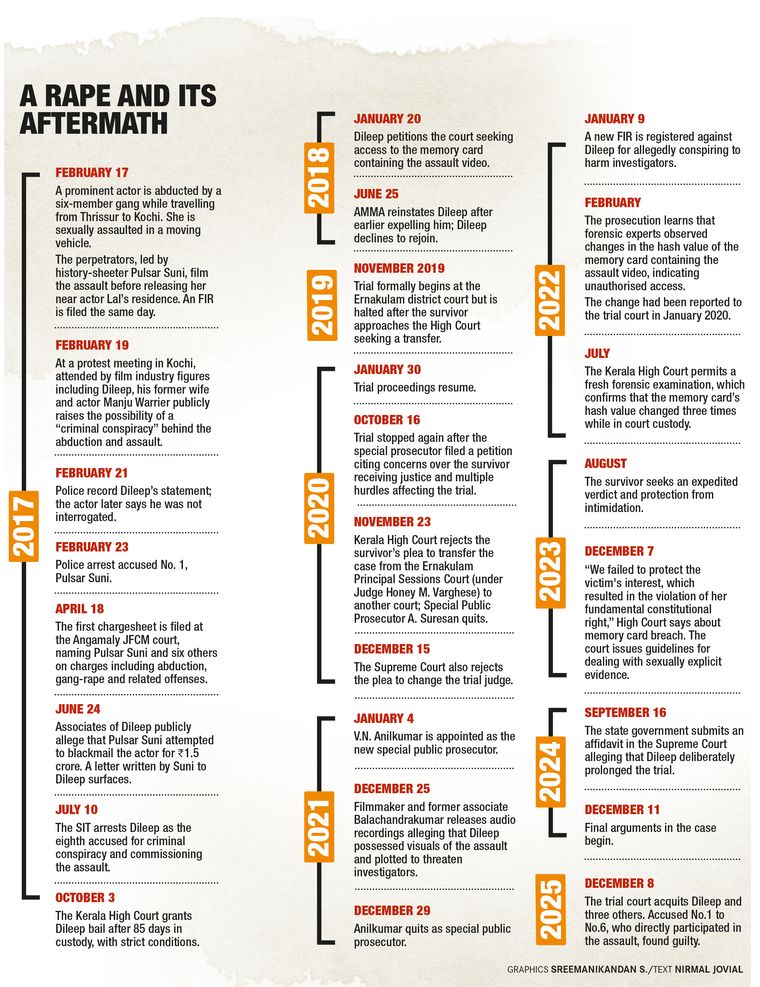
ON DECEMBER 8, the Ernakulam district court complex resembled a crowded film set. People with differing convictions and ideas of justice waited eagerly for the verdict in the February 2017 abduction and rape case involving two prominent actors that had shaken Kerala’s collective conscience.
At 11am, Additional Special Sessions Judge Honey M. Varghese, who had heard the case since 2019, began the proceedings. Of the ten accused, the court found six individuals, including prime accused N.S. Sunil, alias ‘Pulsar Suni’, guilty. However, the courtroom and the world outside remained intensely focused on the fate of accused number 8, influential actor Dileep, whom the prosecution alleged was the master conspirator who had arranged the “quotation” to carry out the sexual assault of the actor in a moving vehicle. As the court pronounced Dileep’s acquittal, the reaction was mixed, with sighs of disappointment as well as relief.
The comments that have poured in since Dileep’s acquittal underscore the same reality: he will remain a polarising figure. Even with a verdict in his favour, those who believe he was guilty will continue to do so, just as those who think he is innocent will never be convinced otherwise. Nevertheless, even those who have been consistent supporters of Dileep over the past eight years acknowledge that the shocking attack endured by the survivor and her prolonged and rare legal battle, along with the women-led movements it sparked, has brought about significant and lasting changes in Kerala’s film industry and beyond.
G. Suresh Kumar, executive member of the Kerala Film Producers’ Association, who met Dileep when he was in jail in connection with the case, said that he believed the case was a conspiracy against Dileep, driven largely by the actor’s prominence. “Dileep was at his peak, and many within the film industry wanted to push him out,” he said. Suresh Kumar further alleged that a section of the film industry colluded with a group of police officers, who, he said, were seeking fame.
Dileep’s first reaction after his acquittal was to allege a conspiracy, directly referencing his former wife, actor Manju Warrier, for what he described as the “real conspiracy” behind the case. The prosecution had built its case on the argument that the actor harboured a personal grudge against the survivor for sharing crucial evidence of his extramarital affair with actor Kavya Madhavan, now his wife, with Warrier.
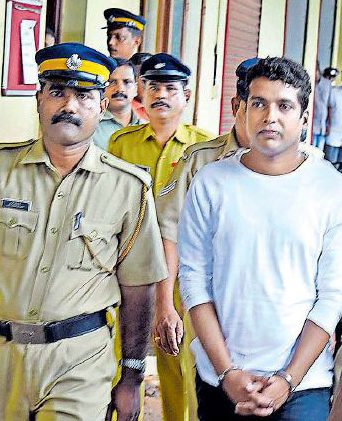 Guilty as charged: N.S. Sunil, alias ‘Pulsar Suni’, the prime accused, has been found guilty.
Dileep appeared to shift swiftly into a retaliatory mode, echoing the arc of many characters he has portrayed on screen. Film producer Saji Nanthyatt, a staunch supporter of Dileep, said that certain people who had developed a grudge because of Dileep’s marriage with Kavya Madhavan conspired to attack the victim, so that the blame would be on Dileep, a natural target because many in the industry knew they had a history. “Also, a pseudo-feminism aimed at dragging Dileep down when he was at his peak,” said the producer.
The survivor has not responded publicly to the verdict so far, but her lawyer Mini T.B. expressed disappointment. In the trial phase itself, the case had witnessed several twists and turns. The entire trial was conducted in camera, as per a petition of the eight accused. In 2019, the case was assigned to Judge Varghese after the survivor requested a female judge. A year later, the prosecution sought to transfer the trial to another judge, raising allegations of bias against the judge; however, the High Court, and later the Supreme Court, dismissed those petitions. Interestingly, two special prosecutors resigned during the trial phase.
“Until the point I quit, the prosecution handled the case properly. What happened after that, I cannot comment on,” said A. Suresan, the first special public prosecutor in the case. He added that he had submitted written representations to the High Court explaining his position. “As for the subsequent prosecutors, based on the information available to me, I believe they, too, handled the case properly,” he said.
Mini, meanwhile, responded to the criticism (about the prosecution’s failure) by noting that a reading of the judgement would reveal the extent of the evidence available to support the conspiracy charge against Dileep, and maintained that the prosecution could not be blamed.
The Association of Malayalam Movie Artistes (AMMA), the influential actors’ body, said it respected the court’s verdict, while the Women in Cinema Collective (WCC)—India’s first female-led group advocating safe, non-discriminatory workspaces—voiced solidarity with the survivor. Actor Parvathy Thiruvothu reacted sharply: “Justice, what? And now we watch a carefully crafted screenplay unfold so cruelly.”
Even before the verdict, the WCC noted that the survivor’s fight had ignited “many tumultuous journeys for women in cinema, the Malayalam film industry, and the state of Kerala”, stressing her struggle was “for every survivor”. The case led to the formation of the Justice Hema Committee, triggered rounds of the #MeToo movement in Kerala, and sparked wider conversations on consent, workplace safety and power dynamics. On-set protocols were strengthened, and the government drafted a film policy, while AMMA revisited its bylaws, fostering a more inclusive environment.
Filmmaker Jeo Baby, who has created women-centric films such as The Great Indian Kitchen, said that the survivor’s legal struggle had had quite a positive impact not only on the film industry but on other professional sectors as well. “Across sectors, beginning with the strengthening of internal complaints committees, there have been several shifts towards making workplaces more gender-equal.”
Even supporters of Dileep acknowledge the changes. Nanthyatt said the film industry implemented internal committees on every shooting set, as directed by the government, and visitors were monitored. “Any form of abuse is unacceptable, and there is now a fear of consequences. There is also increased government surveillance and a clear sense of regulation and restraint.”