


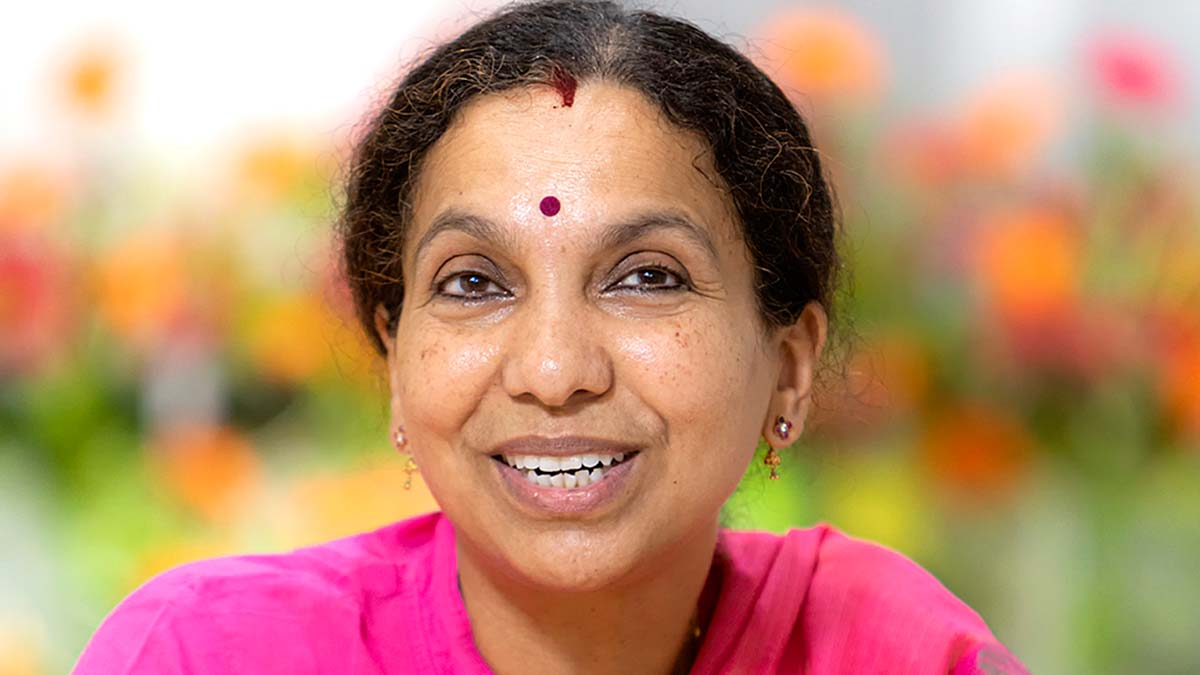
‘We shall implement master plan designed by the Mother’: Jayanti Ravi, secretary, Auroville Foundation

Auroville belongs to nobody in particular; it belongs to humanity as a whole. But to live in Auroville, one must be a willing servitor, says Jayanti Ravi

30-Jayanti-Ravi

Interview/ Jayanti Ravi, secretary, Auroville Foundation

Q/ When you took over, what was your idea of Auroville, and how has it changed under you?

A/ I am not new to Sri Aurobindo’s philosophy. I had the privilege, way back in 2009, of working under Prof Kireet Joshi, IAS, who was the adviser to the chief minister of Gujarat. He had an inner calling and came to the ashram, gave up everything, and was with the Mother till she breathed her last. He worked with Indira Gandhi, Rajiv Gandhi and Murli Manohar Joshi, and then became adviser to our current PM. He is the person who drafted the Auroville Act.

So, he had told me about all the things happening here, and how the Mother’s vision of the city had to be built. He passed away in 2014. He had taught me to read Life Divine, a book by Aurobindo. It is very tough for somebody to read and understand Aurobindo, even for an intelligent person, because everything he writes is very dense.

So when I came here I knew the vision of this place was about manifesting a city, which is not like any other city where there is a lot of commercialism. It would be the most beautiful, functional, economically sufficient city. It will also have a soul and a heart.

Q) How do you plan to implement the Mother’s vision of Auroville?

A/ Aurobindo envisioned that everything should be done with deep sincerity and faith, offering it to the Divine. He conceptualised and spoke about agnostic communities, although they were anchored in faith. He said we have to go beyond the mind and the man. He wanted a "sandbox" – a place where people who wanted to be guinea pigs in this adventure of consciousness could do the best work, not like an ashram where you give up. This included creating the Matri Mandir and building a city – doing all of this with the best quality, sensitively, with consciousness, and with reverence to the Divine.

This idea of Aurobindo is what the Mother envisioned and created. She gave a complete sketch and drawing of the city with every detail. The sketch was not just vague lines. Though she was in her 90s, she never compromised on mediocrity. She got one of the top architects of the time, Roger Anger, from Paris, France, to design this whole city. The same plan was adopted by Kireet Joshi, which was approved by the Resident Assembly and the Government of India way back in 2001. She put up a full design of this galaxy plan and said, “If you are willing, come here as a servitor.” "Willing" means you are voluntary; you are not being forced. "Servitor" means you are a servant of the Divine. So, she wanted us to excel.

Q/ The residents say you are trying to implement an agenda.

A/ The intentions of people when they join are good, but over time they start feeling that this is their land. This entire project initially had nothing to do with the government. But after the Mother left, it went right up to the Supreme Court. People say there were attacks, killings and bloodshed. Then, finally, the residents requested way back in the 1970s to let the government of India take over. The government of India made an act called the Emergency Provision Act in 1980. Then came the Auroville Foundation Act, 1988.

The current team is also trying to be sacrosanct and implicit in following the master plan—because the act is all about the master plan. It says we shall implement the master plan as designed by the Mother. When I joined here, I had a series of meetings with all the stakeholders because everything was in a bit of a logjam.

The land here belongs to the government as per the act. That is the starting point of the conflict… Auroville belongs to nobody in particular. It belongs to humanity as a whole, but to live in Auroville, one must be a willing servitor. But there were people who came here for 2-3 months, more like a vacation. Auroville is not New York or Delhi or Paris. It was meant to be something different. It is not a city with brick and mortar, but with humanity. That was the vision of the Mother.

The truth is that there were lots of complaints here. Anybody who lives in Tamil Nadu knows that drugs, trafficking and idol theft complaints and even paedophilia was happening here. So, there was a lot of tension between foreigners and Tamil villagers, because all of them had given this land as the Mother wanted.

Q/ Why and how did the controversy actually start?

A/ The governing board's first meeting happened in 1991. I am particular that I abide by proper records. I checked all the meeting minutes. The governing board, even in past meetings until 2010, repeatedly maintained that the residents were not listening to them. The residents feel the governing board is their enemy because the board wants the city plan to be implemented, and a section of residents, not all, was opposed to it. The political, financial, and administrative powers were concentrated in a few families and individuals within Auroville. They were, in a way, controlling Auroville for the last several years. But when we said that we were implementing Mother’s vision there, we felt helpless and frustrated. This governing board felt that we shouldn't just be complaining, but we should slowly and steadily move forward. So, when we started, there was opposition. But the good news is we have started building the 4.4 km crown road. The local residents who came forward to build the Matri Mandir said that they would make the road as per the design with their contributions. We have to implement the plan in a time-bound manner.

Q/ The Mother said that 50,000 people will live here. But that hasn’t happened. Why?

A/ True. So, there must be so many others, like the residents here who are from different corners of the world, who want to come here. They cannot come if there is no housing, drinking water, or electricity. So, the purpose of this planned city is also true, so that as we work together on a mission of building the city, that itself changes something within us and makes us more united. The Mother said, "You build the city, and in building the city, you will also experience unity."

Q/ You were talking about the Mother's vision and how the residents were opposing it. What were the challenges?

A/ There are assets called "red assets" here. Some of the buildings were on the Crown Road, designed and built by the residents. In 2016, much before I arrived, the Secretary of Auroville Foundation was designated as the Estates Officer, who has the summary powers of eviction. I have done that now, after giving notices to those who encroached on the Crown Road, as per the Act of Parliament and the Public Premises Act, which is the central act. Slowly, one by one, we cleared every encroachment, and during the course, the case went up to the NGT. For nearly two years, we had to stop building the Crown Road. Fortunately, the Supreme Court's order then came, which unequivocally ruled against the encroachers.

Q/ Why is everyone against the governing body, particularly after you took over? The protesters say that the colours of Auroville are changing. That it is being saffronised.

A/ When there is a long period of inertia or a status quo, and when you start questioning that status quo, opposition naturally arises. When we started, there was so much protest and anger. Even now, everyone here follows a pattern, but the groups which were previously enjoying this continue to oppose it.

Q/ It is said that IIT is building a tram here and there are several other constructions.

A/ We stand to benefit if it develops to its full splendor, leading to significant economic development. IIT is setting up a campus focused on sustainability. Although it's outside the master plan, we have land available outside. It will focus on green energy, hydrogen fuel, and zero-emission tracking, mirroring Auroville's focus on sustainability.

Q/ It is said that 300 Aurovillians were forced to leave as their visas were not approved. A person named Federick has alleged that his visa wasn’t renewed.

A/ That is not true. Only two people have been given exit visa or a “Leave India” notice. I have to give the recommendation letter for them to renew their visas. But the ultimate decision is taken by the ministry of home affairs….

And 99.92 per cent of them have been given visas as per their request. The visas of only three people weren’t renewed. One of them was involved in drugs; one of them got a team from Delhi to protest here; and Federick was staying here for the past two years without a valid visa. He had been given an exit permit because he was staying here without a valid visa for two years. But we are considering his age, and the fact that he is also suffering from cancer. We will allow [him to stay], although he is one of the main protesters.
