



ON OCTOBER 27, 1946, coir workers and agricultural labourers from the rural hamlet of Vayalar in present-day Alappuzha district—mobilised by the Communist Party of India (CPI) and armed with rudimentary weapons—rose against the might of the Travancore princely state. They were protesting against the autocratic rule of diwan Sir C.P. Ramaswamy Iyer, the de facto ruler who sought to keep Travancore out of the Indian Union.
The CPI split in 1964 after decades of internal strife, giving rise to the CPI(M). For the next four years, the two Left parties did not jointly commemorate the Punnapra-Vayalar uprising. Since 1968, however, they have come together to honour the martyrs they both claim—a tradition that endured even when they stood on opposing political fronts.
In keeping with this tradition, on October 27 this year, CPI state secretary Binoy Viswam and Kerala Chief Minister and CPI(M) polit bureau member Pinarayi Vijayan shared the same stage in Alappuzha. Although everything appeared cordial, it came barely an hour after the two had held a closed-door meeting to discuss a serious point of contention—a seemingly autocratic decision by Vijayan, taken without consulting the CPI, other allies in the Left Democratic Front (LDF), or even his own party leadership.
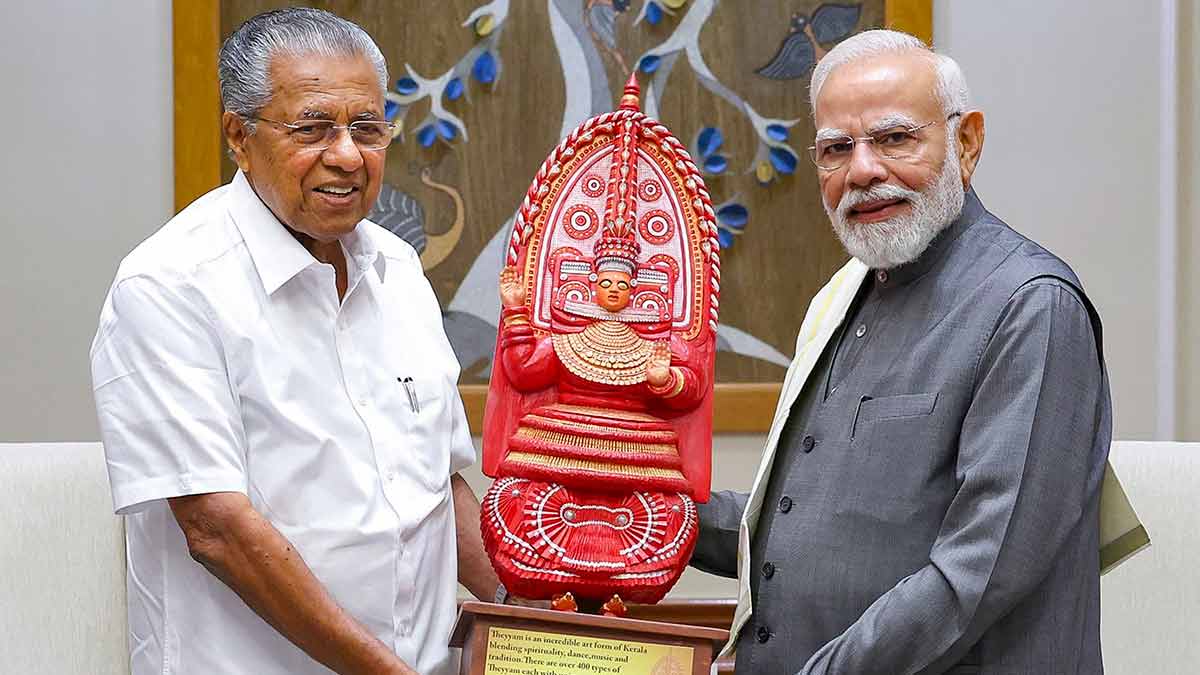
That decision concerned signing a memorandum of understanding with the Union government for implementing the PM SHRI project, a centrally sponsored scheme launched in 2022 to upgrade around 14,500 government schools across the country into model institutions. A key condition in the MoU is that the state must implement “all the provisions of the National Education Policy 2020”. The LDF in Kerala has long opposed NEP, describing it as a “centralising and exclusionary” framework that promotes “saffronisation”, corporatisation of education and the erosion of state autonomy. Calling PM SHRI a “backdoor entry” for the NEP, the LDF had resisted signing it so far. However, the Kerala government decided to sign the MoU after Vijayan met Prime Minister Narendra Modi on October 10.
Six days later, the MoU was prepared in New Delhi. When the media reported the news, Revenue Minister K. Rajan of the CPI raised questions about it at the cabinet meeting on October 22. Neither Vijayan nor Education Minister V. Sivankutty disclosed that the MoU had already been prepared. The MoU was signed the following day by K. Vasuki, secretary of the general education department.
The development shocked CPI(M)’s allies, particularly the CPI. “What kind of government is this?” asked Viswam, accusing the CPI(M) of a “surreptitious policy reversal”. He described the move as a breach of coalition propriety and of the cabinet’s collective responsibility.
Vijayan, Sivankutty and the CPI(M) have all justified signing the controversial MoU on the grounds that over 1,100 crore in Kerala’s Sarva Shiksha Abhiyan (SSA) funds remain blocked, and signing the MoU was a pragmatic move to secure the release of the amount. However, observers argue that the decision goes beyond political shifts or tactical adjustments. To them, it shows how the Centre’s techno-governance framework is quietly reshaping the financial foundations of Indian federalism.
Computational social scientist Arun Kumar P.K. said the single nodal agency (SNA) model—under which each state must name a nodal agency for every centrally sponsored scheme—adopted by the Centre in 2021, played a major role in the dispute. Previously, the Centre directly transferred funds to the states. Under that system, states enjoyed a float fund—money that stayed in the state treasury until spent, allowing temporary “rolling” for other purposes. The Centre later phased out that system, mandating the creation of an SNA as the sole entity eligible to receive funds. Funds would now be released under the Just-In-Time (JIT) system through the Public Financial Management System (PFMS) only when an expenditure or transfer request was made. The PFMS was integrated with the state’s treasury software, IFMS.
“Once integrated, they added an automated compliance layer—that is what we call algorithmic power,” said Kumar. “When a state like Kerala now tries to release funds for the SSA, a mandatory compliance check is triggered, verifying whether the state has enrolled under the PM SHRI scheme. If the check fails, the request is automatically rejected. Unlike earlier, this rejection is not manual—it happens instantly through the algorithm.” Kumar said these measures allowed the Centre to present a deeply political act as a neutral, technical reform.
Although PM SHRI was launched in 2022 and Kerala had refused to sign it, the state continued to receive SSA funds until the first half of the 2023–24 financial year. When it requested the third instalment for 2023–24, the request was rejected on grounds of non-compliance with PM SHRI. “Then they [the Union government] told us that we had to either sign the MoU of PM SHRI or submit an assurance letter stating that we would sign it later,” said Supriya A.R., director of Samagra Shiksha Kerala. “And they cited examples of Tamil Nadu and Odisha—both, they said, had submitted letters.”
In March 2024, the Kerala government signed an assurance letter stating that the state was looking forward to establishing PM SHRI schools and would sign the MoU before the 2024–25 academic year. This was for the 37.5 per cent of funds sanctioned for 2023–24. However, the assurance was neither discussed in the cabinet nor in the LDF, and it came to light only after the state machinery initiated quick moves in Delhi for signing the MoU last month.
Political observer and former IT adviser to the Kerala chief minister Joseph C. Mathew told THE WEEK that embedding PM SHRI enrolment as a precondition within the software was an intentional policy choice. “In truth, this can and must be challenged legally,” he said, arguing that blocking SSA funds by adding a condition not present in the SSA agreement was unconstitutional. “The SSA’s fund flow has nothing to do with PM SHRI. If they can block funds today over PM SHRI, tomorrow they could link it to some new scheme as well. What the Centre has done is purely arbitrary. SSA funds should never have been linked with PM SHRI.”
Mathew said the Central government has effectively imposed an economic sanction on the state. “I don’t subscribe to the state government’s political claim that the Centre is deliberately starving Kerala of funds. Kerala has received more funds than before. But the Centre has also increased the volume of discretionary transfers—funds it can control, delay or conditionally release—such as cesses, surcharges and payments related to centrally sponsored schemes. And that, in itself, is against the spirit of federalism,” he said.
Mathew said signing the MoU now—weeks before local body elections and months before the assembly elections—amounts to “political hara-kiri”. He said the move had little to do with policy and more with other motives, pointing out that the decision was not even discussed within the CPI(M). “This is unprecedented,” he said. “Clearly, there are some personal compulsions [on the CM] at play.”
On October 27, the CPI(M) state secretariat discussed the issue and concluded that withdrawing from PM SHRI was no longer feasible, deciding instead to convince the CPI of the circumstances under which it was signed. Mathew said that within the CPI(M), nobody questioned the chief minister. “Had [former chief minister] V.S. Achuthanandan been alive, this would have never happened.”
Although Vijayan has led the reconciliatory efforts, the CPI continues to demand that the state government withdraw from implementing PM SHRI or the NEP. Sources within the CPI confirmed that the ministers representing the party have submitted a protest letter to the chief minister, saying they felt cheated, as a crucial cabinet decision was kept from them. Reportedly, there have been discussions within the CPI on withdrawing its ministers from the government while continuing in the LDF.
Political observer and former CPI member A. Jayashankar, however, warned that such a move could prove suicidal for the CPI. “The CPI(M) can survive to some extent without the CPI, but the CPI cannot survive without the CPI(M).That is the political reality.”
