



EIGHT YEARS AGO, during the mandala season—the main pilgrimage period when the Sabarimala temple dedicated to Lord Ayyappa opens for worship—Unnikrishnan Potty arrived at the shrine as an assistant to the keezh shanthi (sub-priest). Son of a temple priest, Potty hailed from Pulimath near Kilimanoor in Thiruvananthapuram district.
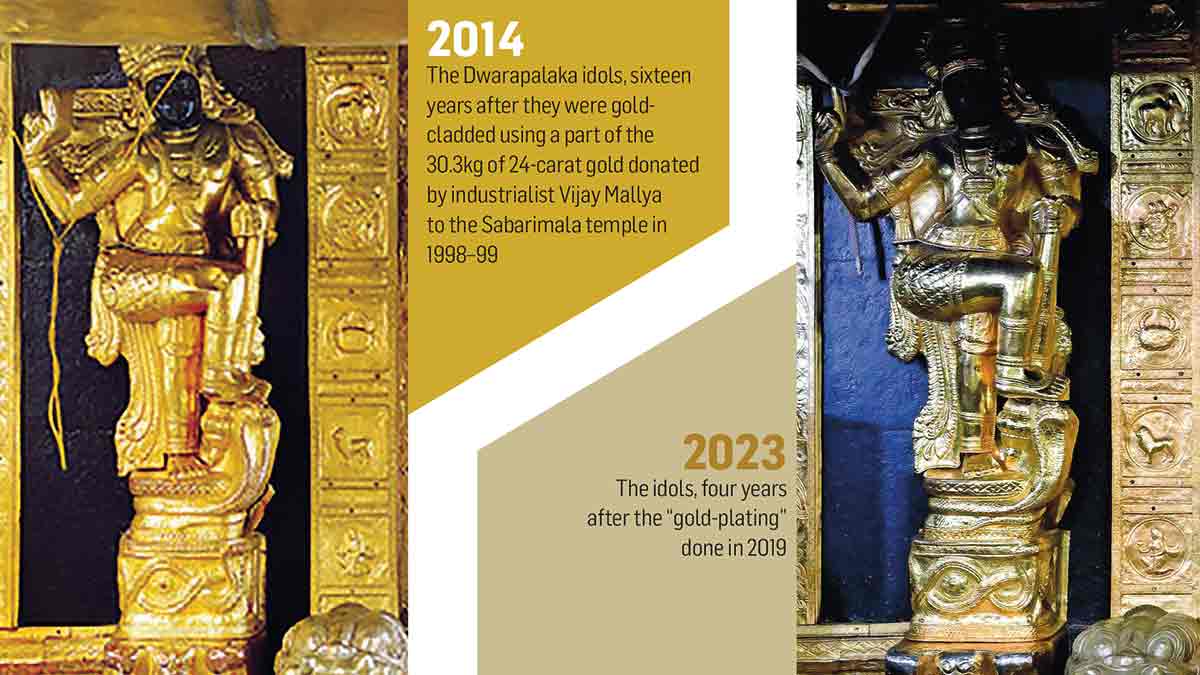
The job that brought him to Sabarimala helped him carve out a niche for himself as the go-to man for arranging special privileges for the temple’s affluent patrons. Offerings and contributions from devotees outside Kerala allegedly began to flow through him. By July 2019, he had become a high-profile “sponsor” in a dubious deal—approved by the Travancore Devaswom Board (TDB), the autonomous body managing 1,252 temples including Sabarimala—to “fix” gold-cladded copper coverings on the Dwarapalaka idols at the entrance to the temple’s sanctum sanctorum.
The TDB manual stipulates that all repair work on the Dwarapalakas and the pedestals on which they are placed be carried out at the Sannidhanam, the main temple complex. But in this case, the items were dispatched to Chennai.
On September 7 this year, the TDB once again handed over the coverings to Potty for another round of “repairs”. This time, however, things took a different turn. On September 9, R. Jayakrishnan, the Kerala High Court-appointed special commissioner to Sabarimala, submitted a report saying the gold-plated coverings on the Dwarapalaka idols had been removed without obtaining court approval. This violated the High Court’s November 2023 order barring the TDB from sending valuable items out of the Sannidhanam without judicial permission.
The special commissioner’s report prompted the High Court to take up the matter suo motu, putting the TDB and the CPI(M)-led state government on the defensive. The court hearings revealed the finding by the TDB’s vigilance wing that 1.564kg of gold had originally been used to gold-clad the coverings of the Dwarapalaka idols.
The gold-cladding was done in 1998–99, after industrialist Vijay Mallya donated around 30.3kg of 24-carat gold to the Sabarimala temple. Documents indicate that this gold was used to cover the two Dwarapalakas and several other parts of the temple.
The cladding on the copper coverings, said former TDB deputy commissioner C.R. Radhakrishnan, was carried out using a mercuric process. “In this process,” he told THE WEEK, “they make a gold foil, like tin foil, clean the copper properly, and then stick the foils on, one by one. After sticking, they heat it and amalgamate it—that’s how the bonding happens.”
Apparently, a surface treated with the mercuric method cannot be electroplated. But, in 2019, the TDB entrusted Potty to carry out this technically impossible process.
As the controversy erupted, Smart Creations—the Chennai-based company that did the gold-plating—said the Dwarapalaka plate it received in 2019 was fully made of copper. Potty, too, said the material he had received was copper, raising suspicions about the TDB’s handling of the plates.
What makes the matter murkier is that the mahazar, or record of procedures, prepared on July 19, 2019—when the coverings were removed for the “fix”—made no mention of gold; instead, it said “copper plates” were being sent for gold plating.
Notably, the court also found that the materials handed over to Potty in 2019 together weighed 42.8kg, and that there was a shortfall of 4.54kg when they were returned after electroplating. The revelations, said the court, had fundamentally altered the “complexion of the case and brings within its fold the ingredients of the offences of theft, criminal misappropriation and criminal breach of trust”.
Political observer Joseph C. Mathew said there were signs of a larger corruption. “What likely happened,” he told THE WEEK, “was this: when the decision was made to gold-plate the idols, many devotees came forward to offer gold to Lord Ayyappa—both in cash and in kind. Each of them believed that their gold would adorn the idol, or at least the Dwarapalakas.” By bringing a proxy in the form of Potty, he added, the conspirators could raise funds far exceeding what was actually needed for gold-plating the coverings. “If the sponsor made a certain amount, those above him would have earned ten times that—that’s the scale of it,” he said.
Prakash Panicker of the Thattavila Vishwakarma family—whose grandfather helped sculpt the current idol of Lord Ayyappa—said there may have been an additional layer of corruption. “Since the original covering was gold foil over copper, the gold cannot be recovered without destroying the copper,” he told THE WEEK. “One must also consider the antique value of a copper plate preserved at the Sannidhanam. What may have happened is that the original gold-clad covering was replaced, and a duplicate copper plate was sent for gold plating. Now, it seems a duplicate of that duplicate was intended [to be gold-plated].” The Chennai-based firm gold-plated only fresh pieces of copper, noted Panicker.
On October 7, the TDB suspended deputy devaswom commissioner B. Murari Babu, who was Sabarimala administrative officer in 2019, for “wrongly recording the gold-plated plates as copper sheets.” Babu maintains that the mercuric process was used only for the roof, while the Dwarapalaka idols were electroplated—a reason, he said, copper became exposed. Radhakrishnan termed the claim absurd, since the idols were also covered using the mercuric method.
Notably, the report submitted by the TDB’s vigilance wing shows significant differences between two sets of photographs of the Dwarapalakas—one taken on July 19 and 20, 2019, and another on September 7, 2025. Also, it has come to light that after the coverings were re-fixed, in December 2019, Potty sent an email addressed to then TDB president N. Vasu, in which he says that he was in possession of excess gold remaining from the gold-plating work, and that he would like to get permission to utilise the surplus gold for other purposes, including the marriage of a girl known to him.
“It unmistakably demonstrates the alarming manner in which certain [TDB] officials had acted in concert with Potty, betraying both the sanctity of temple property and the trust reposed in them by the devotees,” the court observed in its interim order setting up a special investigation team under H. Venkatesh, additional director general of police (law and order), to investigate all aspects of the issue.
The controversy has raised questions about the role of CPI(M)-nominated members in the TDB and the government’s responsibility in safeguarding temple assets. The opposition has demanded the resignation of Devaswom Minister V.N. Vasavan as well as TDB president P.S. Prashanth.
Vasavan has distanced himself from the controversy, saying the gold went missing before his tenure. Kadakampally Surendran, the CPI(M) leader who held the portfolio in 2019, told THE WEEK that he welcomed investigations. Prashanth, who had earlier insisted that the TDB was in the clear, now maintains that all culprits should be punished, inadvertently casting aspersions on the 2019 governing board under the leadership of CPI(M) veteran and Pathanamthitta district secretariat member A. Padmakumar. “Everyone knows a TDB president cannot move any artefact from Sabarimala,” said Padmakumar, who put the blame on the devaswom commissioner in charge of artefacts. However, D. Sudheesh, who was executive director when Padmakumar was president, told journalists there was instruction from the board president to hand over the Dwarapalaka idol coverings to Potty.
The opposition’s protest has been unusually aggressive: it has been disrupting assembly proceedings, raising placards and banners in the well of the house, blocking the view of Speaker A.N. Shamseer, and branding the CPI(M) as “temple thieves”. On October 8, Chief Minister Pinarayi Vijayan broke his silence on the issue, saying the government would not spare wrongdoers. “We are ready to respond to any issue raised by the opposition,” he said. “But they are afraid of the facts.”
