



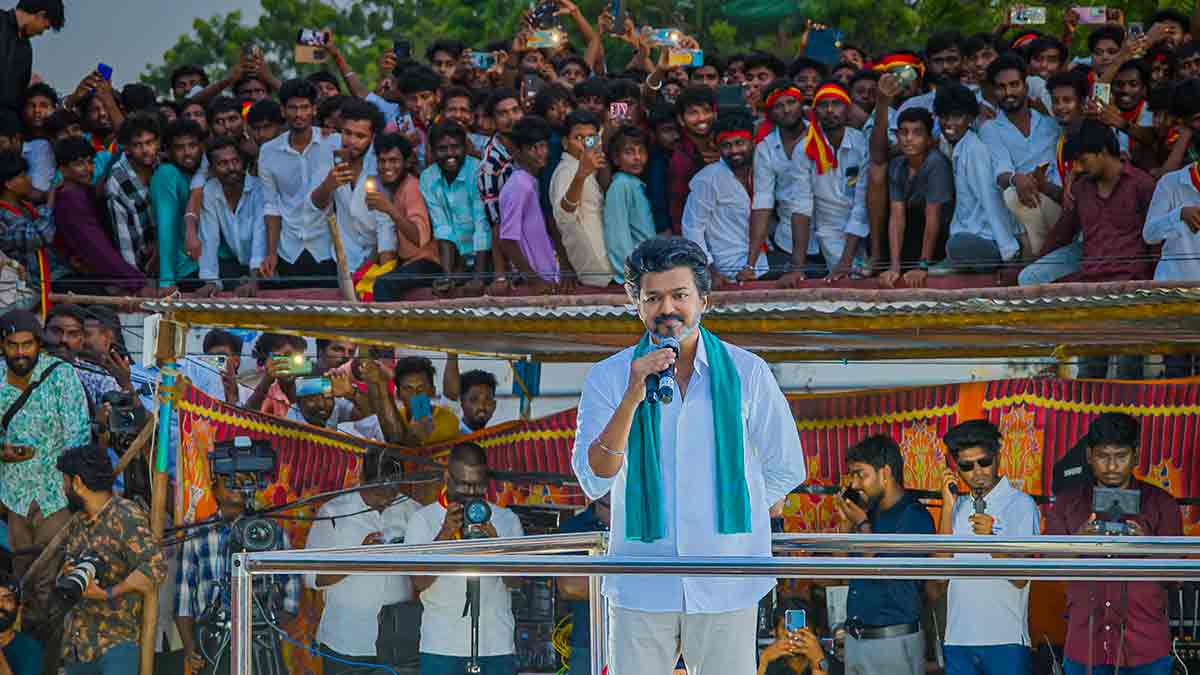
A week after his successful campaign rally in Tiruchirappalli—the heart of ‘Chola Mandalam’, the cultural homeland of the Chola empire and the Kaveri delta—actor-politician Vijay launched the second leg of his campaign with a fierce attack against the DMK.
Arriving in Trichy airport by special flight, he travelled under heavy security to Nagapattinam by road. Inside a specially designed bus, Vijay rolled through suburban routes to Nagapattinam and Thiruvarur, as fans and cadres of his Tamilaga Vetri Kazhagam (TVK) thronged sidewalks, rooftops and road dividers. They chanted “Thalapathy” (commander), hailing Vijay as the Tamil saviour.
Clad in his usual white shirt and khaki trousers, Vijay, 50, climbed atop the bus near the Anna statue at Puthur in Nagapattinam. As the crowd cheered, Vijay held two microphones to ensure that his speech was heard. Technical problems had plagued his Tiruchirappalli rally, forcing him to change microphones thrice.
“How are you all? Have you all eaten?” Vijay asked the crowd, before mounting a sharp attack on the ruling DMK.
“In Ariyalur, when I started speaking, they snapped the power,” Vijay said. “In Trichy, they cut the speaker wires. CM sir, I am asking you—if an RSS leader, [Prime Minister Narendra] Modi ji, or the Union home minister comes here, will you dare cut power like that? Your foundations will shake, won’t they?”
He hailed local Hindu deities and the popular Christian shrine at Velankanni, stressing his secular and caste-neutral credentials. With anti-BJP sentiments having deepened in Tamil Nadu in the past decade, Vijay seems to have adopted the strategy of attacking both the BJP and the DMK, saying the two parties have a tacit understanding.
“Vijay is caste-neutral,” said TVK general secretary Aadhav Arjun, “and you cannot relegate him to a particular religion. He always advocates social justice and equality, and is open-minded and liberal.”
Vijay’s fan clubs, once known collectively as the Vijay Makkal Iyakkam, have transformed themselves into a political party. The huge response to his rallies points to the TVK’s success in establishing an organisational infrastructure that matches the dravida parties. The TVK has 120 district units with 1,680 district-level office-bearers, apart from 8,580 secretaries overseeing the party’s various wings, and 68,469 booth-level secretaries. Together, the party has 2.96 lakh office-bearers across the state.
Vijay seems to be fashioning his politics after his film career. As an actor, he is not known for experimenting with roles or showcasing extraordinary acting skills. But his transition from early-career romantic roles to the current, message-heavy blockbusters has been smooth. In politics, too, he has undergone a similar, smooth transformation—from a leader reluctant to go outside and meet people, to a crusader who questions the government from atop a bus. Like in films, he is sticking to a formula—even as he criticises the DMK and the opposition AIADMK, he shows open reverence to dravida icons Periyar E.V. Ramasamy and C.N. Annadurai.
“People of Tamil Nadu always vote for a charismatic and powerful leader,” said Arjun. “Vijay draws power from this. The people do not want a party with just a powerful ideology; they want a dedicated leader who will work for them.”
Vijay seems to be retracing the steps of M.G. Ramachandran aka MGR, whose popularity as an actor helped him rise to the post of chief minister. At a time when public disillusionment with major parties and their ideologies runs high, Vijay’s mass following can be a crucial advantage.
“We want to smash the entrenched party system in Tamil Nadu and bring in a new, people-driven political system,” Arjun said. “Now our focus is on people outreach. Like Annadurai and MGR, Vijay connects with people, their lifestyle and emotions.”
Vijay and his associates feel that they have found a potent political mix—a combination of dravida politics and Tamil nationalism. The two seem contradictory: dravida politics is rooted in ideology, while Tamil nationalism is more of an emotional issue that, on its own, does not fetch votes. But given Vijay’s mass following, his party expects the combination to have considerable impact.
But pundits feel Vijay may not be able to win elections on his own. Only J. Jayalalithaa has managed it—in 1991, she led the AIADMK to victory, defeating the ruling DMK thanks to the sympathy wave after the assassination of former prime minister Rajiv Gandhi. Her subsequent victories in 2001 and 2011 were as part of coalitions. It was only in 2016 that the AIADMK contested alone again. Jayalalithaa was able to secure majority on her own because it was a triangular contest.
Vijay has been telling his fans and cadres in party meetings that the TVK will repeat the 1977 results, when MGR made his election debut after launching the AIADMK and joining hands with the Forward Bloc, the CPI(M) and the Indian Union Muslim League. The coalition won 33.5 per cent votes, defeating the DMK (24.9 per cent), the Congress (20.4 per cent) and the Janata Party (16.4 per cent).
Vijay had declared last year that he was open to alliances and sharing power. But so far, with the exception of a few AIADMK factions, no prominent party or political leader has reached out to him. The TVK also faces a dearth of leaders in districts—there is no well-known face other than Vijay’s, and none of the party secretaries has contested polls.
To come to power on his own in the current circumstances, Vijay will need to win close to 40 per cent votes. The odds seem stacked against him.
