


Before she became a nun, Sr Vandana Francis was known as Mercy. Her brother Cherian Mathew said the name mirrored her very being since childhood. “She was always instinctively drawn to the suffering of others, and it was this deep-rooted empathy that led her to a life of mission—serving the poor and those in pain in distant lands,” he said.
Sr Preethi Mary’s story is not very different. “There was a convent and a small clinic run by nuns near our home,” recalled her brother Baiju M.V. Maliyekkal. “As a child, she would go to church with them and grew up seeing them.”
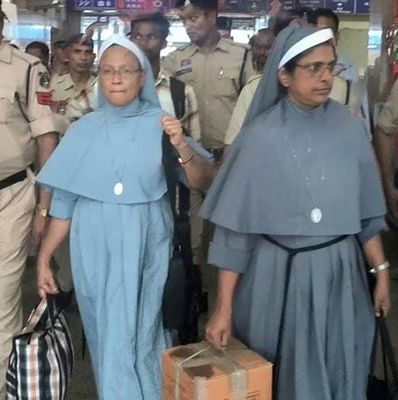 Tough times: Sr Vandana Francis (left) and Sr Preethi Mary after their arrest in Chhattisgarh.
Today, the two men are waiting for their sisters to be released from the Central Jail in Durg, Chhattisgarh—an incarceration they call unprecedented and illegal.
Vandana and Preethi, both in their 50s, were arrested at Durg Railway Station on July 25. They serve the Assisi Sisters of Mary Immaculate (ASMI), a congregation under the Syro-Malabar Church based in Cherthala, Kerala. Three young tribal women from Narayanpur district in Chhattisgarh were with the nuns when they were arrested along with a Sukhman Mandavi. The arrests followed a complaint by the Bajrang Dal, alleging human trafficking and forced religious conversion. The situation escalated after a railway ticket examiner questioned the group, and one woman—allegedly under pressure—stated that she was being taken without consent, though her family later denied this.
Lok Sabha member N.K. Premachandran, who visited the nuns in jail on July 29, told THE WEEK that the nuns faced a terrible ordeal, including mob violence at the railway station and the police station. “Bajrang Dal fanatics told them, ‘Keep your mouth shut like a mute owl,’” said Premachandran. The nuns were taking the women for domestic help jobs in convents with the permission of their families, he said. “After joining a convent, they could study further—many girls have done courses like auxiliary nurse midwifery and have built lives for themselves,” he noted.
Sr Isabel Francis, mother superior of ASMI, corroborated this, saying her nuns were trying to create opportunities for skill training for the three women and to uplift their families. The congregation focuses heavily on running service institutions for the sick and underprivileged, and Vandana is a trained pharmacist, while Preethi is a trained nurse. Both had previously worked in the Narayanpur region, where ASMI began its mission many decades ago, focusing on leprosy care. The nuns still maintain good ties with the local families.
 Anoop Antony Joseph
The Catholic Bishops’ Conference of India (CBCI)—arguably the most influential Christian organisation in the country—alleged that the parents of the young women had arrived at the police station on learning about the incident, but were “illegally prevented” from meeting their daughters. The CBCI also claimed that the nuns were arrested at the behest of “communal elements”. It also pointed out that the initial police charges were limited to human trafficking and that the charge under Section 4 of the Chhattisgarh Freedom of Religion Act, 1968—which pertains to the prohibition of forcible conversion—was added later to the FIR. In their bail application, the nuns said that the three women were already Christians, so there was no question of conversion.
The arrests have ignited a political storm in Kerala, placing both the BJP’s state leadership as well as the leadership of prominent church denominations in the state under fire. Over the past decade, the BJP has steadily courted Kerala’s Christian communities, particularly the influential Syrian Christian denominations that comprise nearly 70 per cent of the state’s Christian population and hold significant social, economic and institutional influence. The BJP had realised that, because of Kerala’s unique demography, its long-cherished dream of gaining power in the state would require support from at least one minority group along with partial consolidation of Hindu votes.
The BJP’s central leadership, including Prime Minister Narendra Modi, engaged in high-profile outreach to bishops of various denominations and sought to tap into perceived insecurities and socioeconomic competition within minority communities. These efforts yielded some success, most notably in Thrissur, where Christian voters helped elect the BJP’s first MP from the state—Suresh Gopi.
Now, with two nuns from the Syrian Christian community jailed in a BJP-ruled state, the party’s ambitious plans in Kerala have taken a hit, especially with the local body polls and the 2026 Assembly elections around the corner. That apparently prompted the Kerala BJP leadership to quickly shift to damage control mode and send a delegation to Chhattisgarh, led by general secretary Anoop Antony Joseph.
In Chhattisgarh, Chief Minister Vishnu Deo Sai had reiterated Bajrang Dal’s allegations of the nuns’ involvement in illegal religious conversion and trafficking and said the “law will take its course”. Deputy Chief Minister and Home Minister Vijay Sharma had said that the FIR was registered on “sufficient grounds” and evidence. This aligns with the BJP’s broader agenda in Chhattisgarh, which has seen increased focus on anti-conversion measures. The state is in the “final stages of drafting a new anti-conversion law”, which Sharma said would “bring greater clarity to the process of religious conversions and is intended to be very effective for Chhattisgarh”.
Kerala BJP president Rajeev Chandrasekhar, however, categorically declared that the nuns were innocent and that the BJP would make all efforts to release them from jail. He also took care to differentiate the BJP from the Bajrang Dal, stating that the latter is an “independent organisation” and that the BJP would “strongly condemn the unjustified act by anyone”.
 N.K. Premachandran
Nevertheless, Bajrang Dal activists continued their demonstrations outside the Durg sessions court where the bail application was submitted. The court, however, refused to take up the bail plea. Instead, it directed the petitioners to approach the NIA special court in Bilaspur, as the nuns had been charged under Section 143 of the BNSS that pertains to human trafficking. Anoop Antony Joseph, who met both Sai and Sharma, claimed the prosecution did not oppose the bail application, but the court cited a directive from the Chhattisgarh High Court requiring such cases to be heard by the NIA court.
“The state government has not asked for the case to be handed over to the NIA. But in cases like this, there is a possibility that the NIA may take over the investigation in the future,” claimed Anoop Antony. “That could be why the court observed that the bail should be sought from the NIA court. It was merely an observation.” However, the prosecution did oppose the bail and argued that the case was beyond the jurisdiction of the sessions court.
Even as the CBCI and the Kerala Catholic Bishops’ Council (KCBC) demanded the release of the nuns, with various church organisations holding protests on ground, their leadership has faced criticism from political parties like the CPI(M) and sections of the Christian community for not speaking out strongly or explicitly against the BJP. CBCI president Mar Andrews Thazhath, archbishop of the Syro-Malabar archdiocese of Thrissur, said the church was “not against anybody”, adding that assistance had been sought from all quarters, including the BJP, for the release of nuns.
KCBC president Moran Mar Baselios Cardinal Cleemis Catholicos said, rather cryptically, “Those who profess love but do not show it in action naturally create doubt in people’s minds.” On July 30, he issued a stronger statement: “If justice is denied, then what kind of friendship are we talking about? Let the nuns get justice first; we can sit down for tea later.”
When asked whether the KCBC had a stronger message for the BJP, spokesperson Fr Thomas Tharayil said, “Unfortunately, the issue has been politicised. We have no interest in doing that ourselves.” Chhattisgarh chief minister Sai, too, had said that the matter was unfortunately given a political colour and that all religions and communities lived in harmony in his state.
Premachandran, who is from the Revolutionary Socialist Party which is a Congress ally in Kerala, told THE WEEK that it was an issue that must be politicised. “How can we not politicise it? Because these attacks on minorities—especially Christians—have increased since the BJP came to power in states like Chhattisgarh. The BJP’s politics is the reason for these attacks,” said Premachandran, who joined the delegation of Congrees legislators from Kerala to Chhattisgarh. The left, too, had sent a delegation. Kerala Chief Minister Pinarayi Vijayan also wrote to Modi, seeking his intervention.
Fr Augustine Vattoly, a Syro-Malabar priest and social activist from the Ernakulam-Angamaly diocese, has been arguing for a stronger response from the bishops on attacks against not only Christians but also minorities and marginalised sections. “We have seen violence in Manipur, against dalits, adivasis, Muslims… We have seen actions with an intent to exclude minorities from the national fold. Yet, many church leaders—especially Catholic bishops—have remained silent,” he said. “If we see protests only when Syrian Christian nuns are targeted, that selective outrage is unacceptable.” He noted that within the Catholic fold in Kerala, the Latin Catholic denomination—influential in the coastal belt of the state—had taken a more critical stance.
Fr Laurence Culas of the Thiruvananthapuram archdiocese of the Latin Catholics told THE WEEK that the church had faced punitive measures for its stance. A former KCBC joint secretary, he alleged that it was after his archdiocese backed fisher folk’s protests against the Adani port in Vizhinjam that the Union government cancelled the Foreign Contribution (Regulation) Act licence of the archdiocese’s social service organisation. “Around 30 projects, ranging from housing, rehabilitation, education to helping children with Down syndrome, came to a standstill. More than 30 per cent of the project beneficiaries were non-Christians,” he said. “Still, we did not back down. We continued the struggle.”
He said the BJP approached them with offers during the general elections last year. “But we have made it clear that we will not compromise with a system that forces us into such undignified bargains,” he said. “Not every Christian denomination or diocese has, unfortunately, shown the same courage.”
—With Vijayan M. Eadezhath in Raipur