


World War II had left Italy devastated. But, when it came to football, Italians had cause for optimism ahead of the 1950 World Cup. They had Grande Torino. The historic 1940s squad of Serie A club Torino had won five consecutive Italian league titles. They looked unstoppable and supplied a large contingent to the Italy team—at one point, 10 of the 11 players. With Torino’s players, a third consecutive World Cup was not unfathomable.
Then, on May 4, 1949, an aircraft carrying the team crashed into the rear supporting wall of the Basilica of Superga, on a hilltop near Turin. The entire squad was gone. Without them, the national team could not recover. Italy were eliminated in the first round, suffered the same fate in 1954 and failed to qualify for Sweden 1958. The next time Italy would fail to qualify was for Russia 2018. Football had changed drastically in those 60 years. But, Italian football had stubbornly refused to modernise.
The events of March 31—missing out on a third consecutive World Cup after being beaten to a 2026 berth by Bosnia and Herzegovina—is a culmination of unmitigated structural decline, masked by an illusion of health.
To understand what is ailing Italy, we must start from the fascist foundations of the national team.
Benito Mussolini’s protectionist policies meant Italy was only partially impacted by the Great Depression. There was also significant state investment in football, which he used as a propaganda tool. Six of the eight Italian stadiums for the 1934 World Cup, including the San Siro (now shared by Inter Milan and AC Milan), were built within 10 years of the tournament—giving Italy the best football infrastructure in the world alongside the United Kingdom. And, Italian players were among the highest paid in the world: superstar Giuseppe Meazza is said to have earned four times the English maximum wage in the 1930s. The outlay paid off with World Cups in 1934 (shrouded in doubt owing to the regime) and 1938 (as clearly the best team). Meazza was adjudged the best player for 1934 and captained Italy in 1938.
Recovery from the failure to qualify for the 1958 World Cup came via the economic boom of 1958 to 1963—industry grew at more than 8 per cent per year, churning out a wide range of products from shoes and typewriters to home appliances and scooters and cars. Football, as it often does, followed the money. The Milan clubs dominated Europe and Italy won Euro 1968. They also reached the 1970 World Cup final, losing only to a generational Brazil team.
Football looked healthy and the economy was transformed. But not all Italians were happy. Former anti-fascist partisans felt the post-war government had betrayed them by staying capitalist and pro-American. The frustration boiled over in the 1960s with student protests and workers’ strikes. Neo-fascists, allegedly backed by rogue agents in the Italian secret services and the CIA (in its desire to stop communism), launched terrorist attacks; far-left groups, partially supported by KGB-linked networks, started their own armed struggle. This led to Anni di Piombo—the Years of Lead (late 1960s to early 1980s). The violence, combined with other factors such as the 1973 oil crisis, decimated the economy. No Italian club reached a European final between 1974 and 1982.
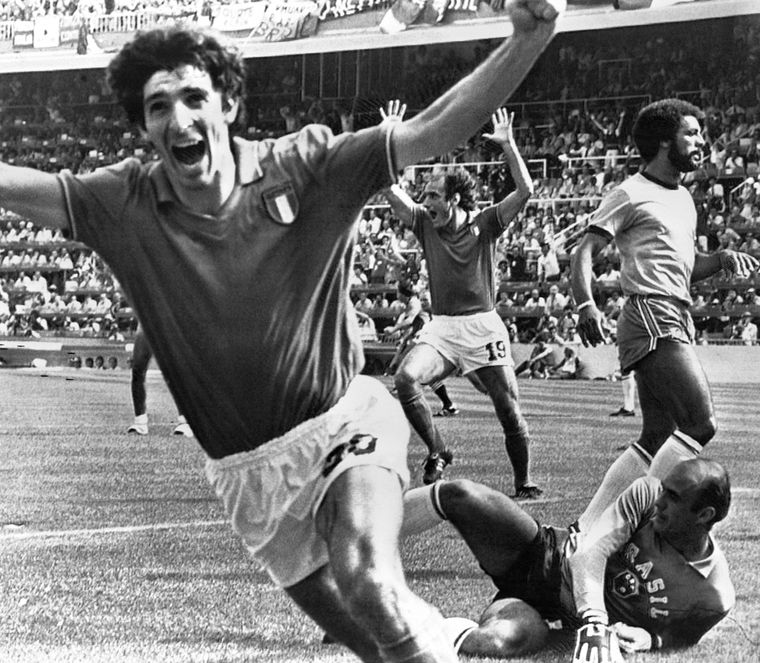 Football Heritage: Paolo Rossi celebrates against Brazil at the 1982 World Cup | AP
Going into the 1982 World Cup, Italy were not fancied. But, under Enzo Bearzot—a former player, heavy smoker and tactician, who, blasphemously, liked attack (having caught the Total Football bug)—Italy had played decent football at the 1978 World Cup and Euro 1980. Bearzot had given Paolo Rossi his national team debut at 21 in 1977. The striker was second only to Mario Kempes in the 1978 World Cup’s player awards. But he got embroiled in the Totonero betting scandal in 1980 and got a three-year ban (later reduced to two). He played three games at the end of 1981-82. Bearzot backed him regardless.
It seemed like a mistake—Rossi and Italy were appalling, barely scraping through the group stage to face reigning champions Argentina and favourites Brazil. The nerves in Italy manifested as vitriol against Bearzot, who responded with a media blackout. This cultivated an us-vs-them mentality among his players. Italy beat Argentina 2-1, shutting down a 21-year-old Diego Maradona. Against Brazil, Rossi exploded to life, scoring a hat-trick in a 3-2 win. He then scored in the semifinal and final as Italy won to equal Brazil’s record of three World Cups.
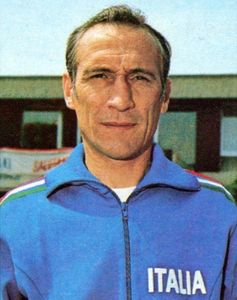 Enzo Bearzot masterminded the unlikely title triumph in 1982. Italy’s managerial pedigree endures even now.
That triumph was soon followed by another economic upswing. Through the mid and late 1980s, Italy prospered thanks to luxury goods, fashion and surging exports. This facilitated imports—Michel Platini, Maradona, the Dutch trio of Ruud Gullit, Marco van Basten and Frank Rijkaard. Platini delivered European success for Juventus and Maradona brought unprecedented glory to Napoli. Meanwhile, the three Dutchmen, under Arrigo Sacchi, made Milan the best team in Europe. The quality of the league helped mould home-grown legends like Franco Baresi, Paolo Maldini and Roberto Baggio.
Italy reached the 1990 World Cup semifinals at home, the 1994 final and gave 1998 champions France their toughest test—losing on penalties each time. They were 30 seconds from winning Euro 2000, conceding a late equaliser before losing to a golden goal. In 2002, refereeing mistakes led to Italy’s elimination against South Korea. The national team was unlucky not to win anything during a time of Italian dominance in the European football ecosystem.
That dominance would soon end. Though the 2003 Champions League final was an all-Italian affair (Milan beat Juventus), financially, Serie A clubs were falling behind Premier League clubs, Real Madrid, Barcelona and Bayern Munich. Italy finally won a long overdue fourth World Cup in 2006, but the squad’s average age was almost 30 and it came in the wake of the Calciopoli referee-appointment manipulation.
The scandal damaged the league’s reputation, but the 2008 financial crisis broke its backbone. Indeed, Italy’s real GDP was lower in 2025 than in 2008. The padrones (patrons)—Silvio Berlusconi at Milan, the Agnellis at Juventus—could no longer keep up with a game growing richer.
A defiant Inter, managed by Jose Mourinho at his peak, won the treble in 2010. But, when they won the Champions League that season—no Italian club has won it since; none even made it to the round of 16 this year—there was not a single Italian player in their starting eleven. It was a sign of things to come.
The consequences were cascading. Serie A stopped attracting the world’s best and lost its stars. Stadiums—most owned by local municipalities rather than clubs, unlike in England, Germany or Spain—continued to decay. Italy’s national training facility has not been meaningfully upgraded since the 1950s. The Italian federation has also not undertaken the kind of structural overhaul that Spain or Germany did after their own lows.
Italy had missed a golden chance to upgrade when hosting the 1990 World Cup: only two new stadiums were built and minor renovations made elsewhere. Of the two, one was demolished within 20 years and the other serves a relatively small club. Without modern stadiums, revenue fell; clubs cut costs and youth development was among the first casualties because of the short-term pressure on cash-strapped clubs.
When prospects do emerge from Italy’s antiquated academies, rarely do they live up to the billing. Mario Balotelli, who did not become the world-beater he had promised to be, did better for Italy than other failed prospects—but was with Manchester City at the time of his finest hour. He starred as Italy reached the Euro 2012 final under Cesare Prandelli. It seemed as if the Azzurri were back after setbacks at Euro 2008 and the 2010 World Cup. But it was a false dawn. The squad was built on players of a richer era: Gianluigi Buffon, Andrea Pirlo, Daniele De Rossi. The 4-0 loss to Spain exposed the gap—Italy were in decline; Spain was at a peak.
A persistent problem is the lack of Italian players playing overseas, limiting exposure to different styles and tactical variety. This becomes more relevant as opponents start to have more players with exposure. Against Bosnia and Herzegovina, Italy had three players based abroad: Gianluigi Donnarumma, Sandro Tonali and Riccardo Calafiori. It can be argued the three Premier League stars are currently Italy’s best players.
Euro 2012 was not the last false dawn. Cristiano Ronaldo’s move to Juventus in 2018 for €100 million screamed of the league’s enduring appeal. But, it was just one club spending unsustainably in a desperate gamble that did more harm than good.
Italy’s Euro 2020 win was greeted as a turning point. In truth, Roberto Mancini, like Mourinho with Inter in 2010, had papered over cracks with tactical intelligence and man-management. He left for Saudi Arabia after Italy lost a Qatar 2022 qualifying play-off to North Macedonia.
The most misleading aspect of Italian football is Serie A’s ranking within European leagues—currently second only to the Premier League. The fact that England has not won anything since 1966 proves that league rankings cannot be taken at face value. France is the top-ranked national team, but its league is fifth. Moreover, Italian clubs, in their desperation for revenue, have also taken the smaller European competitions more seriously than comparable clubs elsewhere. In England, for instance, domestic competition is more financially rewarding—finishing last in the Premier League was worth just over £109 million (about €125 million) in 2024-25; the Conference League is worth around €20 million for winners. So, a high league rank and a weak domestic league can coexist.
Former German captain Philipp Lahm says low intensity is the main issue. “Today’s Italian teams [are like] a Ferrari that has been throttled back from 200 horsepower, with a half-full tank, and runs out of fuel 10 laps before the finish,” he wrote for The Guardian.
Italy is co-hosting Euro 2032 with Turkey—an opportunity to upgrade infrastructure. But interest in the national team is low—attendance figures are dropping. So, there is no political reward to spending big on football, especially because the economy has not roared back. But, Italy recently got some external ‘motivation’: European football chief Aleksander Ceferin said that hosting rights may be taken away unless stadiums—“some of the worst in Europe”—improve.
There is tentative hope in the air. The federation’s old guard has stepped down. And despite all the issues plaguing Italian football, the country is not short of managerial pedigree—nor of raw talent. What is needed now is a structural overhaul and, after it, a clear footballing identity.
Italy have been written off before. In 1982, the answer was to shut the door, back the players and trust the process.