


February 26, 2026.
Day 3 of the Ranji Trophy final between Karnataka and Jammu & Kashmir.
The sun was baking the flat pitch at the KSCA Hubli Cricket Ground. Jammu and Kashmir had made 584 runs in their first innings, but Karnataka, with a top order with 100 Test caps, stood between the visitors and history. K.L. Rahul was on strike, with Mayank Agarwal at the other end. The score: 27/0 in 11 overs.
The script changed in the 12th. The scriptwriter? Auqib Nabi.
The second ball of his fifth over landed on a good length and seemed destined to meet Rahul’s defensive push. Only, it didn’t. Almost as an afterthought, the ball seamed away at the last moment, kissing Rahul’s bat and flying into the gloves of Kanhaiya Wadhawan. It took a Decision Review System appeal to confirm the edge, and replays showed what Nabi had done over and over in the 2025-26 season. Bowl. Wicket. Repeat.
The 29-year-old from Baramulla took down four more Karnataka batters, including centurion Agarwal, handing Jammu and Kashmir a decisive 291-run first innings lead. As the match ended in a draw, the visitors—by virtue of that first innings lead—clinched their maiden Ranji Trophy title, 67 years after making their debut.
Nabi’s father Ghulam Nabi Dar, a government school teacher who wanted his son to study medicine, would have been proud of his surgical precision with the ball. A young Nabi would travel 60km from Baramulla, close to the Line of Control, to train at the Sher-i-Kashmir stadium in Srinagar; there were no facilities closer home. Seeing his love for the game and his persistence, his cricket-loving family gave in.
“Nabi is called a ‘diesel engine’ as he takes a bit of time to get going. But once he does, there is no stopping him,” former India all-rounder Irfan Pathan said on his YouTube channel.
The wheels were set in motion in the 2024-25 season, when he became the second-best bowler with 44 wickets. For a pacer who idolises former South African pacer Dale Steyn, Nabi might only bowl in the 130-135kmph range, but he puts his accuracy and swing to good use. “He bowls eight- and 10-over spells without tiring. His seam is straight, which helps in late movement. Nabi is special,” Pathan said.
The ‘diesel engine’ topped the bowling charts this season with 60 scalps. In the Duleep Trophy 2025-26, Nabi pulled off yet another special—a five-wicket haul, which included four wickets in four balls for North Zone against East Zone.
It was no flash in the pan. It was a culmination of a process spanning more than half a decade. Before this season, Jammu and Kashmir had played over 300 matches and won only 40-odd. It took the team more than two decades just to win their first match—against Services in 1982-83.
Pathan knows what the Ranji win means for the region. He was a player and mentor from 2018 to 2020, promoting unity in the team and developing the youngsters. It was during his scouting trips to Anantnag, Kupwara and Baramulla that he unearthed promising but raw talent such as Abdul Samad, Umran Malik, Rasikh Salam and Nabi. He made them believe they could beat anybody. The team reached the quarterfinals in 2019-20—Nabi took 24 wickets in his debut season—proving they were on the right path.
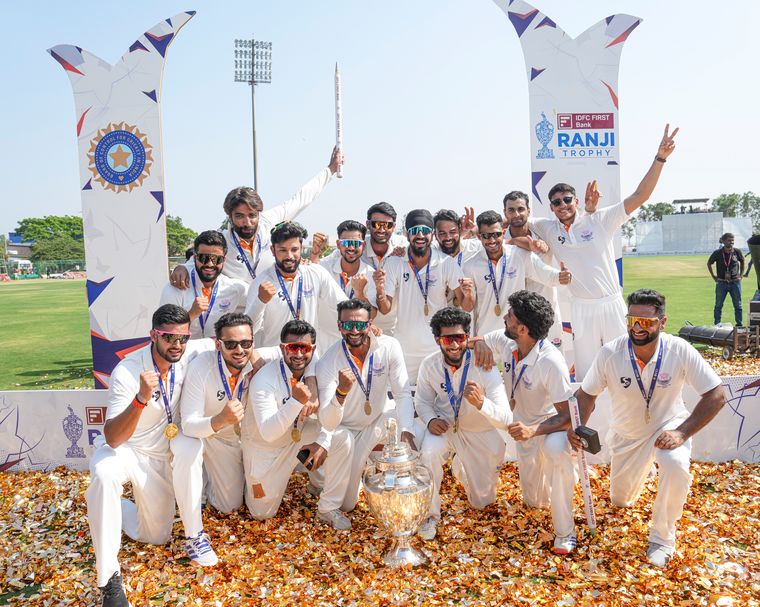 Valley of gold: The Jammu and Kashmir players pose with their maiden Ranji Trophy | PTI
But the abrogation of Article 370, Covid-19 and Pathan’s exit threatened to undo all the hard work. In 2021, the BCCI appointed a sub-committee including current board president Mithun Manhas and Brigadier (retd) Anil Gupta. Born in Jammu, Manhas returned to his roots in 2015 after a stellar domestic career with Delhi. He was a player and mentor for Jammu and Kashmir before retiring in 2016-17. Four years later, with the backing of then BCCI secretary Jay Shah, they rebuilt from the ground up. A statewide talent hunt was held in 2022, which unearthed, among others, left-arm pacer Sunil Kumar, who played perfect foil to Nabi this season with 31 wickets.
Next came the red-soil pitches, alongside local turf wickets and black-soil pitches, which helped prepare players for conditions across India. ‘Jammu’ and ‘Kashmir’ quota systems were dismantled, and merit took centrestage. Bold calls were made: Himachal veteran Paras Dogra was made captain, and the experienced Ajay Sharma was brought in as coach. Bowling coach P. Krishna Kumar and fielding coach Dishant Yagnik were also roped in.
A method was emerging.
Though their campaign in 2024-25 ended with a heartbreaking loss in the quarterfinals—they conceded a one-run lead to Kerala—they had beaten heavyweights Mumbai and Baroda in their own backyard. In 2025-26, they continued their giant-killing spree, beating former Ranji champions Delhi, Bengal and, ultimately, eight-time winners Karnataka.
Nabi, who was at the centre of this revolution, acknowledged the role of senior cricketers in the setup. “Irfan (Pathan) Sir and (Mohammed) Shami bhai are legends of India. I am very lucky to have learnt from them,” he told THE WEEK. In the semifinal against Bengal, he overshadowed Shami’s nine-wicket haul, taking nine for the match and scoring a vital 42.
Nabi, who had taken only 28 wickets since his Ranji debut till the breakout 2024-25 season, prospered under Kumar’s watchful eyes. A Malayali who played for Rajasthan his entire career, Kumar first saw Nabi during the 2023-24 Buchi Babu tournament in Tamil Nadu. He was impressed with Nabi’s wrist position and outswingers. With close to two decades of coaching experience, Kumar realised that Nabi just needed polish.
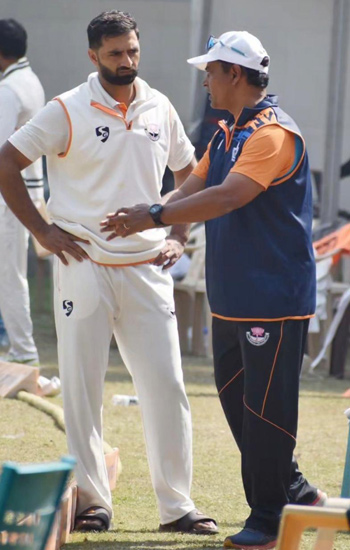 Nabi with bowling coach Krishna Kumar
“He had the will and the determination to improve,” Kumar told THE WEEK. “I made Nabi aware of his own bowling. That’s the most important thing for a bowler. I taught him about inswingers, variations, use of the bowling crease and release of the ball. He picked it up in a year.”
Kumar did not change Nabi’s run-up or action. “He is accurate with his line and length and has the stamina to bowl long spells,” he said. “I have always gone with what he is comfortable with, making only minor changes.”
Nabi is grateful for it. “Krishna sir has always encouraged me to back my strengths,” he said.
Kumar believes Nabi’s skill-set will be handy in the IPL, too—the Delhi Capitals picked him up for Rs8.4 crore at the latest auction. “Nabi is good with his back-of-the-hand slower balls and slow bouncers. He bowls brilliant yorkers and can swing the ball both ways,” said Kumar.
Nabi is unlikely to be overawed by the IPL frenzy, the big names and the advice coming his way, he added. “Nabi is very calm,” he said. “He doesn’t get flustered when things don’t go as planned. And he is mature enough now to listen to all the advice but choose only what works for him.
“These boys from Kashmir don’t have the fear factor because of the hardships they have endured. It’s beyond our imagination. They have the thirst to prove themselves. The bigger the stage, the better. Every situation is an opportunity for them.”
Nabi hasn’t forgotten where he came from. “I want to set up a cricket academy so that no young cricketer faces the challenges I have faced,” he said. He was inspired, like many others in the region, by Parvez Rasool, who was the first Jammu and Kashmir cricketer to play in the IPL in 2013, and in the senior national team.
And now that he is in the IPL, alongside Malik, Samad, Salam and Yudhvir Singh Charak, the dream has just begun. Former India captain Sourav Ganguly, Pathan, Rasool and Kumar have all called for his inclusion in the Indian Test team. The man himself is unfazed by the attention, though. “I am excited to be playing in the world’s biggest T20 league,” he said. “I am not thinking too far ahead. I want to do well for the Delhi Capitals and I am fully focused on it.”
Interestingly, he is sharing the dressing room with Rahul at Delhi Capitals now. Did they discuss his peach of a delivery in the Ranji final? “No,” he said.
Bowl. Wicket. Move on.