



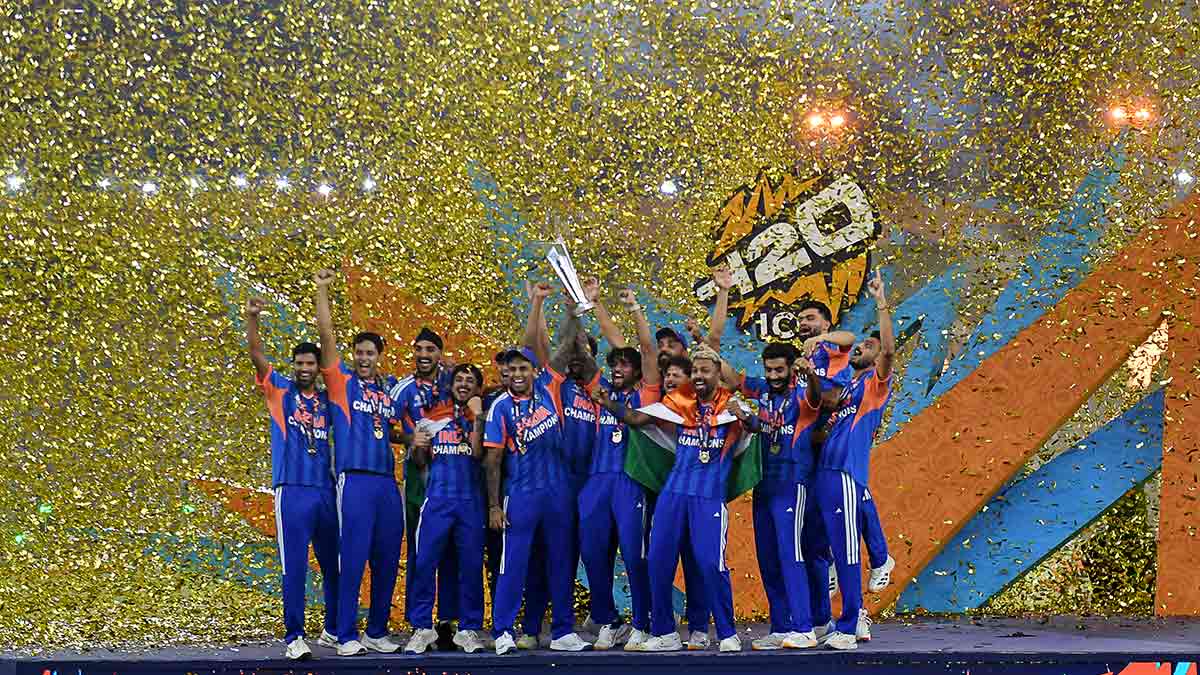
About 30 minutes into the T20 World Cup final in Ahmedabad, I felt a sense of déjà vu. Put in to bat on a good surface, India’s opening pair of Sanju Samson and Abhishek Sharma raced to 92 in the powerplay.
In hindsight, perhaps the game was done at that stage. New Zealand had started well, conceding only 12 in the first two overs, but their tactics and execution thereafter were hit out of the ground. Their mental block worsened with every ball.
The moment took me back 23 years, to another World Cup final where India were at the receiving end. Against the mighty Australia under Ricky Ponting, Sourav Ganguly won the toss and chose to bowl, just like Mitchell Santner did in Ahmedabad. The rest, as they say, was history.
If Ponting had combined with Adam Gilchrist and Damien Martyn to bat India out of the ODI game at the Wanderers, it was Samson, Sharma and Ishan Kishan who went on the rampage against the Kiwis. That 2003 final remains a nightmare for Indian fans. At the time, not many people would have expected India to do the same to an opposition, that, too, in a World Cup final.
India’s blueprint in T20I cricket in the past two years has been built around two frequently used terms—‘fearless’ and ‘intent’. Unfortunately, few teams walk the talk when it comes to high-pressure games. That is where Suryakumar Yadav’s men shone.
Once they realised that New Zealand were shaky, they went in for the kill. Except for three overs towards the end where New Zealand got quick wickets, India were ruthless throughout. Shivam Dube’s assault in the 20th over—24 runs—was the perfect finish.
Much like the 2003 final, this game was virtually decided at the halfway mark. Chasing 256 in a T20 World Cup final is as improbable as chasing 360 was in an ODI World Cup final two decades ago. Which begs the question: Have India started to emulate the ruthless Australian sides of the 2000s?
It would be unfair to compare, given that the Australians were unstoppable across Tests and ODIs. However, if we focus on just the white-ball formats, and T20Is in particular, there is a striking similarity.
Since the end of the 2022 T20 World Cup, India have won 57 of 77 T20Is, including 17 series/tournament wins out of 19. One bilateral series was drawn. That India have lost only 13 games in this period is mind-boggling, given the unpredictability of T20Is, where upsets are more frequent compared with the longer formats.
Take only the period after the 2024 T20 World Cup, and India’s dominance is magnified. Since then, India have won all nine assignments—31 wins of 41 matches and only six losses (before the 2026 World Cup). This was the first time that any team had dominated the volatile format so much.
If Australia set the bar for dominance in Tests and ODIs, India have unlocked a new benchmark for T20Is. ‘Batters win you matches, bowlers win you tournaments’ is one of cricket’s golden lines, but India broke that narrative in this World Cup. Their bowling was mostly about Jasprit Bumrah, with occasional support from Hardik Pandya, but the batting saw everyone step up at some stage.
Of the 780 sixes hit in this 20-team tournament, India hit 106, or 13.58 per cent. It was also the first time any team hit 100-plus sixes in a T20I tournament. Since the end of the 2024 T20 World Cup, India have hit the most sixes—473—from 50 matches. They also had the best team strike rate—157.
Notably, even with such all-out aggression, Indian batters have scored eight centuries and 43 fifties in this period, which means that, on an average, there was one individual 50-plus score a game. To marry unreal aggression with top-notch consistency has been an art that only India have mastered in this format.
In T20I history, teams have posted more than 250 in an innings 30 times. India have done it seven times, all in the 2024-26 cycle. It highlights India’s batting muscle on flat pitches.
And then there is Bumrah. In 2024 and 2026, he was one of the most economical bowlers in the World Cup, apart from being among the top wicket-takers. Varun Chakravarthy might have had an underwhelming 2026 campaign, but on tricky pitches, he becomes a handful. As do Kuldeep Yadav and Axar Patel.
You could argue that the best chance to beat India is on pitches that are not flat. However, in those conditions, the variety in their bowling still gives them the advantage.
Currently, there is a gulf between India and the rest in T20Is. And India’s ODI team isn’t that far behind. Their bilateral series records have been middling, but a runners-up finish in the 2023 ODI World Cup followed by the 2025 Champions Trophy title shows an upward trend. India have now won three ICC titles in a row across the two white-ball formats.
No team in history has held all three white-ball trophies at the same time. The Australians came close but missed out on the 2010 T20 World Cup, as did M.S. Dhoni’s Indian side, which faltered in the 2014 T20 World Cup. India’s challenge will be to translate their T20 mastery into the ODI format.
The 2027 ODI World Cup will be a challenge, more so because of African conditions. It will be the final piece of the puzzle for India in its quest for supremacy. And given that this team just broke a plethora of records with their latest title win, it would take a brave person to bet against them next year.
