


These girls have really set the platform for the upcoming generations in India,” said Mithali Raj, her voice unsteady. “They’ve opened up channels for women’s cricket, and they should be really proud of themselves. I have seen the changes the girls have made.”
You’d be forgiven for thinking that Raj said this after the Indian women tasted gold for the first time on November 2, downing a resilient South Africa at the DY Patil Stadium in Navi Mumbai. Instead, she said this as captain of the cricket team that had just lost the 2017 final to England by nine runs. That was India’s second defeat in a World Cup final, the first being in 2005, in Raj’s first year as captain.
More than eight years later, Raj watched on, this time not with bat in hand, but rather a mic. Sitting beside her long-time teammate Jhulan Goswami, she saw live why they say third time’s the charm.
For a brief moment, the trophy felt like it belonged to all of them, from Shantha Rangaswamy and Diana Edulji to Anjum Chopra, Raj and Goswami, to the young Sree Charani, who made her India debut only months ago. It was a win for the ages, across the ages and the final chapter in a story that began years ago.

Till 2006, the women’s game in India ran more on will than money. The Women’s Cricket Association of India, which ran the sport for 33 years, merged into the BCCI that year. But the BCCI of then was no behemoth, and the rise was slow. From after the 2005 final to the 2017 final, India won 76 of 134 ODIs, a win rate of 56.72 per cent, marginally better than the 52.6 per cent before.
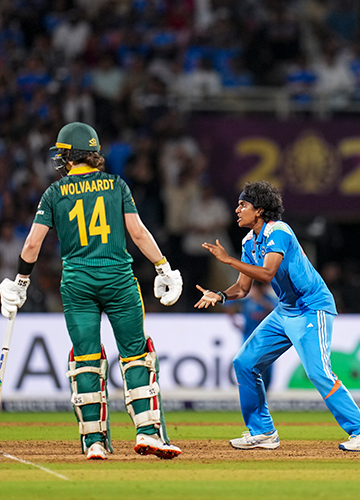 One for the future: Shree Charani, one of the finds of the tournament, first impressed in the WPL | PTI
But, importantly, the sport gained structure and visibility. There were more domestic tournaments, more players got contracts and international exposure became routine. By 2017, India were not underdogs; they were contenders.
The World Cup that year was the perfect stage: major venues hosted matches, Lord’s staged the final, the prize money jumped to nearly ten times the 2013 purse, and, for the first time, every player was a full-time professional on a central contract. It was also the most widely televised women’s World Cup, and living rooms across India tuned in.
Raj’s words after the final felt less like consolation and more like a sign of what could follow. That Lord’s final became the launchpad.
Then on, investment deepened. There was better travel, access to top facilities and more international cricket. But the results did not come overnight. The team struggled for consistency amid transition. Some of the seniors were nearing the end, coaches didn’t have long stints and the lack of tactical continuity stalled progress despite a talented core. From the 2017 World Cup to the 2022 one, which included the Covid-19 pandemic, India won only 22 of 47 ODIs.
Raj’s retirement following the 2022 World Cup—where India failed to make the knockouts—triggered a major rebuild under Harmanpreet Kaur. And there on, the women went on their strongest run in the format. Including the World Cup final, they won 30 of 47 matches, a 63.8 per cent success rate.
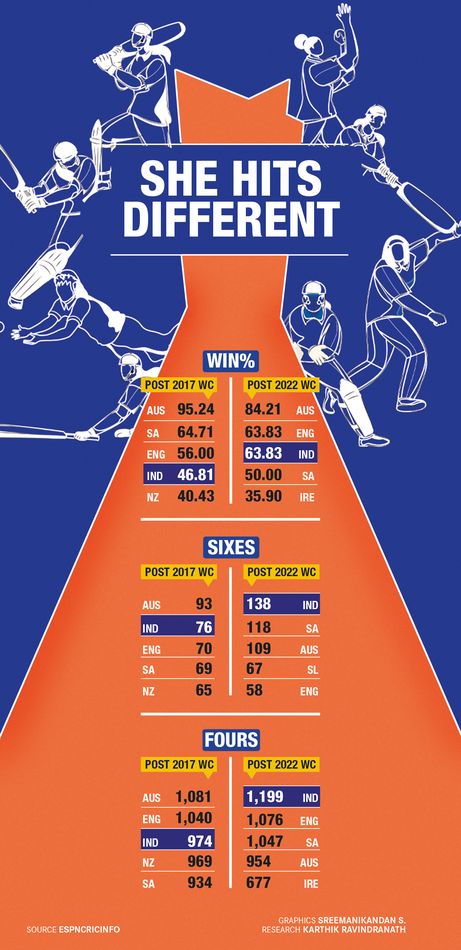
A switch had flipped. Since the last World Cup, India has hit 138 sixes in ODIs, the most by any side. South Africa followed with 118, Australia with 109. The intent was clear. Smriti Mandhana led the way with 42 sixes and more than 2,500 runs at a strike rate of 99. Richa Ghosh added 28 sixes, 12 of them—the most by anyone—in this World Cup. Yet, this wasn’t just about power. India also led the charts for fours, showing how their game had found a balance between precision and aggression.
The Women’s Premier League had had its impact. Launched in 2023, it changed the rhythm of the sport. For the first time, Indian women got the same intensity, crowd noise and global competition that shaped their male counterparts.
Kaur’s first major title as captain came with the Mumbai Indians in the inaugural season. “Now I know what it means to win a trophy,” she had said. Two years later, that knowledge showed.
The league gave opportunity to a breed of fearless cricketers. When opener Pratika Rawal was injured before the knockouts, Shafali Verma, who hadn’t played an ODI for a year, stepped up with the innings of her life in the final. The WPL had already toughened them all. Mandhana, Kaur and Jemimah Rodrigues had learnt to stay composed when the lights were the brightest, and also keep younger teammates calm under pressure.
The other change in 2023 was the entry of Amol Muzumdar as coach. A former domestic batter with a sharp eye for detail, Mazumdar took over when India needed more than motivation—they needed a method.
He brought a measured style to the dressing room. Training sessions were built around clarity of roles and data-backed planning, but his biggest impact was in maintaining emotional balance. Players say he rarely raised his voice; he simply reminded them that composure wins as many matches as aggression.
Under him, the old weakness—lack of depth—was finally gone. In 2017, India had been 191 for three in the final before collapsing. By 2025, the story had changed. Ghosh gave finishing muscle down the order. Yastika Bhatia’s injury was a blow, but the bench held strong. Rodrigues provided calm, Deepti Sharma consistency, and Amanjot Kaur and Sneh Rana the all-round stability champion sides need.
Three of India’s highest ODI totals without an individual century came in this very tournament—clear proof of how collective the batting had become.
Australia remained the toughest assignment, but the contests grew tighter over the past few years. Remember, India had beaten them earlier in the year in a bilateral game, and when they did so again in the semifinal, it seemed like continued progress rather than a bolt from the blue. The final was the fairytale ending.
More than numbers, this win is about legitimacy. For years, the women’s game lived in the shadow of the men’s. The trophy changes everything. Girls who once borrowed their brothers’ bats now have icons with national contracts and endorsements. Television ratings have climbed, and crowds now chant for Mandhana, Kaur and Ghosh like they do for Virat Kohli or Rohit Sharma.
If 2017 was a flicker, 2025 is a steady flame.
The WPL will grow, the brand will expand, and young girls from smaller towns will find clearer paths to the top. The challenge will be to sustain this success and to ensure that every district ground and training camp shares a piece of this momentum. The past decade has shown that the structure, support and self-belief are already in place.
The next step is simple—win more. As Kaur said in the post-match presentation after the final, “We wanted to break this barrier; our plan [now] is to make this a habit.”