



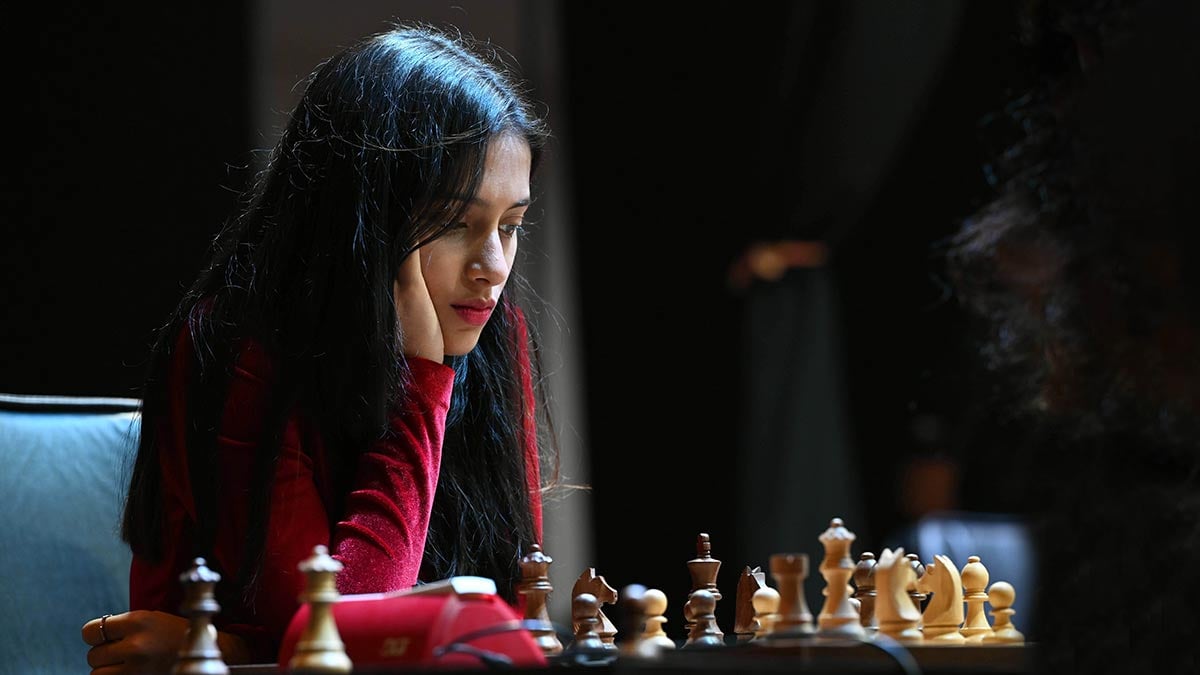
Interview/ Divya Deshmukh, FIDE Women’s World Cup winner
THERE’S ONLY SO MUCH you can hope to win from a single tournament. But Divya Deshmukh hoped for a bit more. The 19-year-old from Nagpur not only booked a berth in the Candidates tournament next year, but also became the first Indian to win the FIDE Women’s World Cup. The added bonus—she went from international master to grandmaster with a famous win over Koneru Humpy in the all-Indian final at Batumi in Georgia on July 29.
Winning the World Cup, it turns out, allows a player to bypass the norms needed to earn the GM title. With that, Divya became only the fourth Indian woman GM, joining Humpy, Harika Dronavalli and Vaishali Rameshbabu.
As historic an achievement as it was, Divya was not ready for the reception back home. Sons of Chennai are used to adoring crowds taking them from airport to home. Nagpur is no Chennai. Yet, scores gathered at the airport with flowers and drums. “That reiterated the faith that maybe chess can be developed in Nagpur,” the exhausted champion told THE WEEK in an interview.
The next few days were a whirlwind—Maharashtra Chief Minister Devendra Fadnavis presented her with a Rs3 crore award, family friend Chief Justice B.R. Gavai dropped in to congratulate her, functions near and far were lined up and the notifications on her phone wouldn’t stop.
But perhaps Divya should get used to it, especially if she continues her recent form. In the past few years, she has won the Women’s World U-20 Championship, the Chess Olympiad as part of the Indian team and now the senior World Cup.
Next year, she will take part in the Candidates; if she wins, she gets an opportunity to dethrone current World Champion, China’s Ju Wenjun. Excerpts:
Q/ Did you speak to Humpy before the final? What is your relationship like?
A/ As we were going to play each other in the final, we did not speak. Humpy akka and I are compatriots. Of course, she’s much older so I didn’t have the opportunity to interact with her when I was younger. I’ve known her for the past three years.
Q/ You’ve risen through the ranks when a lot of eyes are on Indian chess. In previous generations, chess in India used to be mostly about Viswanathan Anand. How do you deal with the attention now, especially with social media and especially in the past few days?
A/ In the past few days, I don’t think I’ve had any time to even think... I have barely slept. But of course there’s going to be pressure. The higher the stakes, the more the pressure. When I was younger, I used to play these world youth category events.... Those situations really taught me how to handle pressure. Of course, it’s still a lot, but I try to focus on my own expectations.
Q/ What is your general relationship with social media? How important is it for a young player?
A/ It’s not me who is using social media. [There’s a team]. I barely use it. I think it’s a good way to connect with people and a good way to form a community where you can interact. But I think after a point, it is exhausting. I try to refrain from using it too much.
Q/ In recent times, the conversation about Indian chess has mostly been about the depth on the men’s side. Do you think your win is crucial in how the general public looks at women’s chess?
A/ I’m happy that along with our men’s chess, our women’s game is also developing. Of course, I hope that this win inspires a lot more young girls to take up chess. And I want to see a lot more girls after my generation reach this level.
Right now, it’s a little bit unclear how it will go. But for now, because of Humpy akka, Harika, Vaishali and a few more, I think we are definitely one of the top countries in the world.
Q/ You dedicated your grandmaster title to your first coach, Rahul Joshi. How did you get into chess and what kind of impact did he have on you?
A/ My getting-into-chess story is a bit funny. I was around five. My sister used to play badminton. She’s eight years older. As I was young, I was also tiny. I could not reach the net or hold the racket. There was a chess class [nearby]. My mom wanted me to play a sport that was not physical so that I didn’t get injured. That is how I started chess and I initially hated it. It was boring for me, like for any other five-year-old. My parents pushed me through it. And after a while, I just got the hang of it.
Q/ And Joshi sir?
A/ So this chess class I joined, that was Joshi sir’s. He has been the guiding force for me and my parents. He introduced me to the chess world and I think he is the reason I started chess.
Q/ Your mother had to sacrifice her medical practice to support you. What kind of role has your family played in your journey?
A/ My family has had the biggest role. Each one of them has such specific roles. My mom left her practice for me. My dad used to [take care of] all the technicalities and he also came with me to tournaments despite having a job (as a doctor). It’s gotten quite hectic. My sister, Arya, has also been such a huge support, morally. And my entire family, [for instance] my aunt. Every time I used to win a tournament, since I was eight or so, she used to always welcome me in a grand fashion. So for me, it is special. Without them, I wouldn’t have gotten here.
Q/ Was there any pressure to become a doctor?
A/ No, but I’m interested in it. Unfortunately, I don’t think I can manage both.
Q/ Do you think that your win, especially given that you’re from Nagpur, will help spread the game to more non-conventional spaces in India?
A/ I’m hoping so. When I landed in Nagpur, I did not expect the kind of welcome I got. And that reiterated the faith that maybe chess can be developed in Nagpur.
Q/ How do you prepare for a tournament? Are you more theoretical or intuitive?
A/ I cannot reveal all my strategies here (laughs). But I think all my preparation for tournaments, it has to include all of it. And I think the main thing is just to stay in shape.
Q/ There was recently talk about the fitness of Mohammed Siraj, who bowled tirelessly in the Test series against England. But people don’t talk about the physical fitness required for chess. You play for long stretches.
A/ Yeah, it was quite a test of resilience to go out there every day. Not just mental. Just to sit at the board in such tense situations for five to six hours and to maintain your energy. It takes a lot. So physical fitness has been very important. It’s something I want to focus on a lot now, seeing how hard it is after the World Cup. People might not think it is a physical game, but I think it is.
Q/ You became a grandmaster through this tournament. Do you think your game reached the next level during the World Cup? Or did you have the attitude that you were mentally already a grandmaster?
A/ I knew it was a title waiting to be achieved. I wasn’t sure when, but I am glad it came now. Of course, it is nice to be a GM, but for me what mattered more was if I was actually capable of performing at that strength. That always mattered more.
Q/ One of your coaches compared you with M.S. Dhoni in terms of being calm on the board. But we have also seen you emotional off it. How do you maintain a balance?
A/ I think it’s quite important. When I was younger, the tournaments taught me a lot about how to be calm in crucial situations. And of course, it also comes from experience and learning.
There have been moments where I wasn’t calm and the result wasn’t so good. And there were moments when I managed to be calm and clinched the situation. It comes from experience.
Q/ You are a naturally aggressive player. Has anyone ever told you to rein that in? Going forward, do you want to strike a balance?
A/ I think it’s what works for me. I definitely want to be an all-rounder and learn all the aspects of chess. But I think aggression is what leads me to victories.
