
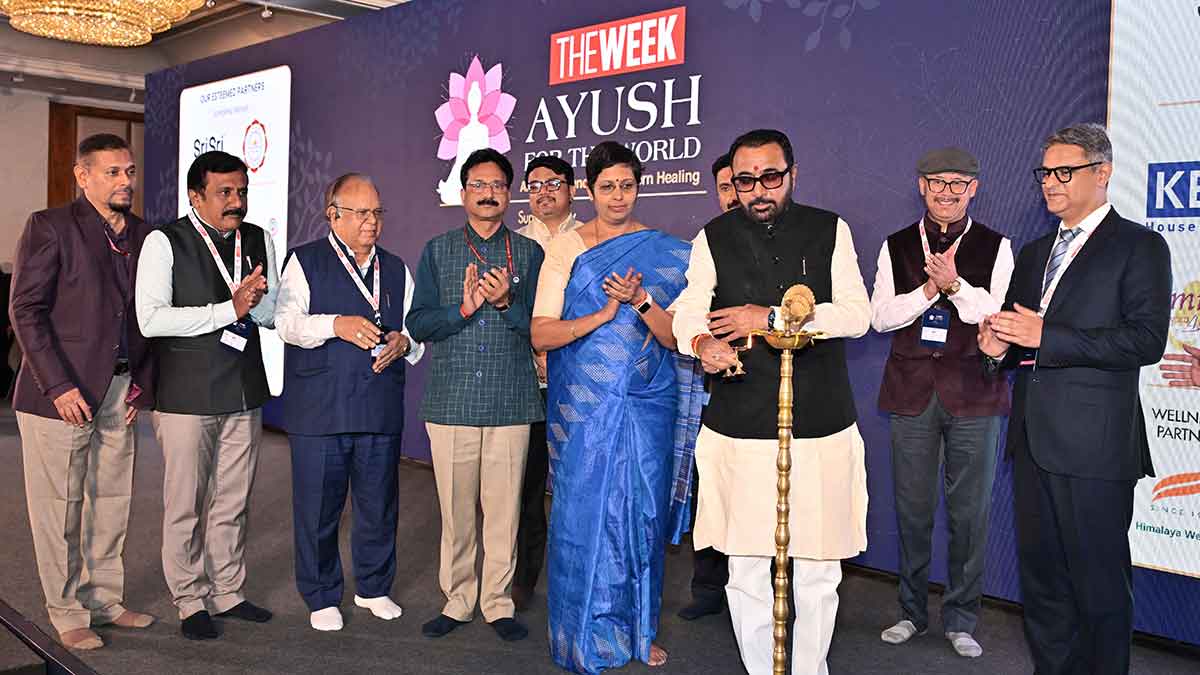
The day did not begin with speeches. It began with sound. Soft, meditative notes of a handpan drifted across the hall, slowly joined by the earthy pulse of a healing drum and the gentle flow of a flute. For a conclave rooted in policy and systems, this was an unusual opening. But, at THE WEEK’s ‘Ayush for the World: Ancient Science for Modern Healing’ conclave in New Delhi, it felt intentional. The message was clear: healing is not merely clinical. It is lived, felt and experienced.

As Anup on the handpan and Pravin on the flute performed, the room seemed to settle into itself. Conversations quietened and shoulders dropped. The space no longer felt like a conference venue. It felt like a pause, something rare in a day shaped by urgency and argument.

That tone lingered. It carried into a live yoga session led by practitioners from the Art of Living. Traditional asanas were adapted into chair-based movements, allowing participation across age groups. Students and faculty from Bakson’s Homoeopathy College joined in, some tentatively at first, then with growing ease.
From Veerbhadrasana to simple seated stretches, the emphasis was not on precision but presence. There was no pressure to perfect the posture, only an invitation to engage. In that moment, yoga shed its image as something to master and returned to what it perhaps always was—a practice to come back to.

From there, the conclave moved into its central question: where do Ayush systems stand in modern health care?

Prataprao Jadhav, Union minister of Ayush, framed his address with both conviction and caution. Calling Ayush “India’s gift to the world”, he placed it in a larger civilisational context. Yet the optimism was grounded in realism. Wider acceptance, he acknowledged, would depend not on sentiment, but on evidence.
That tension between tradition and validation ran through many discussions.
Systems like ayurveda, unani, siddha and homoeopathy have deep historical roots. But speakers repeatedly pointed out that global credibility requires scientific backing, standardisation and clear communication. Ayush is often caught at two extremes—dismissed as unscientific by some, embraced without scrutiny by others.

The way forward, many suggested, lies somewhere in between. Alarmelmangai D., joint secretary in the ministry, highlighted the preventive nature of Indian systems, noting that they address not just physical health, but mental, emotional and spiritual wellbeing. This holistic framework, she said, is precisely what makes them relevant today.
At the policy level, the ministry’s Amrit Kaal Vision 2047 aims to position India as a global leader in holistic health, integrating traditional knowledge with modern science. But vision alone is not enough. Quality emerged as a central concern, particularly in discussions around Ayush products. Experts stressed that credibility begins long before the final formulation reaches consumers.
“Quality starts at the source,” said Dr Babu U.V. of Himalaya Wellness. From soil conditions to cultivation practices and contamination risks, every stage matters. Traceability, he said, is essential from where a plant is grown to how it is processed. He also pointed to pharmacovigilance systems that track customer feedback and adverse reactions, underlining the need for accountability.

Dr Baidyanath Mishra of Dabur brought attention to environmental challenges. Climate change, pollution and natural toxicity affect raw materials. While risks cannot be eliminated entirely, he said, they can be reduced through better agricultural and collection practices.
Regulation, however, remains uneven. Mishra highlighted the complications arising from differing state-level rules, suggesting that a unified national framework could ease processes and support industry growth. At the same time, Dr Anita Balachander of Jammi Clinic cautioned against excessive rigidity. Plants, she pointed out, grow in varied conditions, and complete uniformity may not be practical. What is needed is balance—standards that ensure safety without ignoring natural variability.
If quality and regulation formed one part of the discussion, integration formed another. In sessions on holistic healing, speakers emphasised that health cannot be treated in fragments. Physical symptoms are often intertwined with mental and emotional states. The future of health care, many argued, lies not in choosing between systems, but in combining them.
That idea found resonance in personal reflections. Actor Esha Gupta spoke of yoga not as a passing trend, but as a discipline rooted in awareness. In an industry driven by performance and pressure, she said, yoga taught her to listen to recognise limits. “Discipline is important,” she said, “but so is understanding your body.”
Corporate Chef Manisha Bhasin of ITC Hotels brought the conversation to food, arguably the most immediate interface between body and environment. Her message was simple. “You are a product of the soil,” she said. “But the market has changed how we eat.”
Where once seasons dictated diets, now availability has flattened those rhythms. Watermelons in winter, strawberries year-round, convenience has replaced anticipation. But choice still exists. “Eat what grows around you. If your local vendor doesn’t have it, your body probably doesn’t need it,” she said.
Cooking methods, utensils, even the act of eating without distraction, all contribute to how the body receives nourishment. Nature, she added, already offers balance—cooling foods in summer, warming foods in winter.
Lama Aria Drolma took the conversation inward. Once a successful fashion model in New York, her life now follows a very different path shaped by Buddhist practice. At the conclave, she distilled her philosophy into two words: compassion and mindfulness. “Compassion is a practice,” she said. “It is also the key to happiness.”
Her reflections on death brought a quiet stillness to the room. Speaking of her mother’s passing, she recalled holding her ashes and realising how life, in the end, reduces to something so simple. “Death is something we avoid,” she said. “But it can be just a breath away.”
Yet her message was not about withdrawal, but awareness. Life, she said, need not be renounced; it needs to be understood.
Dr Raghuveer A.R., senior naturopathic physician, Soukya, pointed to lifestyle as the root of many modern illnesses. Conditions like hypertension and diabetes, he said, are often linked to poor habits, diet, inactivity and stress. Where earlier daily life involved physical effort, today’s sedentary routines allow toxins to accumulate. “If you focus on cleansing the system, especially the colon, a large part of the problem can be addressed,” he said.
Vasanti S. Iyer of Sri Sri School of Yoga reinforced the idea of prevention. “Yoga works best before conditions become chronic,” she said. “Allopathy is essential for acute care, but long-term health depends on daily balance—what you eat, how you sleep, how you manage stress.”
Dr Anju Majeed, group executive chairperson, Sami-Sabinsa Group, returned to the question of trust. “Consumers today want assurance,” she said. Safety, consistency and results are non-negotiable. That assurance must come from a combination of good sourcing, rigorous research and transparent communication.
Mekhla Muttoo, a leading expert in pranic healing, introduced yet another dimension—energy. “Pranic healing follows a structured method,” she said. “Energy exchange happens constantly, in everyday interactions. The practice helps maintain balance, especially under stress.”
Late in the day, music returned. Delhi-based musician Vinayak Pant took the stage, blending Indian classical traditions with elements of jazz and folk. His sound felt both rooted and evolving much like the idea of Ayush itself.
Alongside him, tabla artiste Kapil Sharma brought depth and rhythm shaped by years of training in the Banaras and Farrukhabad gharanas. Together, they began with Raag Bhimpalasi.
The notes unfolded slowly, almost tentatively, before settling into a steady, calming flow. Known for its ability to ease restlessness, the raag seemed to align perfectly with the mood of the conclave.
From there, the performance moved into a Pahadi dhun—lighter, more fluid—before transitioning into one of Pant’s original compositions where classical structure met contemporary expression.
The conclave also turned attention to the ground realities that sustain Ayush—particularly agriculture. At 41, Vipin Kumar Thakur of Himachal Pradesh cultivates medicinal crops like aloe vera, ashwagandha, stevia, sarpagandha and chamomile, building a sustainable and profitable farming model rooted in traditional knowledge. Thakur was honoured with THE WEEK’s Warrior of the Earth 2026 award, presented by Mahesh Kumar Dadhich of the National Medicinal Plants Board and Dr Babu U.V. of Himalaya Wellness.
His journey was not easy. Starting with just a couple of crops, he gradually expanded. Today, he cultivates eight varieties across six acres, using organic fertilisers and high-tech practices. Now, selling both raw and processed products, he earns around Rs12 lakh a year. His work stands as an example of how sustainability and livelihood can align, where traditional knowledge meets modern practice at the grassroots.
As the conclave came to a close, what remained was not a single takeaway, but a layered understanding. Healing, as the day suggested, is not confined to hospitals or prescriptions. It exists in how we move, what we eat, how we think, and how we relate to others and to ourselves.