
 To hell with risk: Riders defy gravity in Maut Ka Kua in Surajkund, near Hazaribag, in Jharkhand.
Riders at the Maut Ka Kua or the ‘well of death’
Ticket distributor at the fairground
An outside view of the ‘well of death’
To hell with risk: Riders defy gravity in Maut Ka Kua in Surajkund, near Hazaribag, in Jharkhand.
Riders at the Maut Ka Kua or the ‘well of death’
Ticket distributor at the fairground
An outside view of the ‘well of death’
The mist hangs low on the hilly grasslands of Surajkund—a little temple town some 30km from Hazaribag in Jharkhand. The grass stands still, its tips beaded with cold dew. No birds, no wind—the silence feels almost deliberate. “It used to be a farmland in the middle of nowhere,” the locals say. One night, the irrigation well began to steam—and it never stopped. A temple was built around it, and the place came to be known as Surajkund Dham.
For most of the year, the landscape remains lifeless, suspended in its own quiet myth. But, as winter deepens and the year turns, the empty grounds stir awake. The natural springs—spitting hot water round the clock—become a refuge from the cold. And, then, Surajkund bursts into colour.
It is time for the Surajkund Mela.
Giant wheels creek into motion. Roller coasters rise against the pale sky. The Columbus swings. And at the centre of it all stands an upside-down dome, with steel rods jutting outwards like roots gripping the earth. This is the well of death—the Maut Ka Kua.
The spectacle traces its origins to early 20th-century American carnivals, where vertical-walled silodromes first appeared. “Elders in the village brought the idea to India,” says Ansari, one of the fair’s organisers. In Jharkhand, local accounts place its beginnings in Sisai village of Gumla district. “It started with cyclists in 30-foot pits,” he says, “then came motorcycles, cars.”
Somewhere inside the maze of tents, a zipper rustles.
Meethu Michael, the lead builder, wakes up before sunrise. Eyes half-open, his hands perfectly find a small cloth. He separates seed from stem, crushes tobacco and arranges everything neatly inside his bed. Outside, the world is still.
He waits.
Pulse of life: Meethu Michael, the lead builder, posing in front of the ‘well of death’.
A woman rider
People seen inspecting a bike which was used for the ride
When the first light flickers through the leaves, he lifts his chillum (a straight conical smoking pipe). A match flickers. Smoke rises slowly into the cold air. He exhales, as if releasing a past that lingers but never returns.
Soon, Bhandari—the camp’s quiet cook—joins him, red-eyed, coughing lightly. Outside, he grinds chillies, garlic and onions into a pungent paste that fills the air. Food disappears quickly as riders gather, tools in hand, hunger visible in their movements. Every loose belt is tightened—half a degree at a time. Clothes are ironed. Faces are smoothed with a touch of Glow & Lovely. And, then, the riders turn to their machines. The bikes are relics—ancient two-strokes that no modern mechanic would dare to touch. Stripped to their bare bones, they are little more than engines on two wheels. Some barely seem to have brakes. The riders know them intimately.
“Here, your motorcycle is not just a vehicle—it is your life support,” says Shekhar Tyagi, a seasoned stunt rider.
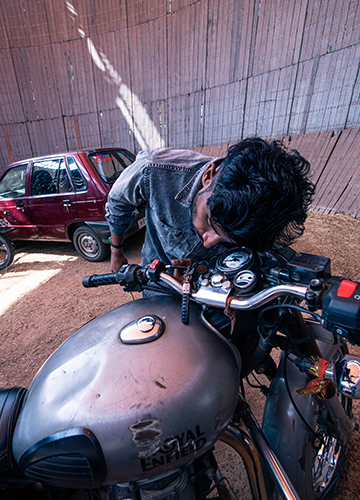 Drive to thrive: A rider checking his bike
Inside the wooden well, Nendhari takes his position. Microphone in one hand, the other resting on the mixer. “The engines roar, the smoke rises high—gather around and witness the well of death!” he calls out. Bhojpuri music blasts through the speakers. He mimics engine sounds, cracks jokes, dances, draws the crowd in. We all go to fairs for thrill. Giant wheels, roller coasters, the Columbus—each demands that the rider surrender to fear. But Maut Ka Kua is the only ride where you witness someone take all the risk; ironically, it brings in the most crowd. Tyagi believes that is exactly where its strange appeal lies. “Here, the audience comes to watch real risk—not manufactured thrill,” he says.
One by one, the engines roar. The vibrations enter your body through the roaring metals.
Badshah rides first. He revs hard until the wooden walls tremble—and, then, suddenly, he is riding them. He circles the vertical walls, inches from the spectators. Hands reach out with currency notes. He snatches them mid-ride, holds them in his mouth, pushes higher, faster—flirting with death. Then, just as abruptly, he slows. Stops. Walks away. Done? No, not yet. Every good story needs a build-up. So come the women.
Rehana and the others ride in—on Bullets, on battered two-strokes—matching the men turn for turn. The engines never really stop. The riders circle, session after session, hour after hour. By evening fatigue sets in.
Back at the tents, Bhandari is at work again. Fresh-cut mutton hangs outside. His knife moves with precision, dropping neat pieces into a bowl of spices that seem almost alchemical. He rarely speaks—but his food does. It takes everyone to keep the well alive.
Night falls. Six people huddle inside a single tent, their closeness helps beat the cold. Outside, the fair falls silent. The engines rest. The well stands still. Morning will arrive sooner than anyone wants and the well, like the men who live inside it, will begin breathing once again.