
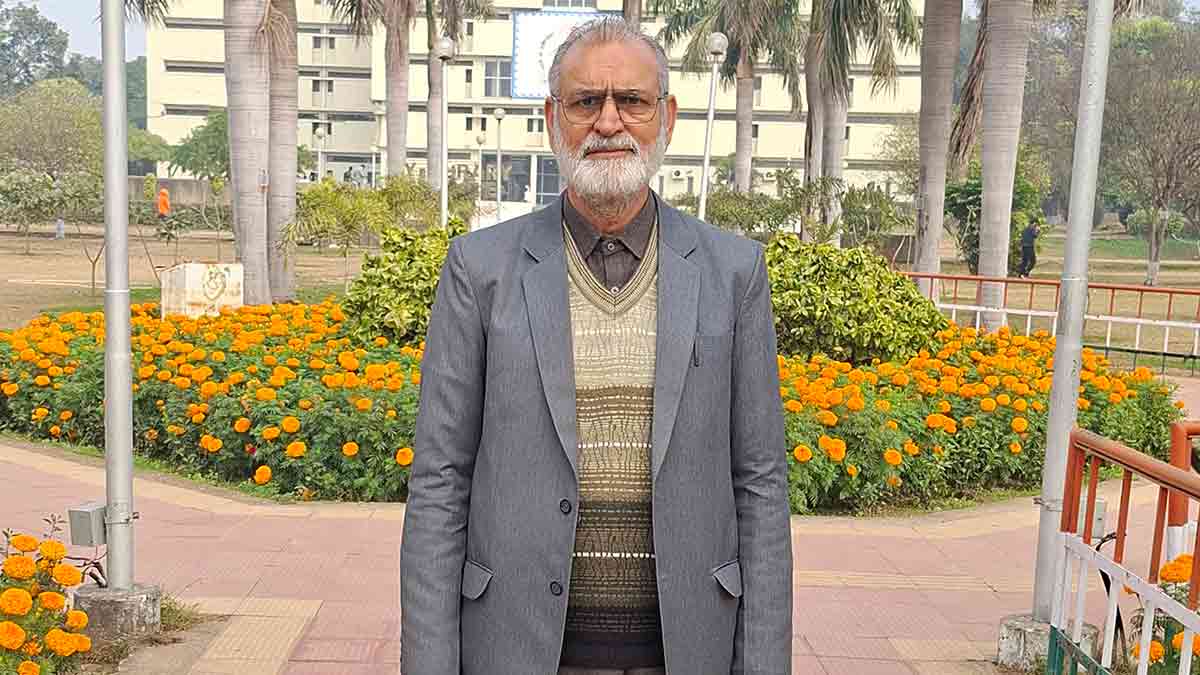
Interview/ G.M. Bhat, former head of the department of geology, University of Jammu
G.M. BHAT, former head of the department of geology at the University of Jammu, is among India’s foremost geologists and a leading authority on the Guryul ravine. A nominee to the scientific board of UNESCO’s international geoscience programme, Bhat has long argued that India’s scientific community failed to prioritise the site’s global importance. In an interview with THE WEEK, he says sustained efforts finally led to the Guryul ravine being notified as a national geo-heritage site, placing responsibility for its protection with the state government. However, construction activity continues within the protected zone. Such work, he insists, is illegal and must stop immediately. Excerpts from the interview:
Q/ What is the current status of the Guryul ravine in terms of UNESCO recognition?
A/ For UNESCO recognition, a site must first be declared a national monument, which was done recently by the Geological Survey of India (GSI). It is then placed on a tentative list that the government forwards to UNESCO. Only after meeting several parameters—such as geological significance, protection status and the scope for long-term preservation—can UNESCO consider it for inscription. If UNESCO grants a tag, the site’s protection becomes assured. At present, responsibility for the Guryul ravine lies with the geology and mining department in Kashmir, although there is no clarity on what steps they are currently taking to safeguard the site.

Q/ How old is the scientific knowledge about the Guryul ravine?
A/ The ravine has been known scientifically since 1837, but it gained prominence in the 1960s when British geologists conducted detailed surveys and investigations. Significant research was carried out by European, American and Canadian scientists, who collected material for global publications. In the 1970s, GSI director H.M. Kapoor collaborated with the University of Tokyo to initiate a ten-year project. Japanese teams measured the site bed by bed, collected fossils, took rock samples and published numerous papers through the 1980s. Canadian geologists followed, with visits continuing until 1987. After the turmoil in Kashmir in the late 1980s, foreign scientists stopped coming, and Indian scientific work remained minimal and largely peripheral.
Q/ Why did Indian scientists not undertake extensive research despite the site’s importance?
A/ That question can only be answered by the concerned institutions. While foreign scientists invested decades studying the site, Indian scientific manpower either lacked focus or failed to prioritise it. Whatever knowledge we have today about the section exists largely because of work done by foreign teams.
Q/ How did your association with the Guryul ravine begin?
A/ In 2007, the department of geology at the University of Jammu marked its centenary with an international conference. I invited Michael E. Brookfield, who has extensive field experience in geology, as a delegate. He was accompanied by an American freelance researcher. The three of us went to the Guryul ravine and spent two days there in April 2007, working intensively on the section. Brookfield later took samples with him, and we published a couple of papers together. This marked the first focused scientific study of the section by Indian researchers.
Q/ Did international interest in the site grow after that?
A/ Yes. Once our papers were published, a geologist from the University of Zurich, Aymon Baud, visited the site with four colleagues. After examining the Guryul ravine, he concluded that it was a superior section. Subsequently, Chinese and Japanese teams became involved, and we resumed work in 2014, leading to further publications. Many geologists collected samples from the site. To an untrained eye, the rocks may appear ordinary, but under the microscope they contain an extraordinary fossil record.
Q/ When did the threat to the site begin?
A/ While Brookfield and I were working at the site, four quarrying mines were permitted to operate there, with approvals granted by the geology and mining department. How this was allowed remains unclear. I warned Brookfield that the site would disappear if this continued. I contacted journalists and sought media coverage, requested Brookfield to publicly explain the site’s importance, and persuaded him to write directly to prime minister Manmohan Singh in late 2007. The issue eventually reached chief minister Omar Abdullah, who was instructed to ensure its protection. Yet, despite directions from the prime minister, it took nearly ten years for protection to be implemented on ground, finally coming into effect in 2017.
Q/ Why are you personally so committed to protecting this site?
A/ This site is my heritage—the heritage of Jammu and Kashmir, of India, and of the world. It had to be protected. I fought everyone. During the militancy years, I personally removed detonators and quarrying machinery, often alone, without considering the consequences. I frequently brought foreign researchers to the site, which required police protection for them, but once they left, I was vulnerable. The mining mafia threatened me, even coming to my home. I stood alone, but there was no alternative.