
SRINAGAR
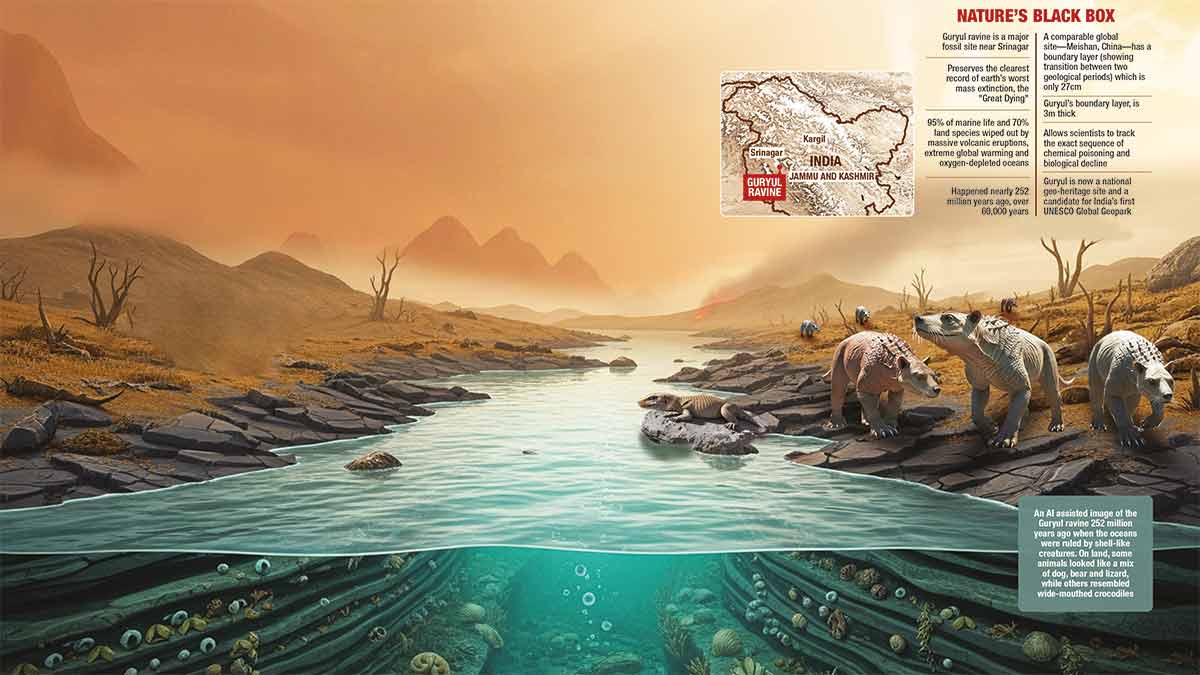
There was a time when there were no birds, no flowers and no grass on earth. The skies were mostly empty, oxygen levels were unstable, the weather was harsh and the oceans were ruled by shell-like creatures.
This was the world 252 million years ago. On land, some animals looked like a mix of dog, bear and lizard, while others resembled wide-mouthed crocodiles. Moss-like corals floated near the sea floor.
Some of the evidence of this prehistoric era is preserved at the Guryul ravine at Khanmoh, 30 minutes drive from the crowded streets of Srinagar. For an ordinary traveller, there seems to be nothing here but rocks. But for geologists, these silent rocks contain clear evidence of a prehistoric world. Preserved within their layers is the record of a unique event known as the “Great Dying”. “It was earth’s biggest catastrophe, which killed 95 per cent of marine life and more than 70 per cent of land species,” says geology researcher Shahrukh Mir. “The detailed secrets of that time can be understood from the Guryul ravine.”
Spread over one square kilometre, with an exposed rock section stretching 1.4 kilometres, the ravine offers a rare look into earth’s most dramatic biological and climatic collapse. The rocks are arranged like pages of a book, recording the breakdown of ecosystems. Each layer reflects a changing environment and shifting oceans.
On October 16, the Geological Survey of India (GSI) declared the Guryul ravine a national geo-heritage site. This status highlights its global scientific value and provides legal protection. It formally recognises that the ravine is not just a local curiosity but a globally important reference site for understanding earth’s history. The site also has the potential to become India’s first UNESCO Global Geopark, joining an international network of sites preserved as natural scientific museums.
Most people are familiar with the mass extinction that wiped out the dinosaurs around 66 million years ago. A massive asteroid, about 10 kilometres wide, struck earth and destroyed nearly 75 per cent of all living species. That event caused sudden and widespread devastation. The Guryul ravine records an even more devastating extinction—the worst in earth’s history—which happened nearly 186 million years before the dinosaurs disappeared. Unlike the asteroid impact, this extinction unfolded over thousands of years. It was driven by rising temperatures, intense volcanic activity, toxic oceans and collapsing food chains.
“Some creatures are very clearly visible in the rocks,” says Ramzan Dar, 61, who lives near the site. “Miners who worked here decades ago used to talk about the prints they could see with the naked eye.”
Abdul Razak Dar, 65, worked as a miner at the site from 1977. He recalls that foreign geologists asked miners to preserve rocks with visible markings. “Whenever we found such pieces and saw some designs on them, we collected them. We found fossilised footprints of birds, maybe animal feet and eggs. From 1998 to 2006, we gave them more than 30kg of such rocks.”
His memories offer a rare human link between scientific research and manual labour on this quiet mountain. During the late 20th century, geologists from the United States, Japan, Europe and China frequented the site. They were drawn by reports of exceptionally preserved fossils, marine shells, plant remains and microscopic organisms locked in undisturbed rock layers.
Mining at the site was stopped in 2006 after the government announced plans to develop a fossil park. “They told us a park would come up here. But we never saw anything. The site was just closed,” Dar says.
For nearly two decades after closing, the ravine remained neglected. It was neither actively mined nor properly protected. There was no fencing, signage or monitoring. This left the site vulnerable to erosion and encroachment, even as scientists continued to describe it as one of the world’s most important Permian–Triassic sections that record the transition between the Permian period (the end of the Palaeozoic Era) and the Triassic period (the start of the Mesozoic Era).
Before mining stopped, Dar estimates that around 30 truckloads of stone were extracted every day. “Our family alone took out four trucks daily. There were no machines then. Around 150 people worked on the mountain on a daily basis,” he says.
Hamidullah Wani, head of the department of geology at Sri Pratap Singh College, Srinagar, says the Guryul ravine offers a detailed deep-water record from the peri-Gondwanan margin of the Neotethys Ocean (the shoreline and shallow-sea regions of the ancient supercontinent Gondwana that faced the newly forming ocean). “It shows a clear link between the extinction event and the onset of anoxic conditions [with no dissolved oxygen], like we see today in parts of several seas, lakes and oceans. The signs of a catastrophe may be reappearing. And we get to know about it by studying the rocks at Guryal,” he says.
The Guryul ravine story begins with the Panjal Traps flood basalts formed by massive volcanic eruptions during the early Permian era. Those eruptions appear to have caused severe environmental stresses that set the stage for the extinction, says Javid Ahmad Ganai, CSIR senior research associate in the department of earth sciences, University of Kashmir, Srinagar. “Above the basalts, fossil-rich sediments document the collapse of ecosystems and their slow recovery. A 200-metre-thick rock sequence at Guryul ravine captures the transition from the late Permian to the early Triassic in remarkable detail,” he says. “What makes the Guryul ravine truly exceptional is the extraordinary level of detail preserved in its rock layers.”
Several sites around the world preserve records of the ancient earth, but the most famous is in Meishan, China. This site is recognised as the Global Boundary Stratotype Section and Point (GSSP), the international benchmark against which all other Permian–Triassic boundary sections are compared.
“The Chinese section is thin and sharp, marked by the sudden appearance of a microscopic fossil called Hindeodus parvus,” says Mohsin Noor, nodal officer for geology and mining at Guryul ravine. “Unlike Meishan’s narrow boundary layer of just 27 centimetres, Guryul ravine preserves a boundary interval nearly three metres thick. This allows scientists to study the extinction as a series of events rather than a single moment—warming seas, oxygen loss, chemical poisoning and biological decline, recorded layer by layer.”
Veteran geologist G.M. Bhat, whose four decades of research helped establish the Guryul ravine as one of the most complete records of the “Great Dying”, regrets that Indian institutions never gave the site enough attention. “GSI director H.M. Kapoor once pushed for the Guryul ravine to be considered as a stratotype,” Bhat says. “China also proposed three of its sites. The competition began in 1990 and continued until 2004.”
China conducted extensive research at all three of its sites. “They studied, excavated and documented everything,” Bhat explains. “But after the late 1980s, hardly anyone came to the Guryul ravine to survey or research. So we had very little new data to present.”
While India had a richer site but little documentation, China, despite its small area, had a lot of evidence. “The International Stratigraphic Commission reluctantly accepted China’s proposal,” says Bhat. Scientific value alone was not enough. Without sustained support, research and documentation, the Guryul ravine lost its chance for global recognition.
Today, that lost opportunity is being reconsidered. The Geological Survey of India has begun detailed mapping of every fossil-bearing layer. The plan is to document the ravine in unprecedented resolution. Scientists believe this effort could revive arguments for recognising the Guryul ravine as a superior global reference section.
Abdul Qayoom Paul, director of GSI Kashmir, says the renewed focus serves several goals. “The idea is to create a high-resolution scientific map that helps the public understand the site and identifies key geological events,” he says. Important layers will be marked with pillars and information boards to support education, awareness and long-term protection.
Despite renewed recognition, concerns remain. Geologists have raised questions about new construction by the State Industrial Development Corporation near the Guryul ravine. “There was no communication from the Department of Industries and Commerce to the geology and mining department before construction began on protected land,” says Noor.
While the core geological section does not fall directly inside the industrial zone, “the GSI has formally informed the administration about the risks posed by nearby construction,” says Paul. These include restricted access to the site and the loss of opportunities for sustainable geo-tourism. Khalid Majeed, director of industries and commerce, acknowledged that he had received the GSI’s letter. “We are trying to understand it,” he says.
Today, Guryul ravine stands quietly between neglect and recognition. As development moves closer and questions of protection remain unresolved, the future of the ravine will decide whether the ancient stories of earth’s darkest hour and slow recovery are preserved or lost.