


Sri Lanka burned, and so did Bangladesh, yet Nepal’s rulers thought the storm would never cross the Himalayas. But discontent soon gathered into a gale that swept away the K.P. Sharma Oli government in early September. A common thread ran through all three fallen structures—the Gotabaya Rajapaksa regime in Sri Lanka, the Sheikh Hasina government in Bangladesh and the Oli dispensation in Nepal: disillusioned youth and entrenched corruption. The rot within the establishment stoked public disenchantment, pushing a new generation to dismantle what they saw as palaces of sin.
Protesters braved tear gas, water cannons and police barricades, and defied curfews to storm palaces that had long served as the rulers’ residences. In Sri Lanka and Bangladesh, the heads of government fled abroad, while Nepal’s prime minister took refuge in army barracks.
Over the past three years, images of frustration in these countries had been spreading rapidly across digital platforms. On July 9, 2022, large crowds barged into the presidential palace at Colombo’s Galle Face. On August 5, 2024, Sheikh Hasina’s residence in Dhaka was ransacked. Last month, Nepal’s youth went further, torching centres of power, from the supreme court to parliament and other government buildings.
The uprisings had roots stretching back years. Large sections of unemployed youth, exposed to the idea of freer, more developed societies through relatives abroad, films and the internet, grew impatient with ageing leaders who failed to respond to their aspirations. They wanted urban amenities, economic growth, better services and a brighter future. But the gulf between the desire for equality and the lived reality of inequality pushed them further away from their rulers.
The leaders, meanwhile, remained oblivious to this shift. Revolt, at its earliest stage, often begins with lament. Frustration with poor governance in daily life gradually translates into a collective sentiment against the ruling dispensation. This pattern was visible in Sri Lanka, Bangladesh and Nepal, where ruling parties paid the price.
“The need of the hour is distributive growth,” says Ambika Prasad, an expert on Nepal politics. “People do not feel truly empowered merely through electoral democracy. They seek economic upliftment.”
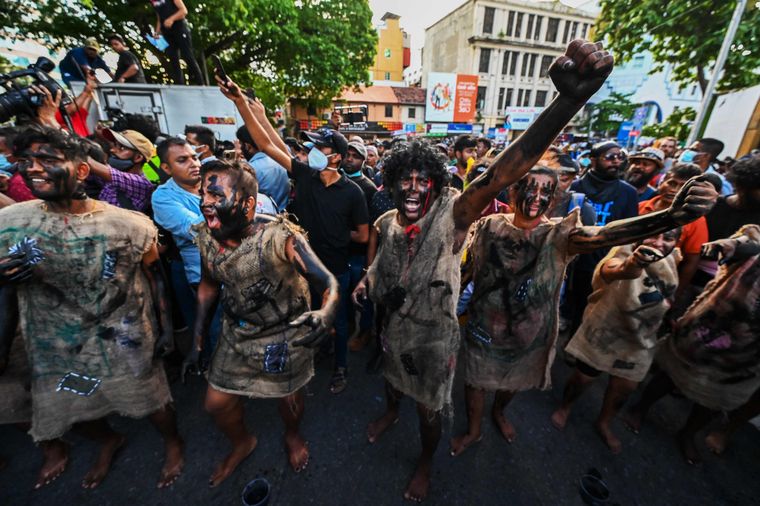 Pressure island: A scene from the 2022 protests in Sri Lanka | AP
Another shared grievance was dynastic politics. “Democracy in these countries has often been reduced to family-run parties. In third-world countries that have failed to deliver economic and social justice, the stability of the state has eventually come under threat,” says Prasad. “By contrast, capitalist countries have managed to provide social security to the downtrodden. Simply electing a democratic government does not bring justice.”
Sri Lanka’s crisis was triggered in April 2021 when the Rajapaksa government abruptly banned chemical fertilisers, ordering a switch to organic farming. The move crippled agriculture and worsened existing hardship in the form of fuel shortages, long power cuts, dwindling foreign reserves and an economy in free fall. Covid lockdowns and the collapse of tourism added to the misery. Within weeks, candlelight vigils gave way to mass protests. By mid-2022, the movement known as Aragalaya had spread across the country.
“There were around 50 organisations or people’s movements involved in the protests,” says Chameera Dedduwage, a digital marketing strategist and activist. “We met frequently to take decisions and give structure. The core group had around a hundred people from different backgrounds.” For him, the turning point came in March 2022, when he joined friends on the streets, convinced it was time to raise his voice against corruption.
Nepal’s protests showed a similar pattern. Scattered groups of Gen Z activists coalesced into a broad anti-corruption front through social media. In Bangladesh, the spark came with the quota reform movement, initially a demand for fair access to government jobs. “The quota reform that began as a demand to end inequity and unfairness in accessing government jobs quickly turned into a wider, home-grown call for overthrowing Sheikh Hasina’s fascist regime,” says Dr Ziauddin Hyder, adviser to the Bangladesh Nationalist Party chairperson and a former World Bank health and nutrition specialist. “The aspiration was to restore human rights and democracy, reduce corruption and secure accountability and, finally, to build an equitable and prosperous Bangladesh.”
Once a state fails to address uncertainty, especially inequality in health care, education and the legal system, conflict in society becomes more pervasive, says Dr Umashankar Prasad, former member of Nepal’s Planning Commission. “The major issue in South Asia after Covid is uncertainty. People are struggling for their basic needs. In Nepal, with 30 million people, and in India, with 1.4 billion, many feel insecure about their future, whether in health care, education or legal protection. If you compare this with Nordic countries, you will find far less uncertainty. Their health, education and legal systems are guaranteed by the government. This assurance reduces inequality and strengthens social stability.”
In Nepal, the political class was on autopilot, enjoying privileges while leaving the bureaucracy to run institutions with little accountability. Their arrogance fuelled resentment, and anger soon engulfed the entire political-bureaucratic system. The youth uprising forced officials into hiding, raising stark questions about the misuse of public funds at the cost of welfare.
Pakistan, too, has faced periodic upheavals, but its centralised, military-led system has been more effective at suppressing dissent. In Sri Lanka, Bangladesh and Nepal, flawed democratic institutions allowed unrest to erupt openly.
These three cases stand as reminders that silence should not be mistaken for stability. Today, South Asia’s youth are not only toppling governments but seeking to draft a new social contract—one in which future generations may not hopelessly wait for promises to get fulfilled. Whether these revolts yield lasting systems of growth and justice or collapse into yet another cycle of betrayal and corruption will define Gen Z’s political future in the subcontinent.
—With Lakshmi Subramanian
THE LEADERS NOW
SRI LANKA
Galwewa Siridhamma Thero
Former Inter-University Bhikku Federation convener; continues as activist monk
Melani Gunathilake
Climate activist; researcher with Law and Society Trust & IPE. Works against legal persecution of protesters
Wasantha Mudalige
Former convener of Inter-University Students’ Federation; now leader in People’s Struggle Alliance, still facing legal cases
BANGLADESH
Muhammad Nahid Islam
Convener of the new National Citizen Party (NCP), founded by the student-youth movement
Asif Mahmud
Adviser in the interim government with a focus on youth and local government
Sarjis Alam
Chief organiser (Northern Region) of the NCP. Remains a vocal political figure, pressuring the interim government on reform goals
NEPAL
Sudan Gurung
Founder of Hami Nepal. Attempting the shift to a non-party, civil society-based mobilisation model
Ojaswi Raj Thapa
A young cafe owner. Represents the younger, digitally-native members of the movement
Balen Shah
Rapper and structural engineer who won the Kathmandu mayor race as an independent. Not a direct leader of the protests