



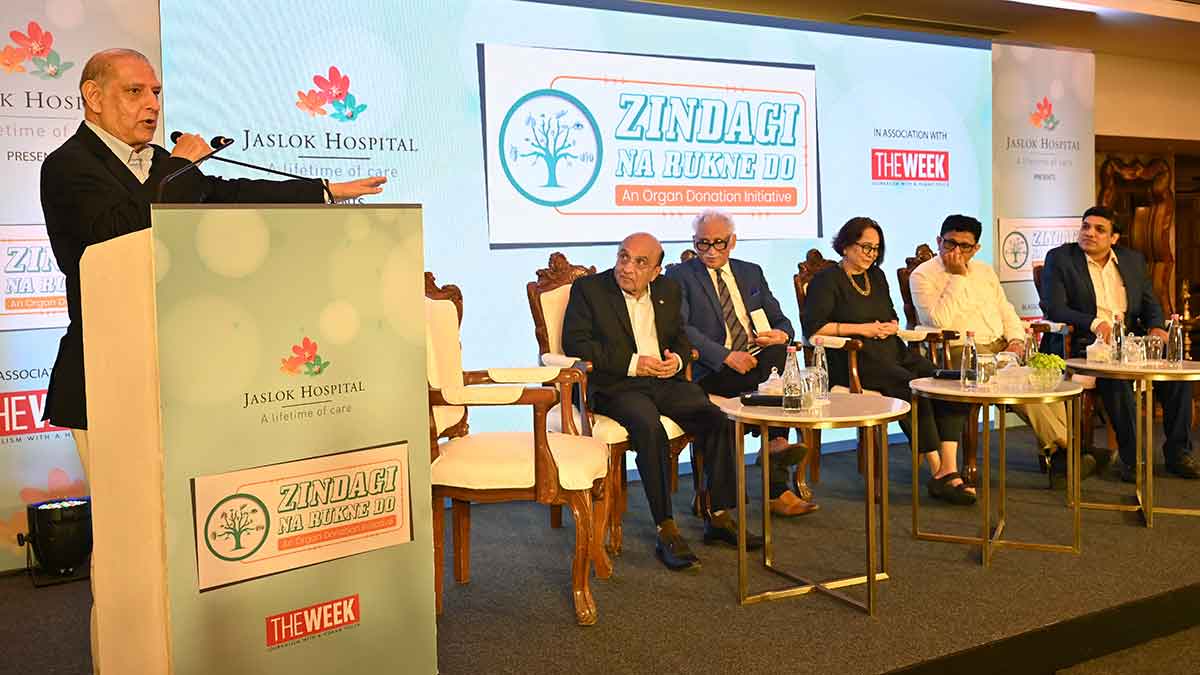
ORGAN DONATION IS not just about saving lives, it is about giving life a second chance.' With this important message, Jaslok Hospital and Research Centre, in association with THE WEEK, hosted an evening dedicated to raising awareness on the need for organ donation. The event in Mumbai on August 26, titled ‘Zindagi Na Rukne Do’, brought together policymakers, doctors, donor families and recipients in an effort to break the silence surrounding this urgent health issue.

The event began with a ceremonial lamp lighting led by Jaslok Hospital CEO Jitendra Haryan and senior dignitaries including Jaslok Hospital Chief Medical Officer Dr Milind Khadke, Jaslok Hospital Chief Marketing Officer Bhavesh Phopharia, THE WEEK Chief of Bureau, Mumbai, Dnyanesh Jathar, and THE WEEK Resident Chief General Manager Shree Kumar Menon.
Maharashtra Health Minister Prakash Abitkar and Brand Ambassador for the initiative Amruta Fadnavis joined in via video message.
In his welcome address, Haryan spoke about the hospital’s long-standing legacy of pioneering health care and its commitment to leading the organ donation movement. “Few decisions in life carry the power to turn grief into hope and a new beginning, and organ donation is one of them. Whether from a living donor or a cadaver donor, it is the ultimate expression of humanity, where compassion becomes a bridge to life. Through ‘Zindagi Na Rukne Do’, we highlight this truth, reminding everyone that the power to give life rests in their hands, waiting for the couarge to act.”
Abitkar, in his keynote address, underscored the government’s role in building stronger systems for transplants. “Our state has the expertise and the institutions. What we need is public awareness and trust to bridge the gap,” he said.
Jathar highlighted the magazine’s editorial mission. “From breast cancer awareness to Parkinson’s and now organ donation, THE WEEK has consistently championed journalism with a human touch,” he said.
Fadnavis delivered an emotional note, urging citizens to view organ donation as a noble social responsibility.
The first panel titled ‘Organ Donation: Breaking the Silence, Saving Lives’ featured a distinguished line-up of doctors: Dr Sanjay Nagral, Director, Surgical Gastroenterology (Academics & Research); Dr M. M. Bahadur, Director, Nephrology (Administration); Dr Indraneel Raut, Additional Director, Critical Care; Dr Pettarusp Wadia, Consultant, Neurology & Lead Movement Disorders; and Dr Shruti Tandan, Consultant, Critical Care.
The discussion highlighted persistent myths that discourage families from consenting to donations. Panellists called for streamlining hospital protocols, increasing public trust in the system, and sensitising families during critical moments.
This was followed by a moving testimony from a deceased donor’s family member, who shared how one person’s decision gave hope to others.
The second panel, ‘One Gift, Many Lives: The Impact of Organ Transplants’, was moderated by Dr S.K. Mathur, President, Zonal Transplant Coordination Centre, and brought together some of the country’s top transplant specialists: Padmabhushan Dr A.B. Mehta, Director, Cardiology; Dr Shailesh Raina, Director, Urology; Dr Aabha Nagral, Director, Gastroenterology & Chief Hepatologist; Dr Rushi Deshpande, Director, Nephrology (Academics), and Dr Upendra Bhalerao, Consultant, Heart Transplant Surgery.
This session focused on the transformative impact of transplants—not just on patients, but also on entire families. Panellists emphasised India’s shortage of organ donors despite having advanced medical capabilities.
The audience heard heartfelt testimonies from Ronak Bhatia, a liver recipient, who shared the joy of regaining normal life, and Dinesh Nagda, a kidney donor, who spoke about the fulfilment of saving another’s life.
The evening concluded with a vote of thanks by Khadke, who reaffirmed the hospital’s commitment to strengthening organ donation systems.
As the event drew to a close, the message was clear: organ donation is not merely a medical intervention, but an act of humanity. In the words of one panellist, “One decision can ripple across generations—a single donor can save multiple lives.”
