


Since class seven, Sadiq Ali Mir, 21, from Jammu and Kashmir, has been nurturing a dream—to be an aerospace engineer. This year, that dream grew wings. Mir, a fresh aerospace engineering graduate from RV College of Engineering (RVCE) in Bengaluru, was chosen as an astronaut candidate for engineering and development with Titans Space Industries Inc, a private aerospace company in the United States. If all goes well, Mir will be a part of the company’s first space mission in 2029.
The selection process at Titans Space was tough—Mir faced detailed tests and interviews with senior leaders, including CEO Neal Lachman and chief astronaut William McArthur Jr, also a former NASA astronaut. His strong academic performance and leadership in student aerospace projects helped him secure a place. The 2029 mission will include orbital operations, space-based research and long-term living in space. Alongside preparing for the mission, Mir has also been accepted into a master’s programme in space systems at Kepler Space University in Florida.
There are many young minds like Mir in India. Shubhanshu Shukla, the first Indian to travel to the International Space Station, recently remarked that one of the most rewarding aspects of the Axiom-4 mission was inspiring young Indians to dream of space. Shukla recalled his live interactions from the orbit with school students, and said that they often asked how they could become astronauts. “The good news is that ISRO [Indian Space Research Organisation] and India are ready to make these dreams a reality,” he said.
For Srimathy Kesan, founder and CEO of Chennai startup Space Kidz, space missions with youngsters has always been about breaking barriers and proving that age, background and privilege can never limit imagination. Her journey began with Kalamsat, the world’s lightest satellite—just 64g—built by high-school students and launched by NASA in 2017. Kalamsat was more than a payload; it was the spark that ignited the minds of 750 girls from government schools across villages in India to build AzaadiSAT, a constellation satellite, on India’s 75th year of independence in 2022. For many of the girls, it was their first exposure to science beyond textbooks. Only 14 to 19 per cent of girls get a real chance to pursue science, said Kesan, citing research, but given the platform, they shine as bright as the stars they seek. And now, Kesan is the mission director of ShakthiSAT, where 12,000 girls from 75 rural government schools, joined by young dreamers from 108 countries, are coming together to build a historic satellite to the moon.
“Together, these children are proving that space has no boundaries, and neither does human courage,” says Kesan. “We are building not only a satellite, but a new generation—a powerful group of girls from humble backgrounds, each brilliant in her own right, now given the opportunity to rise.”
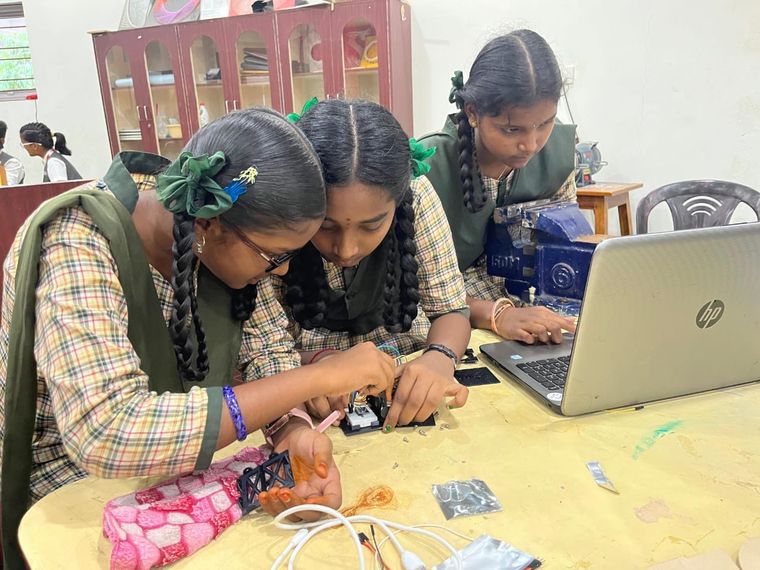 Catch ‘em young: Students at a recent workshop on satellites organised by Space Kidz in Tirupati.
Pawan Chandana, cofounder of Hyderabad-based Skyroot Aerospace, which launched India’s first private rocket, Vikram-S, in 2022, says there has never been a better time to be a young entrepreneur in India. “In the early days, you may run into hurdles around funding or policy, and that can feel discouraging. But the good thing is, India now has a support system that backs risk-takers,” he says. “The government sees the value startups bring, not just in returns for investors, but also in building new capabilities for the country in areas we have never been strong in before.”
When Chandana launched Skyroot in 2018, India did not have a policy or legal framework for a startup to launch a rocket. But “within a couple of years, the government opened the space sector and established IN-SPACe, dedicated to encouraging and promoting bold ventures in space technology,” he says. And that has led to several startups led by young entrepreneurs that are making waves in the space sector. For instance, Bengaluru-based Pixxel is working on hyperspectral imaging satellites that could help in monitoring crop health, mapping minerals and tracking pollutants. Then there is Agnikul Cosmos in Chennai, which focuses on customisable rockets. Its rocket, AgniBaan, is designed like a Lego, with the number of engines to the launch location determined by the customer. In March 2024, Agnikul Cosmos launched its SOrTeD-01 vehicle, marking the first single-stage launch of a vehicle powered by a semi-cryogenic engine from Indian soil.

The foundation of this space revolution lies in education and outreach programmes. “Universities are offering certificate and diploma courses in space science and technology for young students, while several online platforms offer courses related to space science, with content suitable for young learners,” said space analyst Girish Linganna. “The practical aspect of space education is becoming increasingly important, with students now working on actual space missions rather than just theoretical projects.”
For instance, IIT Roorkee’s Centre for Space Science and Technology (CSST) started its PhD programme in 2023, and today its PhD scholars are engaged in cutting-edge research, including composite materials for space applications, space structure, space mechanism and radar systems. CSST has also signed 15 MoUs with premier ISRO centres and reputed research organisations, thereby enabling its PhD and MTech students to undertake internships and dissertation projects (the MTech programme was launched in 2024).
Praveen Sharma, who is doing his PhD in radar-based remote sensing, worked on an “an IIRS [Indian Institute of Remote Sensing]-ISRO funded project on satellite-based landslide early warning system”. Likewise, Vikram Kumar Verma, an MTech student, did his internship at ISRO’s Space Applications Centre in Ahmedabad, where he worked on a project related to reflectarray antennas. Then there is Major Ashutosh Sharma of the Indian Army, who is also doing his MTech from CSST. “This niche technology area is highly relevant to the defence and strategic sectors, making the programme not only academically enriching but also nationally significant,” he said.
Mir’s alma mater RVCE is a pioneer in student satellite development. Their ‘Team Antariksh’ developed RVSAT-1 that joined ISRO’s historic SpaDeX (Space Docking Experiment) mission in December 2024. “RVSAT-1 is designed to study the growth of Bacteroides thetaiotaomicron, a gut bacterium, in space,” said Linganna. “This research aims to improve astronaut health, develop advanced antibiotics and create recycling systems for long-duration space missions.”
India’s space tech sector is poised for transformative growth, with an ambitious goal of achieving a $44 billion space economy by 2035. This target isn’t just about economic growth; it represents the dreams of millions of young Indians who see space as their calling.