


AT A RECENT graduation ceremony in Mumbai, a man in his eighties stood out. He was no parent, neither a professor, yet there he was, standing quietly in the crowd. When the young woman on stage saw him, she broke into a smile, walked down, and pulled him into the frame. “He is the most special person in the crowd,” she said, wrapping an arm around him. To her, he was family. The applause that followed was not just for her. It was for the bond they had built—one weekly visit at a time. That moment was not staged. It was a snapshot of the ethos of The Goodfellows, a social enterprise that pairs young adults (called goodfellows) with grandpals—senior citizens who live alone or crave meaningful companionship. In that college, at that time, it was a grandpal who had come to attend the graduation ceremony of his goodfellow.
The WhatsApp group chat of The Goodfellows buzzes with glimpses of more such heart-warming interactions. There is a video of an octogenarian opening a birthday card she had made for her college-going goodfellow Kartik. Then there is a selfie that a young Vaibhav took along with his Anuradha aunty inside a metro, her first ride after years of being home-bound.
India is growing older. With more than 150 million citizens aged 60 and above and rising urban migration among younger generations, a silent crisis is brewing—that of isolation. The Goodfellows didn’t come from a think-tank or business plan, but out of one young man’s decision to spend time with an elderly couple during the Covid-19 lockdown. “Uncle and Aunty Punjabi fed me well,” says founder Shantanu Naidu, 33. “I gave them my time.”
That gift—time—turned into the company’s mission. “I realised companionship was missing from the lives of our elderly,” says Naidu. “And I thought, what if we made that the central offering?”
Naidu pitched the idea to Ratan Tata, his mentor and close associate from his early days as a Tata employee—he started as an engineering intern in 2009 and eventually became an assistant to Tata and is now the general manager, head - strategic initiatives at Tata Motors. Tata not only endorsed his idea but also invested in it. When the startup launched in 2022, it did so with credibility and care.
The idea initially took shape at Naidu’s Colaba home in Mumbai, where THE WEEK met him and cofounders Niki Thakur, 25, and Gargi Sandu, 30. Thakur says the idea filled a gap she felt by being away from her grandparents who live in Nepal. For Sandhu, who knew Naidu as a close friend, the idea was a natural, given her “deep bond with her ajji”. Her grandmother is part of almost all of the company’s meetups, events and workshops.

“We don’t offer medical care, we offer time and that is the only central philosophy of The Goodfellows,” says Naidu, as he pets his golden retriever Winter and labrador Zoey. It is the three of them who interview and shortlist goodfellows and warn that it is not easy. It is a mix of both formal education and humane instincts, they say, and one can definitely not prepare for this job; it simply comes from within. “We are not just looking for empathy,” says Sandhu. “We are looking for reliability, grit, a kind of presence that can weather silence.”
When they first started, they had no idea how people would respond. But the pilot lit a spark. Rupesh, 22, one of the first goodfellows and Thakur’s brother, still remembers his early visits to Mukund Sule, a retired banker living in Thane. “It was informal, almost experimental,” he says. “We didn’t know if this would work. But right away, there was a bond.” That bond still holds. “He is family now,” says Rupesh. “I have had many grandpals, but Mukund uncle—he is a constant in my life.”
Another of his grandpals are the Kerkars. Inside their home in Thane, the dynamic is unmistakable. Pratibha Kerkar hands Rupesh a list of groceries. He switches off the gas while walking out. He knows exactly where Satchidanand uncle’s reading glasses are kept. “It is like we have a son now,” says Pratibha. Rupesh not only helps with doctor visits and bank errands but checks in on them during late nights, sets reminders, saves contacts and just hangs out with them. “This is my second home,” he says, sipping sambar over a game of memory blocks. Pratibha has made fresh idli sambar and halwa at home, in anticipation of Rupesh’s coming. “I love to cook. We have a cook, still I do it whenever I feel like it. Rupesh loves idli sambar and so I thought of making it. Now that my daughter isn’t here, it is nice that he keeps dropping by. There is someone to appreciate my cooking,” she says, with a wide grin. Rupesh brought the memory blocks as per the instructions from the department of psychometry at The Goodfellows. “This helps them in building cognition and exercises their mind. There is a purpose to everything we do,” he says.

The matches are not random. Every goodfellow is paired with care. “We use psychometric tools and in-depth interviews to ensure a good match, and most importantly emotional compatibility,” says Thakur. “Of 10 applicants, only two or three make it through.” But what if the pairing goes wrong? “Our goodfellows have high levels of empathy and compassion; they are carefully chosen,” says Naidu. “We cannot go wrong there. That is the core of what we do. These individuals are bright and have their heart in the right place. Loneliness is not solved by just having people around you. You have to feel seen, heard and loved.”
Anjali Uchlani, 21, joined The Goodfellows seven months ago while doing her graduation via distance education. She discovered the initiative while writing to Naidu about Motopaws, his animal welfare NGO. “He told me, ‘Join Goodfellows instead.’ I had no idea it would change my life,” she says. Her first grandpal, Veer Mohini Juneja, loved Akbar-Birbal stories. So she would buy second-hand books, read a couple of them before leaving for his home and then read them out loud to him, mimicking voices and adding flair. “I have never read these many even as a kid,” she says, laughing.
But it was with Anaadi Shankar Tiwari, founding member of Sahara and Satellite TV, that the bond turned profound. It took them time to connect, little by little. Today, Tiwari is teaching Uchlani Bengali. Her time spent with grandpals become dinner conversations with her parents. “They are so proud of me,” she says, blushing. There is a quiet grief, too, in these relationships. Tiwari keeps a photo of his late wife on the wall. “He looks at it when he thinks nobody is watching,” says Uchlani. On Tiwari’s advice, she is now developing an animal rescue app.
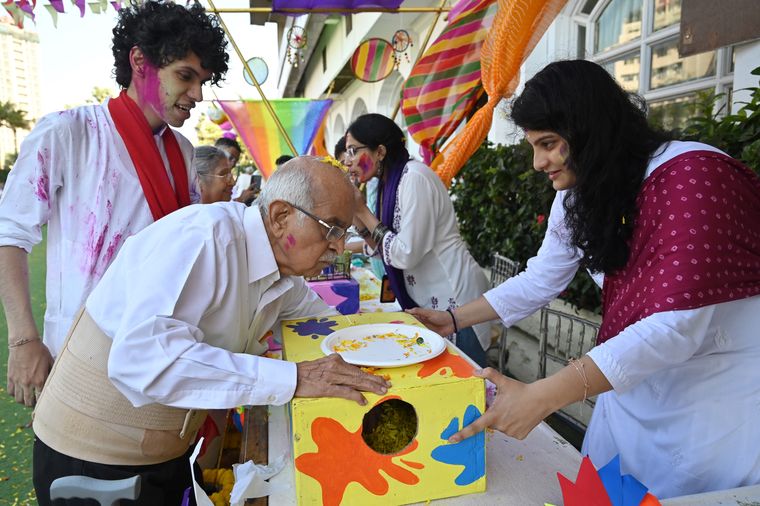 Fun and games: A grandpal takes part in an activity during the Holi celebration by The Goodfellows | Amey Mansabdar
One of the standout memories for Uchlani was attending a Goodfellows workshop with Tiwari. The session, part of the ‘Mind & Moment’ initiative, was designed to engage seniors through music, games and memory work. “He told us the session was too easy—he wanted more cognitive stimulation,” says Uchlani. “He pushes us to do better.” Numerous workshops and events keep happening and every festival and occasion is celebrated to the fullest, says the team.
In March, at the Taj Lands End in Bandra, The Goodfellows hosted its first large-scale Holi celebration—no harsh colours, no thumping EDM, just a gentle ‘Phoolon (flowers) ki Holi’. Grandpals arrived with their goodfellows, not families. There was thandai (a spiced cool drink), sweets and music from the 1960s and 1970s. “For the first time in years since my husband passed, I celebrated Holi,” says Mrs Mehta. Her goodfellow, a student, had insisted she come, even driving her all the way to Bandra. “I felt seen,” says Mrs Mehta, tears forming. “This was for us oldies. That doesn’t happen often.”
And in August, they celebrated Friendship Day, too. “I don’t remember the last time I even acknowledged the existence of such a day. It is as if we are just opening to life beyond the routine, with these youngsters who keep our spirits high at all times,” says a sassy Ajji, who prefers to be referred to as such.
“They are not scared of time, they are scared of being invisible,” Naidu chips in. “Even if they do not have the memory, they feel the love and they feel the joy and we must continue giving them that.”
The Goodfellows headquarters in Fort looks more like a university dorm than a startup. “We rotate between departments—marketing, psychology, logistics—and then we all go on visits,” says Chhaya Jagtap, a goodfellow in her early 20s. Each visit lasts at least two hours, more if needed.
Back in south Mumbai, Vijay Sehgal, 81, sits down for a chat with his goodfellows, Pooja Gosavi, 26, and Sakshi. While Pooja has known him for two and a half years, Sakshi came into his life a few months ago. Sehgal joined the startup within two months of its launch. At first, he had doubts—“What do I talk about with a 24-year-old?” Now, Pooja is the first person he calls—for movie bookings, phone issues, even small decisions. “She threw me a surprise birthday party,” he says, grinning. “She coordinated with my kids, called my old friends, my colleagues. I was stunned.” She smiles. “He never admits he is wrong though,” she says, cheekily. He laughs. “That’s because I never am.” Their banter says it all. There is warmth, just like with family.
Every grandpal has a designated point of contact, usually a family member, whom the goodfellows update regularly. Sehgal’s daughter lives in Mumbai and son in Gurugram. “I live alone out of choice, not compulsion,” says Sehgal, who lost his wife 23 years ago. “The goodfellows come to me for two hours, every alternate day, thrice a week.” They have accompanied him on doctor visits, often being mistaken for his family. “They take down notes and that helps because I forget as soon as the consultation is over,” he adds. “The love and affection that I get from these youngsters is unparalleled. It is a dream for any senior citizen of today.”
With successful pilots in Mumbai, The Goodfellows is expanding into Bengaluru, Pune, Kochi and Hyderabad. “Every city has its rhythm,” says Thakur. “But the loneliness is universal.”
For goodfellows like Uchlani, it is not the salary or perks but “that look in their eyes when you enter the room. Some grandpals sit by the door, waiting,” she says. “When you arrive, it is like someone turned the lights on.”
The Goodfellows is not a charity. It charges a subscription—affordable and partially subsidised through private donations. But its core promise remains emotional dignity. “We are not here to fix anyone,” says Naidu. “We are here to be with them.”
In a world that often forgets its elders, The Goodfellows is remembering. Not with speeches or slogans. But with presence. A hand held during a walk. A shared story. A late-night call.