



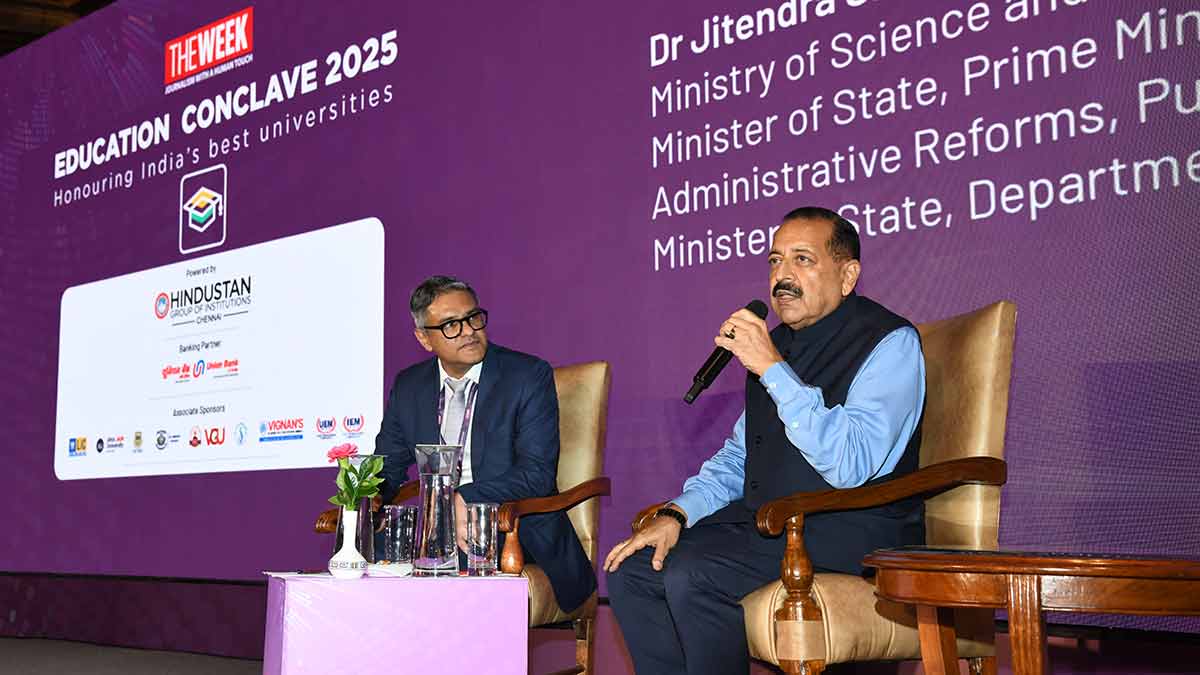
At a time when India stands at the cusp of a transformation in education powered by AI, shaped by the National Education Policy (NEP) 2020, and challenged by questions of access, ethics and employability, THE WEEK Education Conclave 2025 brought together some of the most compelling minds in academia, government and civil society. Held in New Delhi on July 30, the conclave served as a forum for examining how India can truly democratise education while preparing its youth for a dynamic, yet unpredictable future. As India looks ahead to 2047, marking 100 years of independence, the conclave imagined what it would take to build a truly ‘Viksit Bharat’ through education.
Dr Jitendra Singh, minister of state (independent charge) at the ministry of science and technology, and minister of state in the prime minister’s office, was joined by policymakers like former UGC chairperson Jagadesh Kumar, Shashi Tharoor MP, and institutional heads and thinkers like National Human Rights Commission secretary general Bharat Lal at the day-long event. The conclave was a kaleidoscope of insights, candour and vision outlining the roadmap to world-class education for Indian students. The central themes of values in education, technological integration, social equity, mental well-being and the need for mindset shifts resonated deeply with the audience.
Dr Singh said India was no longer a seeker, but was being sought after, marking a pivotal shift in the country’s education and innovation leadership. Once a follower, India has now emerged as a nation that others look up to, reinforcing its global stature across science, technology, education and talent spheres.
The minister emphasised that today’s youth must lead the global movement in innovation and science. He highlighted the critical role of AI and emerging technologies in propelling India’s educational ecosystem forward and contributing to the nation’s evolving global identity. He introduced his “3A Formula”—Awareness, Aptitude and Avenue—as the framework to guide young talent towards their full potential and destiny. He noted India’s success in not only absorbing global knowledge but also influencing global trends, especially in space science, research and higher education. Dr Singh also called on universities, startups and industry to break out of silos and forge stronger collaboration for innovation.
Tharoor, in a conversation moderated by Riyad Mathew, Chief Associate Editor and Director of THE WEEK, challenged the outdated colonial constructs still embedded in the Indian education system. “We are producing job seekers, not job creators. And, more worryingly, we are still pushing our best minds abroad,” he said, referring to the country’s long-standing issue of brain drain. With his characteristic wit and historical sweep, Tharoor questioned the Anglocentric bias that still dominated elite Indian education. He called for greater embrace of Indian languages, including “Hinglish”, a hybrid that he said could make knowledge more accessible. “Why should we judge intelligence through an English-medium prism?” he asked, questioning why rural talent is often filtered out of top opportunities due to linguistic bias. Tharoor advocated for an education system that balances employability with creativity and emotional depth, echoing other speakers on values and ethics.
Setting the moral tone of the day, NHRC secretary general Bharat Lal spoke about the need to embed ethics and values into the very fabric of education. “We need to teach our children how to think, not just what to think. Sympathy, compassion and acceptance are not optional, they are foundational,” he said. He argued that India’s unique civilisational ethos, rooted in diversity and spiritual pluralism, offered a rich value system which modern education must reclaim. “If we are to create responsible citizens for 2047, we must teach values, not just degrees. All religions in India speak of acceptance, compassion and duty. These must enter classrooms,” he said, drawing applause. He also urged institutions to go beyond textbook reforms and truly invest in character-building and emotional intelligence. His call was poignant in the context of rising student distress and mental health challenges.
In a forward-looking session, former UGC chairperson M. Jagadesh Kumar focused on the impact of AI on education and India’s aspiration to become a developed nation by 2047. “We are moving into an era where routine knowledge is no longer enough. AI will automate much of what we teach today. Our job is to equip students with the ability to ask the right questions, not just give the right answers,” he said. Highlighting NEP 2020’s push for flexibility, digital learning and skill integration, Kumar said India’s youth can be global leaders if given equitable access to emerging tools. “We must ensure that the benefits of AI and digital tools reach not just the top 10 per cent but the last-mile learner in the most remote villages,” he said. Kumar also emphasised environmental sustainability, social equity and inclusiveness as pillars of his vision of a Viksit Bharat.
Professor John Varghese, principal of St. Stephen’s College, Delhi, spoke about the pressing need to reimagine Indian education to match the demands of a globalised world. “Education today is no longer confined by geography. We are part of a global landscape, and India has the potential to lead,” Varghese said. Citing the global success of Indian students at top universities, he stressed that both the government and the private sector must collaborate to unlock this potential. He welcomed the NEP as a positive shift but acknowledged its limitations. “The NEP is a step forward, but it doesn’t address every challenge. We have identified significant gaps that still need attention,” he noted.
Varghese also drew attention to the widening lag between technology and institutional adaptability. “Technology changes every three months. Students catch up in six. Teachers take two years. Institutions? Five. This disconnect leaves students underprepared,” he remarked.
Joining the conversation, former ISRO chairman S. Somanath posed a fundamental question: “Are we focused on building world-class students or should we first aim to build world-class institutions?” He argued that excellence in individuals must stem from the quality of the institutions they belong to. Highlighting the situation in Kerala, Somanath pointed out that thousands of higher education seats remain vacant not because of a lack of ambition among students, but because institutions are not seen as aspirational. “World-class status is not built overnight,” he said, advocating for sustained investment in institutional quality and long-term vision. He also flagged the mass migration of students from regions with weak educational ecosystems. “If society does not view an institution as high-quality, it will fail to attract both top students and top faculty,” he said, stressing the need for urgent improvements in institutional standards, especially in engineering education where many colleges deliver sub-par outcomes.
Dr Biswajoy Chatterjee, vice chancellor of the University of Engineering and Management, Jaipur, took on the widening disconnect between engineering education and industry demands. “Many colleges today are struggling either with too many seats or too few takers. We need to reassess their relevance and output quality,” he said. Dr Chatterjee cautioned that technical skills alone are not enough. “A technically proficient person without values or character can be harmful to society. We must focus on producing responsible individuals, not just skilled workers,” he said.
Dr M. Srinivas, director of AIIMS Delhi, added that institutions like AIIMS were setting global benchmarks in education and health care delivery. “The key lies in building a high-quality ecosystem, one that adapts quickly to emerging challenges and evolving aspirations.” He cited examples of modernisation at AIIMS, including advanced simulation labs, digitised platforms and research-driven collaboration opportunities. The objective, he said, was to move beyond exam-oriented learning to a system that fosters meaningful contribution to the nation and the global south. Dr Srinivas also addressed the critical gap in indigenous medical technology. “Over 80 per cent of our medical equipment is still imported. At AIIMS, we are now working with Indian manufacturers and innovators to reduce this dependency and develop home-grown solutions.”
Dilip Chenoy, former head of the National Skill Development Corporation, pointed out the urgency of change. “Learning is no longer linear. Knowledge doubles every day, but teaching hours remain the same. We must scale up. Many engineering courses don’t match market demands. The first two years of college do not translate into hands-on skills. If we want graduates to be industry-ready from day one, we must revamp our systems accordingly.”
Underscoring the importance of Indian education, Dr Lata Suresh, who heads the Knowledge Resource Centre at the Indian Institute of Corporate Affairs, said much of the educational strength was returning to India. “The NEP should have been implemented long ago. It promotes a multidisciplinary approach—something we practised in ancient times,” she added, criticising the rote-learning model introduced by Macaulay’s system and emphasising the NEP’s potential to be revolutionary. “What industry needs today is creativity, innovation and skills. We must embed research and development into the curriculum right after 10+2. The curriculum must be aligned with industry needs,” Suresh said.
Nakul Kumar, co-founder and CMO of Cashify, spoke about his entrepreneurial journey and the idea of creating a smartphone reselling platform: “When I started, I had a safety net. I didn’t have to worry about how my parents would survive if I didn’t earn. That cushion let me take risks.” Setting up Cashify in 2013, Kumar faced setbacks. “Two ventures failed, two worked. The key lesson is never give up,” he said. “If you survive five or six years, you thrive. Eventually, you rule.”
Throughout the conclave, certain themes echoed with urgency: values and ethics, mental well-being, teacher training, industry alignment and regional equity. Speakers agreed that India’s educational reform cannot merely be cosmetic. Tweaking syllabi or digitising classrooms will not be enough. What is needed is a shift in spirit, purpose and imagination.
THE WEEK Education Conclave 2025 ended not with applause alone, but with a renewed sense of resolve. The journey to a Viksit Bharat begins in the classroom but it must touch every mind, every heart and every home. The conclave did not end with easy answers but it did offer a clear mandate: India’s education system must evolve, not just in syllabi or screens, but in spirit. From value-based learning to AI integration, from mental health awareness to skilling for tomorrow, the conclave laid out a roadmap that is bold, inclusive and rooted in Indian realities.
