


BORDERING CHHATTISGARH and Telangana, Gadchiroli had long been a Maoist stronghold. But in recent years, security forces have gained the upper hand, neutralising several Maoists and forcing many to surrender. The district in Vidarbha is now witnessing a wave of developmental projects and fresh business investments.
Chief Minister Devendra Fadnavis, who is also the home minister and guardian minister of the district, dreams of transforming Gadchiroli into a steel hub. “We are well on the way towards fulfilling that dream,” he said a month ago, while laying the foundation stones for a slew of projects, including a 4.5 million tonne per annum (MTPA) integrated steel plant by Lloyds Metals and Energy Limited (LMEL).

Fadnavis also inaugurated LMEL’s 4 MTPA pellet plant at Konsari and laid the foundation for a township in Somanpalli, a 100-bed hospital and a CBSE school in Konsari. An 85km slurry pipeline and an iron ore grinding unit at Hedri were also launched. “A massive socioeconomic transformation is taking place in Gadchiroli since Lloyds Metals began industrialisation in the district. The rapid pace of change will help Gadchiroli emerge as one of the top 10 districts in Maharashtra in terms of per capita income in the next five years,” said Fadnavis.
LMEL currently operates India’s largest iron ore mine, which is being expanded to increase dispatchable capacity to 26 MTPA. It already produces 0.34 MTPA of direct reduced iron (DRI), which is expected to be scaled up to 0.7 MTPA. The company is also planning to boost pellet production to 12 MTPA in phases to meet anticipated demand. The integrated steel plant will have an initial wire rod capacity of 1.2 MTPA, eventually expanding to include a 3 MTPA hot rolled coil (HRC) facility.
“The operationalisation of our upcoming steel plant will pave the way for the transformation and upliftment of Gadchiroli, positioning it as the next economic powerhouse of the country,” wrote B. Prabhakaran, managing director of LMEL, in a letter to investors. He stated that the steel plant would be completed in 30 months. With access to high-grade pellets, secondary steel units would also be established in the region. “With the government’s support, we can compete with China’s quality and grade of steel,” he added.
Local job creation is a key focus of LMEL’s investments. So far, the company has generated 14,000 jobs in the district. The steel plant is expected to create an additional 20,000 employment opportunities. Notably, 10,600 employees, including workers, have received shares under the employee stock option plan (ESOP).
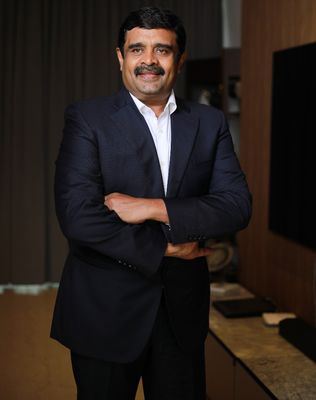 B. Prabhakaran
Gadchiroli was long a hotbed of Naxal violence. That image is now changing, with many Maoists eliminated or choosing to lay down arms. In June, 12 Naxalites with a combined bounty of over Rs1 crore surrendered in the presence of Fadnavis. He noted that 44 Naxalites had surrendered in the past 18 months alone.
LMEL has collaborated with the Gadchiroli police to provide employment to surrendered Naxalites as part of an initiative to rehabilitate them and reintegrate them into mainstream society. They were given necessary training and placed in roles across the company. “After surrendering, I got a job in Lloyds Metals and also received three months of training,” said Govind Aatla, a former Naxalite. For many of them, who had come from impoverished tribal backgrounds with little access to education or basic amenities, the training and employment they receive offer a renewed sense of purpose and hope.
“My family was extremely poor, and I had no opportunity for education. Now, with training from Lloyds Skill Development, I can live a peaceful life,” said Sainath Pungati, another former Naxalite. Shanti Navrokulla, who had lost both her parents at a young age, said she decided to leave Naxalism when she realised there was no end to her hardship. “With this job, I can live a safer, more progressive life,” she said.
In a significant social shift, many women from the region have been trained in skills ranging from housekeeping to motor vehicle driving. This has significantly improved their financial condition, with some earning salaries from Rs15,000 to Rs55,000 a month. According to LMEL’s annual report for 2024–25, more than 250 women were trained in roles such as excavator operation, LMV and HMV driving, and other core mining tasks. Additionally, 132 local women were trained in hydraulic mechanics and other technical skills and given employment in mining operations.
The Lloyds Foundation has also introduced a fully sponsored programme for exceptional students from Gadchiroli to pursue undergraduate and postgraduate studies at Curtin University, Australia.
While industrialisation is reshaping the economic landscape, Gadchiroli’s natural wealth remains a focus. About 70 per cent of the district has forest cover, spread across 14,412 square kilometres. Keen to preserve this green identity, the state government has set a target to plant one crore trees in the district in two years. In July, a drive was launched to plant 40 lakh trees. LMEL is working on a suggestion by the chief minister to set up a high-standard nursery to improve the survival rate of saplings to 80–85 per cent.
The slurry pipeline, the first of its kind in Maharashtra and only the fourth in the country, is part of the company’s efforts to minimise pollution. Transport vehicles are currently powered by liquefied natural gas, and the company is actively deploying electric vehicles for iron ore excavation, significantly lowering its carbon footprint.