


As the French priest Abbe Carre travelled across India between 1672 and 1674, one of his stops was in north Konkan. There, he asked a local commander about the ultimate aim of the Maratha warrior king Shivaji Maharaj. The commander replied that the ruler wanted to establish a kingdom that stretched from the Indus to the Bay of Bengal and down to the south.
Carre mentions this conversation in the account he wrote once back in Europe, throwing light on Shivaji’s ambitions to free India from the Mughals and establish a ‘Swarajya’.

An authority on Maratha history, the late Ninad Bedekar often spoke of it in his lectures on Shivaji. Bedekar—an engineer-turned historian—believed that Shivaji was the only king and general who understood strategy and tactics as they are studied today, and each of his forts is testimony to his in-depth knowledge.
Bedekar, like many a Maratha, would be delighted by the inclusion of 12 Maratha forts on the UNESCO heritage sites list, in early July. UNESCO describes them as Maratha Military Landscapes of India.

The forts are: Shivneri, Rajgad, Raigad, Pratapgad, Panhala, Lohagad, Salher, Khanderi, Sindhudurg, Suvarnadurg and Vijaydurg in Maharashtra—the last four of them sea forts—and Gingee in Tamil Nadu. All 12 were either constructed or fortified during the Maratha rule starting from Shivaji to the end of the Peshwa regime in 1818.
Each of these forts holds stories of Shivaji, stories of blood, conquest and empire. For instance, before his fateful meeting with Shivaji at the foothills of Pratapgad fort, General Afzal Khan of the Adil Shahi dynasty of the Bijapur sultanate had asked all his 60 wives to end their lives. Only Afzal Khan knew what he was in for—having been a subedar in the region, he knew the terrain and the trouble that it would bring him.
The battle of Shivaji and Afzal Khan was fought in the Javli region. The thickly forested area, controlled by the More clan, was a vassal kingdom of the Adil Shahi dynasty. It was one of the early pursuits of the young Shivaji—he captured Javli, built the Pratapgad fort and lorded it over the surrounding areas. Angered by it, the Adil Shahi dynasty sent Afzal Khan to the fort. Shivaji killed the general in the celebrated duel and defeated enemy forces, marking his first military triumph against a major regional power.
Not long afterwards, Shivaji went further south and captured fort Panhala or Panhalgad, about 20km from Kolhapur. This caused immense heartburn to the Adil Shah. He sent his general Siddi Jauhar to lay siege to Panhala and capture Shivaji. Legend says Shivaji escaped using two palanquins and a select group of 600 soldiers led by Bajiprabhu Deshpande. The first palanquin went down the fort from the main route with a Shivaji lookalike in it—his name was Shiva Kashid. Shivaji and the soldiers escaped through a secret route and went towards Vishalgad. The lookalike was captured and killed. Siddi Jauhar then began chasing Shivaji and his small army. En route to Vishalgad was a narrow pass named Ghodkhind—so called, it is said, because only two horses could pass through it at one time. Deshpande scattered his men around Ghodkhind and asked Shivaji to proceed towards Vishalgad. Shivaji was reluctant; he did not want to leave his soldiers behind. Eventually, it was decided that upon reaching Vishalgad, Shivaji would fire three cannons as a signal. On hearing this, the soldiers would withdraw to Vishalgad.
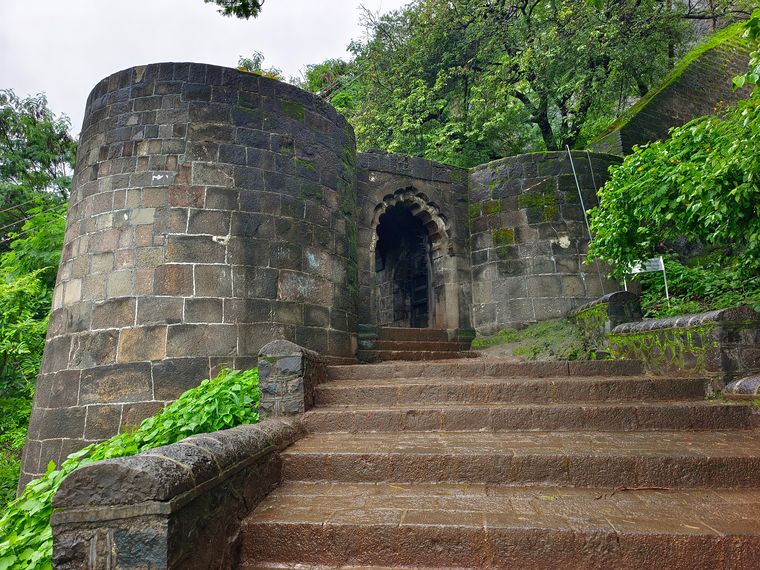 Shivneri fort is the birthplace of Shivaji. Every year on February 19, the Maharashtra government celebrates Shivaji’s birthday here, with ministers and local people participating | Shutterstock
Jauhar and his army reached Ghodkhind shortly after Shivaji had left for Vishalgad. A fierce battle took place and Deshpande was seriously injured. However, only when he heard Shivaji’s signal did he lay down his life. The soldiers who survived retreated into the jungles. Ghodkhind is now called Pavankhind as it became pavan (holy) after the sacrifice of Deshpande and his men.
Today, there is a big statue of Deshpande with swords in both hands in the middle of Panhala fort town. There is a motorable road till the top and it is a popular weekend destination for short picnics and a quick peek into Maratha military history. Interestingly, the singer Lata Mangeshkar had a beautiful bungalow in the fort town.
Another fort on the list, Shivneri, is the birthplace of Shivaji. It was part of the jagir (land grant) that Shivaji’s father, Shahajiraje Bhosle, got while in the service of the Nizamshah of Ahmadnagar. Eminent historian G.S. Sardesai writes in Marathi Riyasat that the Mughal emperor Shah Jahan was unhappy with the growing clout of Shahaji Bhosle and thereby the Nizamshahi in the Deccan. In the latter half of 1635, he came to the Deccan and began chasing Shahaji Bhosle. His general Shaista Khan (Aurangzeb’s uncle whose fingers Shivaji is said to have chopped off in a daring raid to oust him from Pune) captured Sangamner and Junnar and besieged Shivneri fort where the Bhosle family was camping. Shahaji Bhosle tackled the Mughal forces with guerilla warfare and moved them to fort Mahuli in Thane. Shivneri is in the Junnar taluk of Pune district and every year on February 19, the Maharashtra government celebrates Shivaji’s birthday here, with ministers and local people participating.
Few people know that Shahaji Bhosle eventually commanded regions up to what is today Bengaluru. He and elder son, Sambhaji, were in the service of the Adil Shah as commanders in Karnataka. Shahaji Bhosle’s grave is near Bengaluru.
Rajgad finds itself on the UNESCO list for being the first capital of Shivaji’s kingdom. He strengthened this fort after he got hold of a treasure in the neighbouring Torna fort. Shivaji and his mother, Jijabai, lived for the longest time in this fort. Rajgad is about 60km southwest of Pune, near Nasrapur village. Though the trek to the fort is arduous, once on top, one can see nearby forts in the Sahyadri range that Shivaji had controlled.
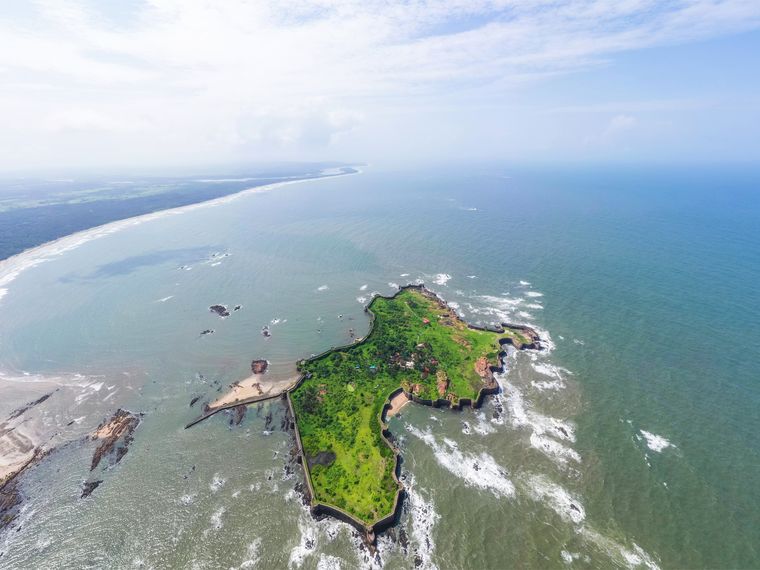 Coastal muscle: Sindhudurg was one of the prominent sea forts of the Maratha empire | Shutterstock
Another important fort in Shivaji’s legacy is Raigad—he was coronated there in 1674. It was originally controlled by the More clan. When Shivaji captured Javli, Chandrarao More took refuge in Rayri fort. Three months later, Shivaji defeated him and renamed it Raigad. It was completely rebuilt by Shivaji’s architect Hiroji Indulkar. An inscription on a step in the fort says: Seveche thayi tatpar, Hiroji Indulkar (In your service forever, Hiroji Indulkar).
The Gingee fort in Tamil Nadu was originally part of the Nayak kingdom. The Nayak was a descendant of a general of the Vijayanagara empire. Shahaji Bhosle and Mustafakhan had laid siege to it in 1648 on behalf of the Adil Shahis, but Bhosle wanted to leave with his army midway. Mustafakhan did not take kindly to this and had him arrested. The fort remained with the Bijapur dynasty till Shivaji captured it in 1677.
This was part of his southern campaign, for which he formed an alliance with the Sultan of Golconda to resist the Mughals. In fact, the sultan had ordered a special throne for Shivaji to be seated when the two met. It is from Golconda that Shivaji continued his southern conquest and captured Gingee and Vellore forts.
Talking of his forts, an interesting aspect of Shivaji’s rule is his navy. After the mighty Cholas, he was the first Indian king to have a full-fledged navy and sea forts. Even the Mughals did not have an effective navy; nor did the Adil Shahis, the two land-based enemies of Shivaji.
In the waters, his enemies were the Portuguese, the British and the Siddis of Janjira. To counter them, he built a strong naval force by picking commanders from coastal Konkan. His main base in north Konkan was initially Kalyan, along with twin forts of Khanderi and Underi. Khanderi has a presence of the Indian Navy. In south Konkan, his main bases were the forts of Suvarnadurg, Vijaydurg and Sindhudurg. All of these were built on the rocks close to the shore.
Among Shivaji’s naval commanders were Muslims like Daulatkhan. He began employing Muslims in 1647, when around 1,000 discontented Muslim soldiers of the Adil Shah came to Shivaji, seeking employment. He was initially reluctant, but his senior adviser Gomaji Naik Pansambal said the soldiers had come hearing of his glory and he should not disappoint them. “The ruler has to employ people from all 18 varnas and castes. If you recruit only Hindus, it will be difficult to lay the foundations of an empire,” Pansambal is quoted as saying in Sardesai’s Marathi Riyasat. Shivaji never ignored this advice.
At the time of his death, Shivaji had an army of nearly two lakh soldiers, control over nearly 400 forts and a strong navy that had raided regions up to Mangalore and Daman-Diu. Kanhoji Angre, who eventually became grand admiral of the Marathas and after whom INS Angre is named, is said to have made his beginning as a sailor in Shivaji’s navy.
Even after Shivaji’s death, his forts and military system stood rock solid when Aurangzeb entered the Deccan. The Marathas loyal to the Swarajya cause fought from every fort for the next 25 years under Sambhaji Maharaj, Rajaram Maharaj and Maharani Tarabai. During their battle with Aurangzeb, the Marathas would surrender a fort when they were exhausted or had run out of rations and supplies.
After Aurangzeb died, the very first among the Indian warriors to regroup were the Marathas. They eventually built a strong empire and went on to capture not just Delhi, but the region up to Attock in the northwest and Kolkata and Cuttack in the east.