



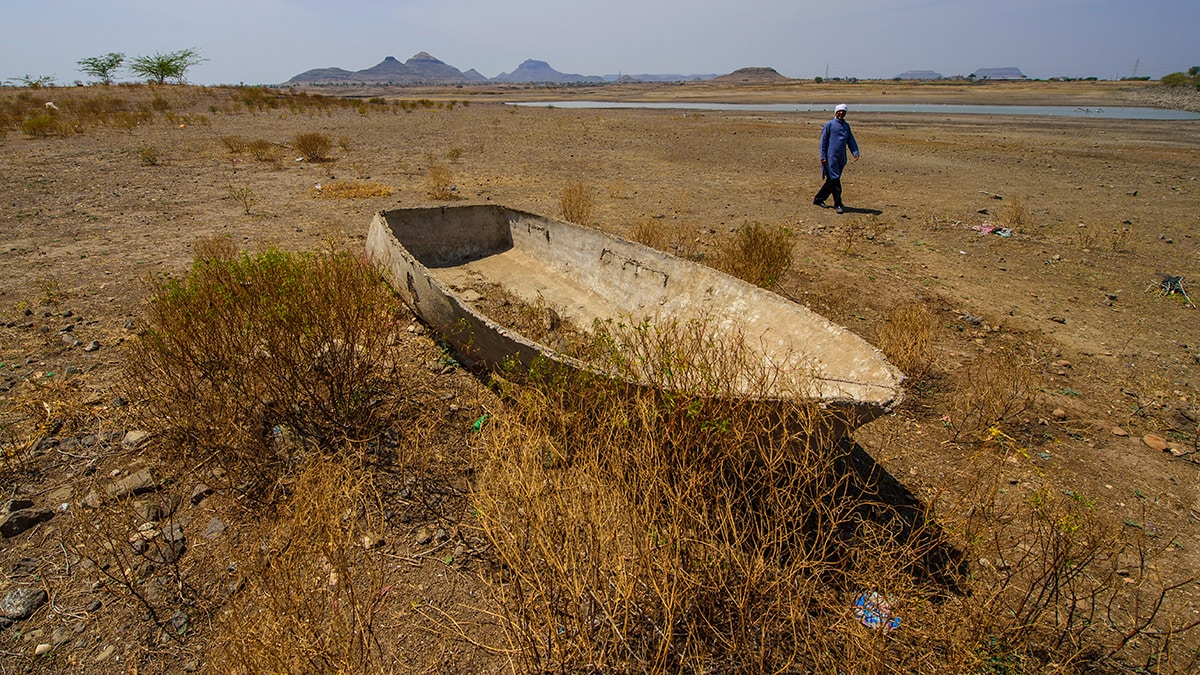
Kartiki and Sri Punyavati keep asking their uncle Bhagwat Jadhav when they can meet their parents. Bhagwat, unfortunately, has no answer. He does not know how to tell the two girls, aged six and two, the painful truth—that their parents are no more.
Bhagwat’s elder brother Sachin, a cotton and soybean farmer, ended his life on April 13 by consuming paraquat, a herbicide known to cause certain death if ingested. On hearing the news, his wife Jyoti, who was pregnant with their third child, drank from the same bottle discarded near their house. Two swigs of paraquat wiped out three lives within hours.
The Jadhavs’ house in Malsonna, a village in Maharashtra’s Parbhani district in the Marathwada region, is typical of a small farmer’s dwelling. There are just two partially open rooms made of black stone, with a tin shed covering a small open space. When THE WEEK visited Bhagwat, his hands were still stained with henna—he got married only recently. “He used to constantly worry about how he would repay his debts,” said Bhagwat, as Kartiki and Sri Punyavati played nearby. “He had borrowed a few lakhs from a bank and some more from a private lender.”
Bhagwat’s father, Balaji Jadhav, is rarely at home. He prefers working in the fields to distract himself from the trauma of losing his son and pregnant daughter-in-law. “Even the tehsildar was unwilling to visit until our leaders raised their voices,” said Kishor Dhage, Parbhani district chief of the Shetkari Sanghatana, a farmers’ organisation led by former MP Raju Shetty. Following the state government’s inaction, Shetty and his supporters organised a silent march in protest. “Deputy Chief Minister Ajit Pawar found time to visit a nearby temple but not to offer condolences to the grieving family. Even the district’s guardian minister, Meghna Bordikar, a local herself, has not visited,” Dhage said.
Bhagwat explained that Sachin had spent nearly Rs1.5 lakh on his soybean crop but earned only Rs65,000 from the sale. “We own a little more than five acres. After two years of unseasonal rainfall and failed crops, Sachin became despondent. He kept saying, ‘Where will I get the money to repay the loans?’”
Bapurao Tekale, 38, spoke about his father, Bhagwanrao, also a cotton and soybean farmer from Malsonna, who died by suicide on February 27 after ingesting paraquat. He had taken a crop loan of Rs1 lakh from the State Bank of India. “With accumulated interest, it had risen to over Rs3 lakh,” Bapurao said. Dhage added that cultivating soybean requires approximately Rs90,000 per hectare, but the average income from its sale is barely Rs70,000.
Maharashtra Congress president Harshvardhan Sapkal said that just as farmers were grappling with debt, unseasonal rains in May caused additional losses. “The BJP-led state government remains inactive. Immediate assessments and compensation are necessary,” he said. Sapkal criticised the discontinuation of the crop insurance scheme, which had provided some compensation.
He also expressed concern about the government’s lack of preparedness for the upcoming kharif season. “There is no sign of planning from the agriculture department,” he said. “Fake seeds are being sold across the state. Traders are linking fertiliser sales to seed purchases, exploiting the farmers.”
In 2024, Maharashtra recorded 2,635 farmer suicides, compared with 2,851 in 2023 and over 4,000 in 2022. Although the numbers are falling, the underlying crisis is far from resolved. According to the Economic Survey of Maharashtra, agriculture and allied sectors were expected to grow by 8.7 per cent in 2024. Yet, distress and suicides persist. The suicides are largely concentrated in Marathwada and Vidarbha, where irrigation coverage is only 15 per cent. While governments announce relief packages, these hardly ever improve irrigation, seed quality or storage infrastructure.
Karnataka faces a similar crisis, with suicide numbers slightly lower than Maharashtra’s. On March 9, Dattatreya Hunachappa Melakeri, a 55-year-old farmer from Kodadoora village in Kalaburagi, hanged himself because of the mounting debt. He had borrowed Rs2.5 lakh from two banks and another Rs5 lakh from private lenders. In April, Ayyappa Ballari from Lingasugur in Raichur district, hanged himself from a neem tree. He had loans totalling Rs15 lakh for a tractor and other expenses from cooperative and private banks. In the past two years, Karnataka recorded 2,329 farmer suicides. From 2019 to 2022, there were 2,377 suicides, but compensation was awarded in only 462 cases, often denied on technical grounds.
The Economic Survey of Karnataka shows that agriculture grew by 3.5 per cent last year. But a major concern has been the damage caused by heavy rains to maize, paddy, cotton and sugarcane. Only 17 per cent of cultivated land in Karnataka is covered by crop insurance. Small and marginal farmers struggle to enrol due to bureaucratic hurdles and slow claim settlements. Karnataka allocated Rs51,339 crore to agriculture in the latest budget, yet farmers remain burdened by debt. Many borrow not only for farming but also for personal expenses such as children’s education or weddings.
Harassment by microfinance institutions triggers suicides. These firms offer “easy” loans, but with interest rates between 20 and 40 per cent, often flouting Reserve Bank of India norms. Still, credit availability is a concern. NABARD’s agricultural credit sanction to Karnataka dropped sharply—from Rs5,600 crore in 2023–24 to Rs2,340 crore in 2024–25. The state has urged the Centre to provide interest subvention to offset the shortfall. Chief Minister Siddaramaiah has written to Prime Minister Narendra Modi for urgent clearance of irrigation projects, especially the Mekedatu reservoir on the Kaveri and the Kalasa Banduri project on the Mahadayi.
A price crash due to bumper harvests has also brought devastation. In April, tomatoes sold at just Rs10 per kilo. The lack of an adequate minimum support price, rising input costs, poor procurement mechanism and inadequate storage facilities continue to affect small farmers’ cash flows. Social distress is growing. Farming is increasingly seen as unviable, and young farmers struggle to find brides. Farmer organisations have demanded a rollback of three “anti-farmer” laws—the Karnataka Land Reforms (Amendment) Act 2020, the APMC (Regulation and Development) Amendment Act 2020 and amendments to the Karnataka Land Revenue Act. They have also proposed an incentive of Rs5 lakh to women who marry farmers.
Although Tamil Nadu has not witnessed suicides on the scale of northern India, the state recorded negative growth in agriculture and allied sectors over the past year. The DMK government has introduced a separate agriculture budget, but farmers and agricultural associations argue that beyond subsidies, it has done little to improve the sector’s health.
Farmers across Tamil Nadu have reported increased distress over the past decade due to climate change issues and policy decisions at both Central and state levels. Tamil Nadu has a cultivable area of 6.03 million hectares, with a net sown area of 5.24 million hectares. Paddy remains the principal crop, cultivated on approximately 4 million hectares. Yet, paddy procurement—a lifeline of Tamil Nadu’s agricultural economy—has become increasingly burdensome.
The Tamil Nadu Civil Supplies Corporation runs 3,148 direct procurement centres across the state, with a capacity of 1.81 million tonnes. Yet, this infrastructure suffices for only around one-third of the 12 million tonnes of paddy produced annually. “Without sufficient warehousing and proper infrastructure, we cannot store paddy safely during the monsoon. These days, rains arrive unseasonably and with great intensity,” said P.R. Pandiyan, president of the Coordination Committee of All Farmers Associations of Tamil Nadu.
In a controversial move, the Tamil Nadu government has accepted the Union government’s proposal to transfer grain procurement authority to the National Cooperative Consumers’ Federation in all districts except those in the Kaveri delta. The move brought in private firms. “One such firm procured paddy worth Rs170 crore, but failed to make payment or return the rice. This could become a massive liability for the state,” Pandiyan warned.
Farm insurance, too, remains a pressing concern. Pandiyan points to the Central government’s Pradhan Mantri Fasal Bima Yojana as part of the problem. “A few corporates signed agreements worth Rs500 crore, and now it is completely commercialised. As a result, we don’t receive timely compensation, despite the Union budget allocating nearly Rs5,000 crore for farm insurance,” he said.
Beyond procurement and insurance woes, climate change remains critical—especially in the delta. In recent years, summer crop cultivation has been abandoned due to the early onset of the southwest monsoon. A report from the state agriculture department says 9.1 lakh acres were affected by heavy rains and natural disasters in 2024–25. Key factors included torrential rains in January 2025, a volatile southwest monsoon and Cyclone Fengal in December 2024. These disruptions led to a marginal decline in agricultural growth, a first in eight years.
Farmers fare no better in Telangana as well. The plight of tenant farmers in the state are often missing from official statistics. M. Srinivas, a 39-year-old tenant farmer from Himmatnagar in Karimnagar district, took his life last year. The same pesticide meant to protect crops became his final resort.
Srinivas had leased seven acres to cultivate paddy and corn. Over three years, repeated crop failures left him with no income and rising debts. “First pests ruined the crop, then heavy rains,” said his widow, Latha. “He paid Rs1 lakh annually to lease the land. With no income, loan interest compounded. By the third year, the debt went up to Rs8 lakh. It haunted him.” Now, Latha raises two daughters and repays the debt.
Tenant farmers in Telangana face systemic exclusion. Of the state’s estimated 6.6 million farmers, around two million are tenants. Activists say tenant farmers lack access to institutional credit and must borrow from private moneylenders at exorbitant interest rates. Government schemes tend to benefit only landowners, leaving tenants without subsidies, crop damage compensation or insurance. According to Rythu Swarajya Vedika, a farmers’ rights group, tenant farmers in Telangana suffer from a disproportionately high suicide rate, accounting for 40 per cent of all farmer suicides in the state.
While the Telangana government’s latest budget increased agriculture spending by 15 per cent, funds have primarily gone to irrigation projects and fertiliser subsidies. The state is yet to introduce comprehensive tenancy reforms or tenant-focused financial schemes.
G.V. Ramanjaneyulu, founder of the Secunderabad-based Centre for Sustainable Agriculture, said that after bifurcation of Andhra Pradesh in 2014, Telangana initially saw a decline in farmer suicides. But over the years, agriculture became a high-risk endeavour as the government withdrew from insurance schemes because of high premiums. “This created a bigger crisis, as in the event of a natural disaster or crop failure, there was no compensation,” he said. “Instead, the state compensated with welfare schemes.”
Experts argue that to ensure long-term viability, farmers must shift to dryland horticulture, agroforestry and less water-intensive crops. But without structural reforms, institutional support and political will, farmers like Sachin, Srinivas, Ballari, Tekale and Melakeri will continue to fall through the cracks.
—with Lakshmi Subramanian and Rahul Devulapalli
