



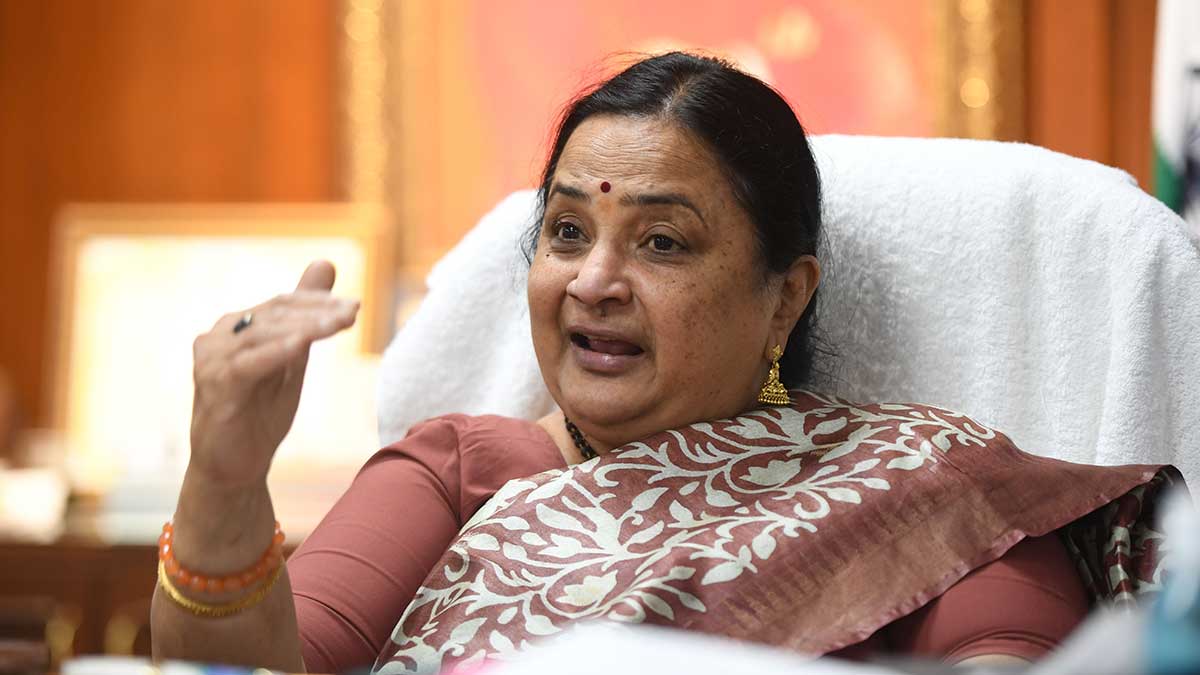
Interview/ Prof Santishree Dhulipudi Pandit, vice chancellor, Jawaharlal Nehru University
Q/ Could you take us through some of JNU’s recent initiatives?
A/ The School of Environmental Sciences has now a strong focus towards green hydrogen, green energy and energy conservation. We also have an instrumentation centre―we buy expensive experimental instruments using funds from the department of science and the department of biotechnology and share them with all state universities which cannot afford them. These universities need only pay us a nominal fee.
At the School of International Studies, we impart training in writing and diplomacy (with the intent of equipping students to pursue careers as diplomats). The School of Life Sciences has been given a multidisciplinary project from the National Research Foundation. We have a centre for molecular medicine, a course in ayurveda biology, which integrates ayurveda with modern science, and a course on manuscriptology. We are trying to integrate different knowledge systems.
Q/ What are the most interesting projects that JNU is working on?
A/ Different schools are working on industry-sponsored projects, especially the schools of computer sciences, nanotechnology, biotechnology, molecular medicine and life sciences. Recently, we got an offer from a perfumery company to work on perfumes and food colours. Through this, students [of the School of Physical Sciences] can get exposure to the beauty, perfumery and food colouring industry. Knowing chemistry is not enough; it is a specialised field. France is the leader in perfumery and the students can look towards international opportunities. Many students could be absorbed by the companies who sponsor different projects.
An agriculture company has approached us for a patent held by a professor, related to bacteria. Many of our researchers are realising that there is industrial value to their research.
Q/ Is JNU embarking on any international tie-up?
A/ I recently met the Armenian ambassador and, for the first time in 40 years, China’s ambassador came to JNU. We have collaborations with many countries. The School of Languages has trained a lot interpreters who work in government departments and interpretation is an add-on skill to foreign language courses. If industry requests us to train their staff in foreign languages, we provide that training.
Q/ Any new courses or centres?
A/ Our schools and centres make their own syllabus. If a faculty wants to start a skill-based course, they can do it. It just needs to be cleared by the academic council. So, there is total autonomy. Programmes can change every semester.
We recently started the Chhatrapati Shivaji Maharaj Centre for Security and Strategic Studies, within the School of International Studies. It will focus on Maratha history and its relevance, especially with regard to guerrilla warfare. We also have centres for Hindu, Jain and Buddhist studies. We recently had a first-of-its-kind vedanta conference. It was a huge success. We have also introduced archaeology as part of the history course. We take students to different sites, which will help them work as archaeologists.
We are also thinking of starting a centre named after Lachit Borphukan, who was one of the greatest warrior-generals of Assam, and Rajendra Chola, as there is growing interest in maritime studies. We are talking to the shipping ministry about how we can train students. The course will cover ship building and maritime strategy.
