


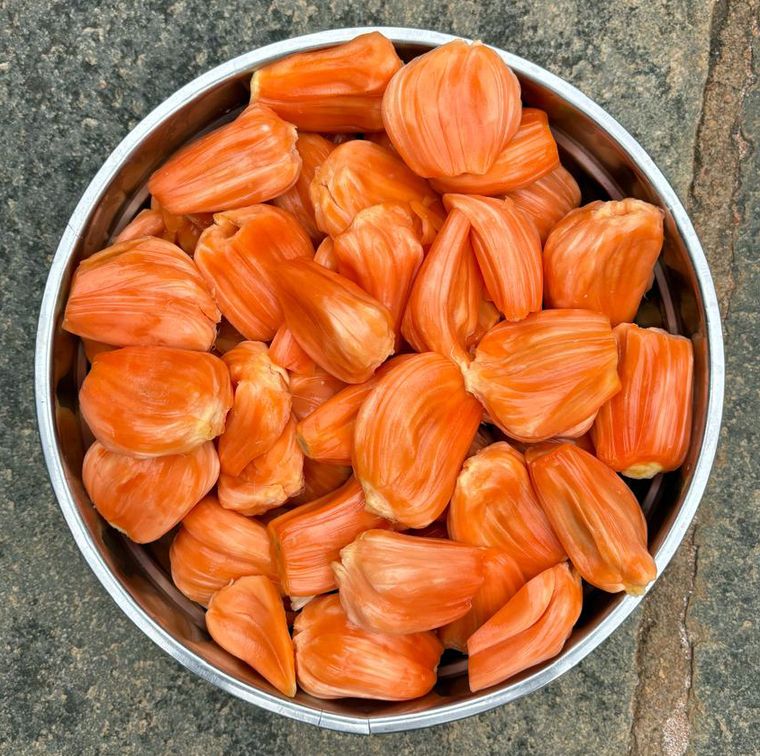
With its coppery red flakes, sweetness in taste and high nutritive value, a 40-year-old jackfruit tree has changed the fortunes of a farmer in Karnataka by fetching him over Rs1 crore annually.
A two-hour drive from Bengaluru through lush green coconut groves, mango orchards, paddy and millet fields―fed by the Hemavati river canals―takes you to the village of Seegenahalli in Tumakuru district. The village is now famous for ‘Siddu’, the celebrity mother tree protected by a fence and round-the-clock CCTV surveillance. However, this tree that bears 450 fruits in a single season is not the only reason behind the prosperity of S.S. Paramesha, 42, the farmer who owns it.
Come May, farmers, horticulture enthusiasts and scientists from across the country make a beeline to Paramesha’s nursery, where he sells nearly 30,000 saplings of the rare variety jointly developed and commercialised by the Indian Institute of Horticultural Research (IIHR), Bengaluru, in 2017. During monsoon, TV channels, documentary filmmakers and agriculture students come to the village to get a glimpse of the grand tree and the thriving nursery.
Siddu’s speciality was noticed by Dr G. Karunakaran, principal scientist, IIHR-Central Horticultural Experiment Station, Hirehalli, during a survey to identify superior jackfruit genotypes in the traditional jackfruit-growing tracts of southern Karnataka. Seven years since, Paramesha, who used to earn Rs8,000 annually from his jacktree, now earns over Rs1 crore by selling the saplings and earning royalty from government and private agencies.
Siddu is named after Paramesha’s father S.K. Siddappa and family deity Koratagere Siddeshwara of Siddeshwara Betta in Tumakuru. The name was shortened to Siddu for registration. It is a rare distinction for a fruit to be named after a farmer, and the late Dr Sri Shivakumara Swamiji, former pontiff of Sri Siddaganga Mutt, released the ‘Siddu Halasu’ into the market.
Siddu is patented under the Protection of Plant Varieties and Farmers’ Rights (PPV&FR) Act, 2001, for 18 years (April 2023 to April 2041). The patent gives Paramesha special and exclusive rights to multiply the variety, sell the saplings, build a market, distribute, export the variety and also grant permission to other individuals or organisations to do the same. He can also file a case for any patent violation. Siddu has won him three national awards―Custodian of Novel Jackfruit Award (Indian Council of Agricultural Research-IIHR), Innovative Farmer National Award (ICAR-Indian Agricultural Research Institute) and the PPV&FRA award.
The origin
The Siddappa family used to grow coconut, areca, mango, paddy and millets on 120 acres. Siddappa’s father had discouraged him from planting jackfruit as he considered the land unsuitable. The family used to relish fruits gifted to them by their relatives every season. A cousin gave him the copper-coloured ‘Chandru tole halasu’.
“My cousin gave me two to three fruits,” recalls Sidappa. “Not all seeds develop into a plant. But I saw one had germinated and I got it planted on my farm. It started bearing fruits within a few years. But I had never imagined that it would bring us so much prosperity. Initially, we only distributed the fruit to family and friends every season and they always asked for more. Last year, the tree was struck by heavy winds. So, we planted 50 saplings (developed from the mother plant through bud grafting).”
Siddappa laments over the fact that farming is no longer sustainable or profitable. “Jackfruit cultivation is a better option,” he says. “However, we are a traditional farming family. So, we will not give up.”
Paramesha started assisting his father on farm after dropping out of college following his class 12 exams. “After our jackfruit variety was judged the best among 180 varieties at various fairs, I was trained to protect the variety and also multiply the saplings using bud grafting,” he says. “I started off with a small nursery near home. But the growing demand for saplings forced me to expand and build a dedicated nursery with a water tank and sprinkler.”
The demand for the saplings has increased from 6,000 to 30,000 a year in seven years. The nursery took shape at a time when Prime Minister Narendra Modi was pushing for doubling farmers’ income through linking biodiversity to livelihood security initiatives. The IIHR has signed a three-year MoU with Paramesha, and grows the saplings at its substation at Hirehalli and nurseries and sells each sapling for Rs170 and pays 40 per cent royalty to Paramesha. Last year alone, he got Rs16 lakh in royalty. The IIHR also maintains the germplasm (40 second generation plants with the same genetic material from the original Siddu) in their model farm to extract the bud for grafting. The buyers are free to grow the saplings for fruits, but cannot multiply the sapling without paying royalty.
The technique
The saplings should be ideally planted during monsoon (May-August) for better outcome, as the soil is moist and ready to anchor the roots. The survival rate is higher if the temperature is moderate.
“For bulk order, the buyer provides us with the two-feet tall rootstock in the soil pouch,” says Paramesha. The rootstock is prepared by seeding native variety seeds in a soil pouch and nurturing it with manure and water. The sapling preparation is fully organic as cowdung slurry and groundnut chaff is used as manure to keep the soil porous. Once every 20 days, a teacup of this mixture is added to the soil. The saplings need to be watered at least once a day, for which sprinklers are used. After three months, the saplings grow to two feet tall and are ready for bud grafting.
“At my nursery, graft specialists from Thrissur extract the bud from the Siddu variety by scraping the H-type skin of the mother plant to be grafted on the stem of the rootstock plant,” explains Paramesha, who has hired 10 women labourers to work in the nursery. “The graft is taped. Multiple buds are extracted from a single twig of the mother tree and replanted on the jungle variety.”
After 30 days, the bud graft starts growing twigs, and all the twigs of the native variety (recipient) are cut off. “The bud graft will dominate and not allow other varieties to branch out,” says Paramesha. “The bud graft remains taped for one month and once the twigs of the rootstock are chopped off, it takes another six months for the grafted saplings to grow two feet tall. That is when it can be sold in the market. This sapling develops into the Siddu variety, bearing fruits identical to the mother tree.”
Paramesha has also developed a model farm with seven varieties of mango and 30 varieties of jackfruits. The model farm made Paramesha inquisitive about crop diversity, and he started networking with scientists and started attending seminars. “I have been experimenting with different varieties and also planted a few different varieties along with the Siddu variant, as it gives better yield due to cross pollination,” says Paramesha, whose younger brother is an engineer in Bengaluru. “The Vietnam variety on my farm bears fruits all year. I also sell saplings of other varieties.”
Last year, Paramesha bought an Isuzu S-CAB to ferry 500 saplings at one go and tied up with a courier agency to cater to his growing clientele. “Home is where the heart is. As a farmer, I feel more empowered today with access to latest technology,” says Paramesha, who monitors his farm and the prices online on his iPhone. “The nursery demands your total dedication and attention. I hardly leave my village except for seminars, fairs and award ceremonies.”
WHAT MAKES ‘SIDDU’ SPECIAL
The quality and taste of the coppery red flakes is said to be better than the yellow and white varieties
The Siddu variety is most suitable for dry climate and red soil, with adequate sunlight and water
It cannot grow in waterlogged area or amid areca, mango or coconut plantation, as each sapling needs to be 25ft apart
In Malnad and coastal areas, where there is heavy rainfall, it should be planted on a slope
It has high soluble solids, which determines fruit quality. Its phytochemical composition is carotenoids (4.43mg/100g), lycopene (1.12mg/100g), total flavonoids (3.74mg catechin equivalents/100g), total phenols (31.76mg gallic acid equivalents/100g) and Vitamin C (6.48mg/100 g). Its total antioxidant activity, ranging from 11mg and 14.93mg AEAC/100g in FRAP and DPPH assay, indicates its potential as a health-promoting and functional food component, according to IIHR