


Journalist Mazhar Farooqui was en route to an iftar party when he first heard the explosions. Streaking lights in the Dubai night sky followed by a thud. “There was always a sense that tensions could escalate, but the idea that it could spill so close to the UAE felt unlikely,” Farooqui told THE WEEK. “It’s one thing to read about conflict in the region, quite another to feel it.”
Dubai and Abu Dhabi are among the most targeted places in the UAE in the current conflict between the US-Israel combine and Iran.
For many Indian expatriates like media analyst Yashwant Deshmukh, it is a dream interrupted. “Dubai is not a home away from home,” he said. “It is home with all the safety and security one could hope for. But war is a black swan event. And with interceptors blazing, big booms and alarms going off on a daily basis, this is the new normal now.”
People THE WEEK spoke to blamed Iran’s offensive against neighbouring nations on geography. A person in Dubai, who did not want to be named, said: “There is not much animosity among the common people against the Iranians, although not too many were in favour of the Khamenei-led regime.”
UAE authorities have ordered the closure of Iranian schools, the iconic Iranian Hospital and the Iranian Club, a centre of Iran’s culture in Dubai. The government has also warned of a 2,00,000 dirham penalty if any retailer is found to be overcharging for commodities. There is no evident inflation, although on March 31, fuel prices suddenly rose by 30 per cent, a rarity in the UAE.
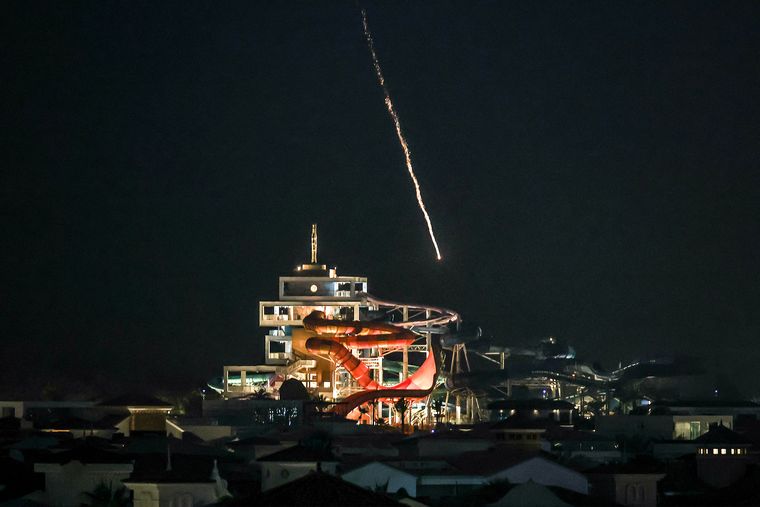 Scary streak: An intercepted projectile falls into the sea near Dubai’s Palm Jumeirah archipelago on March 1 | AFP
With Iran thwarting President Donald Trump’s objective of a short and decisive conflict, the deployment of about 8,000 US specialist soldiers to the combat zone indicates that the war could be a protracted one.
Iran’s regular barrage of drones also underlines the fact that its hit-back capability has not been neutralised.
“No one even in their wildest dreams thought that Iran would be launching thousands of missiles and drones into the UAE,” said Farooqui.
Since the start of Iran’s attacks, the UAE Air Defense Forces have intercepted 433 ballistic missiles, 19 cruise missiles and 1,977 drones. On a daily basis, there are 20-30 drone and 15-20 missile attacks. Government records say 11 people have died while 188 have been injured. Those affected included locals and also people from a number of countries, from India and Indonesia to Sweden and Ethiopia.
Yet, the human spirit endures. “Life has been largely normal,” said Farooqui. “Work continues and people are still stepping out. There’s concern, yes, but it hasn’t translated into panic. Seeing intercepts and hearing loud booms are unnerving, yes, but they also make you realise how much effort has gone into keeping things steady here… People trust the systems in place and that is why daily life hasn’t been disrupted in any major way”.
Schools and universities have moved to remote learning till April 17. Offices are functioning, though some have allowed hybrid arrangements. Public transport is operating as usual.
Even so, there is a sense of disbelief and unease. The UAE has over the years built a reputation for stability in a turbulent region. Now, that image of a land of golden dreams and a safe haven has taken a beating.
The biggest fear among people is two-fold: one, the conflict is happening too close for comfort, and two, no one knows how long it will last.
“People are generally staying put,” said Deshmukh. “Huge numbers have not flown out to safer places. There is anxiety, yes, but panic, no.”
Things are not the same everywhere. Jordanians, for instance, are struggling to get used to the ‘new normal’. Rana Sabbagh, former editor of The Jordan Times daily, told THE WEEK: “In Jordan, we are not used to hearing sirens wailing every 30 minutes or bangs from anti-missile launchers or projectiles falling. One fell about 100 metres from my home and created a crater and damaged windows. The sirens are getting on our nerves.”
Since the attacks began, Jordan has intercepted 268 forms of projectiles. A staunch US ally, it borders Israel and is a major base for the US military. “Prices of food and commodities have gone up exponentially and traders are trying to make a fast buck,” said Sabbagh. “To keep fuel prices normal, the Jordan government is paying Iran millions of dollars in subsidies so that the daily cycle of life doesn’t get affected. All this will have major consequences for the country’s GDP and we already have huge debts. Nobody really knows when and how the war will end. God knows, Trump knows and [Benjamin] Netanyahu knows. We have over 8,50,000 Lebanese roaming in the streets who have been forced to leave their homes in the south. People have lost jobs and are sleeping in the streets, there is a huge humanitarian crisis unveiling. The country is bankrupt and nobody can help now.”
She added that Arabs have been wary of Iran and its proxies in the region like the Hamas, the Houthis and Hezbollah. “We see Iran as a country that has disturbed lives in Sunni-majority countries,” she said. “We have been careful of the prospect of Iran trying to export its way of living with the clerics running the show.”
While there isn’t much sympathy for the regime, there is a lot for the Iranian people. “Many Iranians I know are saying that even though they hate the present regime, it is heartbreaking for them to see how their country and its culture are being wiped out. But changing a regime can only be done by the people.”
In Saudi Arabia, which is home to the holy cities of Mecca and Medina—which makes it an area of concern for Muslims worldwide—there have been no reports of any scarcity of food, water, petrol or groceries.
Ghazanfar Ali Khan, president, Indian Expatriates Society, told THE WEEK on the phone from Riyadh: “Saudi leaders have reassured the public on supplies, while alternatively working to boost global oil supplies.... Of course, all are worried because of the attacks, but the million-dollar question is [when this conflict will end]. The final outcome will depend on how the US manages Israel’s role in the confrontation with Iran, and whether the GCC countries can avoid this conflict that exclusively serves an Israeli agenda at the expense of broader regional security. A prolonged closure of the Strait of Hormuz will threaten a biting global recession, while causing surging energy bills globally.”
Besides disruptions in the energy supply chain, India is likely to be impacted by the ongoing crisis as nearly 10 million Indians live and work in the Gulf region. More than a week ago, Prime Minister Narendra Modi had said: “Since the war began, more than 3,75,000 Indians have safely returned. From Iran alone, nearly 1,000 Indians have returned safely.”
But with dramatic developments almost on a daily basis, and with neither side showing signs of reconciliation—despite Trump’s statement that the conflict could end within weeks—there is a strong apprehension that things can get much worse. Even as the crisis is spilling out into newer areas.