


It was the day of the Blood Moon—a total lunar eclipse. But Sunday, September 7, 2025, marked another kind of eclipse: an internet failure that caused digital darkness in parts of India, south Asia, Africa and the Middle East. The reason: the severing of submarine cables in the Red Sea.
Whether accidental or deliberate, the incident revealed a reality that remains largely unknown to the wider world: a war seems to be brewing in the depth of the oceans. Governments across the world are waking up to a stark vulnerability—one capable of crippling communications, financial systems and information flows within seconds. And there is not much the governments can do, because submarine cables have never been designed for war situations.
Escalating tensions in the Middle East have sharpened this realisation. Two strategic choke points—the Strait of Hormuz (between the Persian Gulf and the Gulf of Oman) and the Bab el-Mandeb Strait (between the Red Sea and the Gulf of Aden)—carry a dense web of strategically important submarine cables.
The threat is amplified by geography: the Hormuz Strait is relatively shallow, barely 150-200 metres deep, while the Bab el-Mandeb Strait remains under the influence of Houthi forces in Yemen. Narrow sea lanes, the risk of mines and volatile geopolitics have together created such a fragile environment that any submarine cable disruption could now take very long to resolve.
One of the most disruptive incidents for India happened in 2008, when submarine cables in the Mediterranean and the Persian Gulf were severed. There were suspicions of sabotage, but they were never officially confirmed.
“Nearly 60 per cent of India’s Europe-to-India connectivity was affected in the form of slow internet and greater latency due to the re-routing efforts required,” said Soham Agarwal, a submarine cable expert and associate fellow at National Maritime Foundation, Delhi.
More recently, in March 2024, multiple cables in the Red Sea corridor were damaged amid rising hostilities in the region. Fingers were pointed towards the pro-Iran Houthi rebels, who had been targeting ships since November 2023. With Iran now directly engaged in conflict with the US and Israel, the risks have risen manifold. Major undersea cables to India—such as Google’s Blue-Raman, Bharti Airtel’s 2Africa and Sea-Me-We 6, and Reliance Jio’s India-Europe Xpress—all pass through the Red Sea.
Nearly 99 per cent of global communication—supporting everything from military operations and financial transactions to health care and education—flow through these undersea cable networks. These cables are the exposed arteries of our digital civilisation—carrying an estimated $10 trillion in daily financial transfers, enabling 400 million voice calls per minute, and facilitating 15 million video conferences.
Said Vice Admiral Sanjay Vatsayan, vice chief of the Indian Navy: “The Navy is fully aware of the challenges that are increasingly coming up. There have been instances of disruptions and we are looking at it from the Navy’s perspective—as to what are the capabilities we would need. Most of them are unmanned underwater capabilities, as the cables are located deep.”
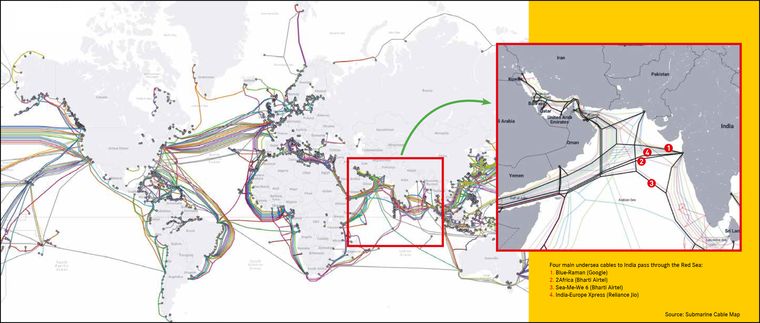
In India, submarine cables and the networks are looked after by the department of telecom under the ministry of communications. “Undersea cables are certainly part of the critical infrastructure of the country,” said Rear Admiral Monty Khanna (retd). “Any resource on which a nation has high dependency, the denial of which would adversely impact its economy and security, is a potential target in combat—even in situations short of war. It is therefore imperative for us to take necessary steps to mitigate this vulnerability.”
But these cables remain remarkably exposed. Roughly 600 in number, they stretch over 1.4 million kilometres—enough to circle the earth nearly 38 times. Covered with layers of steel, rubber and polymer to withstand tremendous deep-sea pressure and marine activity-related hazards, the cables cannot be fully buried, hidden or guarded across their entire length.
There are several reasons why undersea cables are preferred over satellite links—higher bandwidth and data-carrying capacity, faster transmission, and lower costs being the main ones. Satellites are largely used as a backup for telecommunications. With demand for both data storage and bandwidth continuing to rise exponentially, this dependency on submarine cables is only expected to increase. Experts anticipate a 48 per cent surge in cable kilometres by 2040, which will only magnify the existing risks.
In March 2025, reports emerged that China had developed a deep-sea cable-cutting device capable of operating at a depth of 4,000 metres. Compact, precise and designed for submarine integration, the device reportedly has a 150mm, diamond-coated wheel that does 1,600 revolutions per minute. More than just a technological milestone, this development signals the potential weaponisation of undersea infrastructure.
Deep-sea cable wars have precedent. During the Spanish-American war of 1898, US forces severed the submarine communication cables that connected Spain with its colonies. It led to the gradual decline of the Spanish empire and the rise of America—underscoring the strategic importance of such networks.
The first submarine cable was laid in 1850 across the 33km-wide English Channel connecting England’s Dover with France’s Calais. Eight years later, in 1858, the first transatlantic telegraph cable was laid across the Atlantic Ocean to connect Ireland’s Valentia Island to Trinity Bay in Canada’s Newfoundland. The vulnerability of the cables has ever since been a concern.
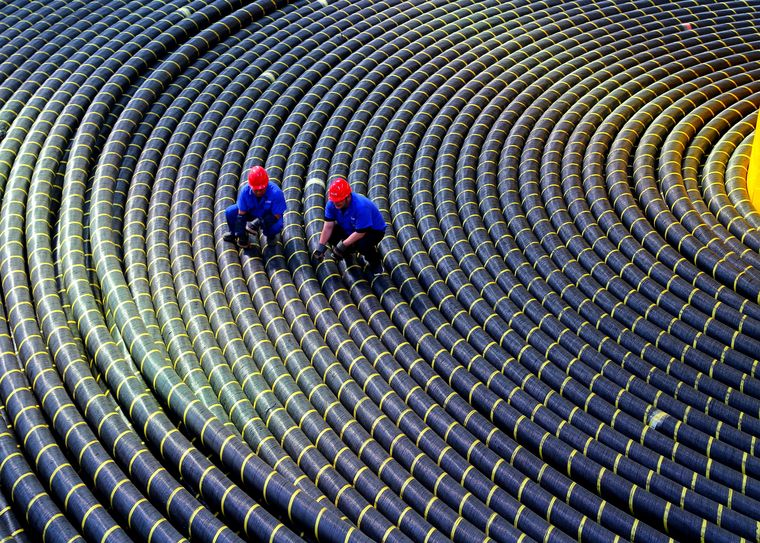 High-wire act: Workers at a submarine cable manufacturing facility in China’s Shandong province | Getty Images
“The biggest challenge in securing undersea infrastructure from sabotage is in determining the actor, and the intention of the actor,” Agarwal told THE WEEK. “Even if the AIS (automatic identification system) data helps corroborate the vessel, establishing the intention of parties is extremely challenging, as it can often be attributed to accidental damage.”
The fact is, most causes of cable damage are often accidental—that is, from bottom-trawling fishing and anchoring. Even the modus operandi for acts of sabotage often corresponds to dragging an anchor along the seabed.
“Therefore, it is difficult to say whether an incident truly is sabotage,” Agarwal said, adding that the recent incidents involving the Nord Stream pipelines in Europe and submarine cables off the coast of Taiwan suggest that disruptions have geopolitical causes and consequences.
These cable networks that crisscross the sea floor to connect continents, countries and geographies make them a prime target. The biggest concentration of these submarine cables is in the Atlantic, through which the communication between North America and Europe takes place.
“The deep-sea cables are left unattended in international waters while 99 per cent of cyber communication happens through them,” former National Security Advisory Board member Anshuman Tripathi told THE WEEK. “Any misadventure by any state or non-state actor can have very serious consequences. It is thus imperative that self-protecting and reporting technologies in these cables be upgraded and made more sophisticated to discern sabotages from accidents.”
A 2021 study by the Centre for Strategic and International Studies (CSIS) listed several objectives of a sabotage. “Severing a cable might achieve: cutting off military or government communications in the early stages of a conflict, eliminating internet access for a targeted population, sabotaging an economic competitor, or causing economic disruption for geopolitical purposes,” it said. This necessitated enhanced intelligence, surveillance and reconnaissance in the maritime domain.
Reports already indicate that criminal actors are increasingly gaining access to high-end technologies like self-propelled underwater weapons, torpedoes, and even chemical and laser weapons. There are also growing possibilities of the deployment of autonomous weapons lying dormant or moving undetected along the vast seabed, only to activate at a predetermined time and place.
Another aspect of the vulnerability is the growing possibility of cyberattacks by both state and non-state actors. Such attacks could result in the immediate compromise and theft of user data, as well as the loss of control over network and management systems.
While rapid technological advances in the domain of underwater operations are increasingly available to adversarial actors, there remains a significant gap in awareness and preparedness to counter these evolving threats. This persistent vulnerability in critical infrastructure poses a clear threat to national security and commercial interests.
Submarine cables typically run along the seabed at depths of around 2,000 metres. While damaged cables can be repaired in most cases, it may take weeks for a ship and crew to reach the affected site and begin recovery and repair. By then, disruptions could result in economic losses amounting to trillions of dollars.
Estimates suggest that the average cost of repairing a submarine cable ranges from $1 million and $3 million, with the average repair time of 20.6 days—excluding restoration costs.
At depths exceeding 1,000 metres, nearly 90 per cent of cable faults remain undetected for 6-8 hours, during which a lot of damage would already have taken place. On top of it, at any given time, only about 35 per cent of global cable routes are under active monitoring.
Recent incidents point to a troubling rise in suspected sabotage. Between October 2023 and the end of 2024, more than 11 cables in the Baltic Sea were damaged, leading to suspicions in the west of deliberate interference by Russia.
These incidents have alarmed NATO, prompting it to launch a dedicated mission called ‘Baltic Sentry’ to protect undersea cables in the region from both state and non-state threats. After a meeting with leaders of Baltic nations allied with the west in January 2025, NATO secretary general Mark Rutte said, “Across the alliance, we have seen elements of a campaign to destabilise our societies through cyberattacks, assassination attempts and sabotage, including possible sabotage of undersea cables in the Baltic Sea.” Frigates, maritime patrol aircraft and naval drones have since been deployed across the Baltic maritime area to enhance surveillance and deterrence.
Concerns were raised earlier about submarine cable vulnerabilities. In 2017, the US Office of the Director of National Intelligence warned of increasing risks because of “heavy reliance on undersea cables, increasing data volumes, and technological advancements to cable systems that have created new vulnerabilities”.
In February 2023, the Netherlands’ military issued a warning that Russia had begun espionage activities and appeared to be “preparing operations for disturbance and sabotage” of underwater infrastructure in the North Sea, including gas pipelines.
In December 2023, a Telegram channel affiliated to Houthi forces posted a map of submarine cables in the Red Sea, although they had earlier denied allegations of attacks on cables. Along with the map, the Houthi-affiliated group posted a message underscoring the strategic importance of Yemen as far as submarine cables were concerned.
Cable damage is not uncommon. More than 150 faults occur globally each year. Damages are mainly caused by a range of factors, including fishing and shipping activity (which accounts for about 60 per cent of the incidents), natural calamities and equipment failure. But the disruptions it can lead to can be significant.
For instance, on December 26, 2006, a 7.0 magnitude earthquake off the southern coast of Taiwan triggered massive underwater mudflows extending more than 245km. It caused submarine cables to break at 22 points, disrupting communications and slowing the internet for nearly 50 days, despite 11 cable repair ships working overtime.
Today, however, the most serious threat remains deliberate sabotage, where warring parties target each other’s undersea cable networks.
To address these growing challenges, a 40-member International Advisory Body for Submarine Cable Resilience that includes India was set up in 2024. Jointly launched by the International Telecommunication Union (ITU) and the International Cable Protection Committee (ICPC), the advisory body “aims to strengthen the resilience of submarine cables, which are essential to the functioning of the global digital economy”. The advisory body held its inaugural virtual meeting on December 12, 2024, and followed it up with a physical meeting at the Submarine Cable Resilience Summit in Nigeria’s Abuja in February 2025.
India hosts about 17 international subsea cables across 14 landing stations— where submarine cables meet the terrestrial networks—in Mumbai, Chennai, Kochi, Thoothukudi and Thiruvananthapuram. With rapid strides in technology, the data-carrying capacity of these cables have increased from hundreds of megabits per second (Mbps) to hundreds of terabits per second (Tbps).
In India, Mumbai and Chennai have the highest concentration of submarine cables. New locations are being set up in Digha in West Bengal and Mahuva in Gujarat.
Submarine cable systems are typically financed either through private ownership or consortium models, where multiple members incur the total cost of building and operating the landing stations. Globally, a small group of companies dominates cable-laying and maintenance, including SubCom (US), Alcatel Submarine Networks and Nexans (France), Prysmian Group (Italy), NKT (Denmark), NEC (Japan), and Huawei Marine Networks (China). They collectively operate 51 cable-laying vessels.
In India, major operators include Tata Communications (five cable landing stations in Mumbai, Chennai and Kochi), Global Cloud eXchange (formerly Reliance Globalcom, with stations in Mumbai and Thiruvananthapuram), Reliance Jio (Chennai and Mumbai) and Bharti Airtel (Chennai and Mumbai), Vodafone and IOX (which is building a landing station in Puducherry). Sify Technologies and BSNL are also operating cable landing stations.
The global undersea communications cable market size is projected to reach $41 billion by 2028, with India expected to record the fastest growth in the Asia-Pacific region.
With each passing year, safeguarding submarine cables are becoming more critical. “India’s services exports in 2023-24 stood at $341 billion, with the vast majority of such services traversing through just 17 undersea cables,” Khanna said. “Our dependence on these is anticipated to increase, as India’s services exports are projected to rise to $618 billion by 2030, surpassing even our exports in merchandise.”