



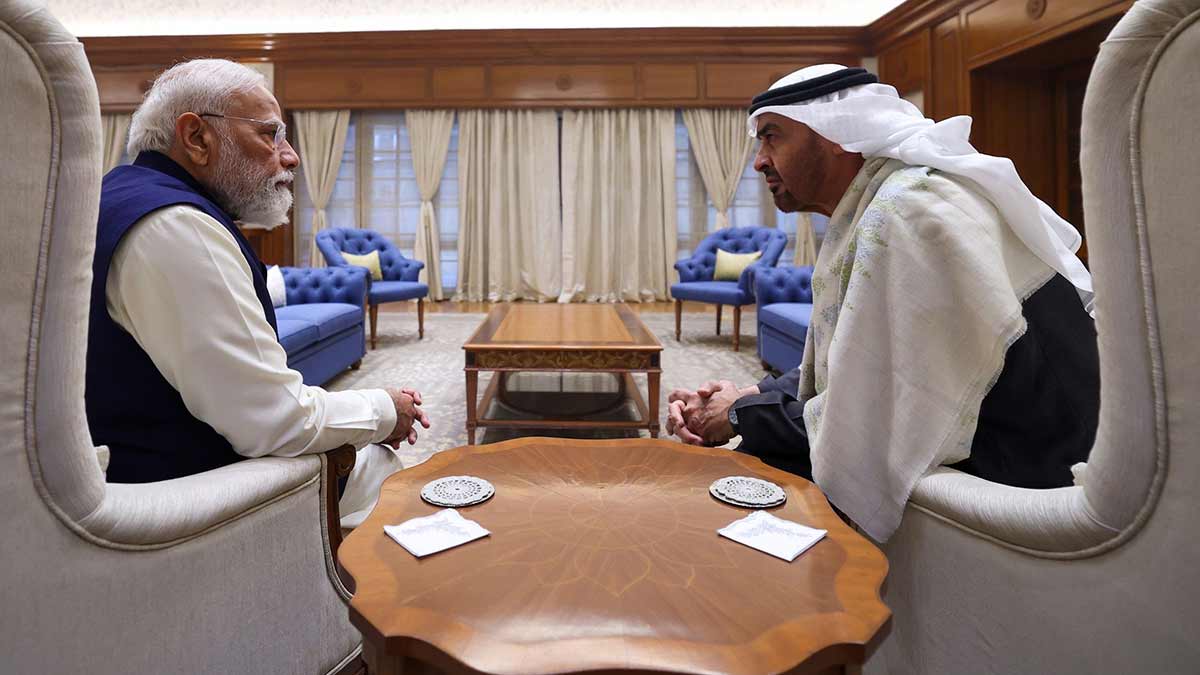
Over the past decade, India–UAE relations have acquired a rare quality in today’s turbulent geopolitics: stability combined with steady deepening. The UAE has emerged as India’s anchor partner in the Middle East, a status reaffirmed by the visit of UAE President Mohamed bin Zayed Al Nahyan (MbZ) last month. The visit was rich with outcomes, underscoring the maturity and strategic depth the relationship has attained. Since Prime Minister Narendra Modi’s first visit to the UAE in 2015, this was the 11th leadership-level engagement—testimony to the priority both sides attach to the partnership.
What makes the relationship distinct is its generational continuity. The visits of Abu Dhabi Crown Prince Sheikh Khaled bin Mohamed bin Zayed in September 2024 and Dubai Crown Prince Sheikh Hamdan bin Mohammed bin Rashid Al Maktoum in April 2025—both at the prime minister’s invitation—were not merely symbolic. They produced concrete outcomes across defence, nuclear cooperation, energy, education and economic engagement, reinforcing the sense that India–UAE ties are being future-proofed.
India’s vital stakes in the Gulf are well recognised in New Delhi. Nearly nine million Indians live and work in the region, while bilateral trade with the Gulf accounts for close to $180 billion. Against this backdrop, inviting MbZ as chief guest for India’s Republic Day in 2017 was a strategic signal. That visit culminated in the signing of a Comprehensive Strategic Partnership Agreement, laying the foundation for the rapid expansion of ties. The momentum accelerated further with the Comprehensive Economic Partnership Agreement (CEPA) in 2022—the UAE’s first CEPA and India’s first in the Middle East. The accompanying vision document outlined an ambitious, forward-looking roadmap.
High levels of trust have encouraged both countries to experiment with new, and often pioneering, initiatives. Education is a case in point. The UAE became the first country to host overseas campuses of India’s premier institutions, with IIT Delhi in Abu Dhabi and IIM Ahmedabad in Dubai now fully operational. These campuses enhance the global profile of Indian higher education while serving the aspirations of the Indian diaspora. Financial and technological cooperation have been equally innovative. The UAE was the first country to build its domestic debit-card system, the Jaywan Card, on India’s RuPay platform, and the first major trading partner with which India agreed to conduct trade in national currencies. Already, over 9 per cent of bilateral trade is settled in rupees and dirhams.
People-to-people and cultural ties have also been institutionalised. To serve the needs of 266 CBSE-affiliated schools with more than 4.7 lakh students in the Gulf, the CBSE opened its first overseas office in Dubai in 2024. The inauguration of the BAPS Hindu Temple in Abu Dhabi by Modi in 2024—the largest in the Middle East—stands as a powerful symbol of the UAE’s inclusive ethos and the confidence underpinning bilateral ties.
MbZ’s recent visit added further substance. Outcomes ranged from a defence cooperation framework and a joint space initiative to a $200 billion bilateral trade target, collaboration on artificial intelligence, data embassies, infrastructure investment, small modular nuclear reactors, a supercomputing cluster in India and a ten-year LNG supply agreement. Particularly significant was the signing of a letter of intent towards a strategic defence partnership, a timely development given the evolving security architecture in the region.
The UAE’s role as a long-term investor in India’s growth story is now firmly established. Abu Dhabi Investment Authority’s $1 billion commitment to India’s National Investment and Infrastructure Master Fund in 2017 was an early signal of intent. Since then, the UAE has emerged as India’s seventh-largest source of foreign direct investment, with cumulative inflows exceeding $22 billion, much of it directed towards infrastructure.
CEPA’s early results have been encouraging. Bilateral trade has grown by 37 per cent since 2022–23, prompting leaders to set an ambitious target of $200 billion by 2032. With India’s exports to the UAE rising 28 per cent last year to $36 billion and imports increasing 41 per cent to $64 billion, the target appears achievable. At a time when unilateral tariffs by the United States threaten to dampen export growth, deeper engagement with reliable partners like the UAE provides a valuable buffer. Beyond numbers, CEPA has strengthened trust between businesses and investors, generating positive spillovers in investment and supply-chain integration.
New trade-facilitation initiatives further reflect this pragmatic ambition. Bharat Mart at Jebel Ali is expected to give a major boost to Indian MSME exporters seeking access to global markets. The proposed Bharat–Africa Setu aims to leverage DP World’s logistics footprint across Africa with India’s export strengths, spanning West Asia, Africa and Eurasia. The Virtual Trade Corridor announced during Sheikh Khaled’s visit is close to becoming operational, with potential benefits not only for bilateral trade but also for broader connectivity initiatives such as the India–Middle East–Europe Economic Corridor.
Cooperation in civil nuclear energy marks another strategic frontier. Building on the MoU signed in September 2024, both sides have agreed to explore partnerships in advanced nuclear technologies, including large reactors, small modular reactors, plant operations, maintenance, and nuclear safety. With the UAE generating nearly a quarter of its domestic electricity from nuclear power—the only GCC country to do so—the complementarities are evident. This collaboration aligns well with India’s clean-energy commitments and recent legislative initiatives.
The significance of President MbZ’s visit, however, goes beyond the announced agreements. Intra-GCC political dynamics, which have dominated headlines in recent weeks, carry implications for India’s interests. Navigating the Middle East requires constant recalibration—deepening ties without becoming entangled—guided by India’s principles of strategic autonomy and multi-alignment. In this complex landscape, the UAE has consistently proved to be a trusted, all-weather partner.
The writer is distinguished fellow, JSW School of Public Policy, IIM Ahmedabad and former ambassador to the UAE and the Maldives.
