



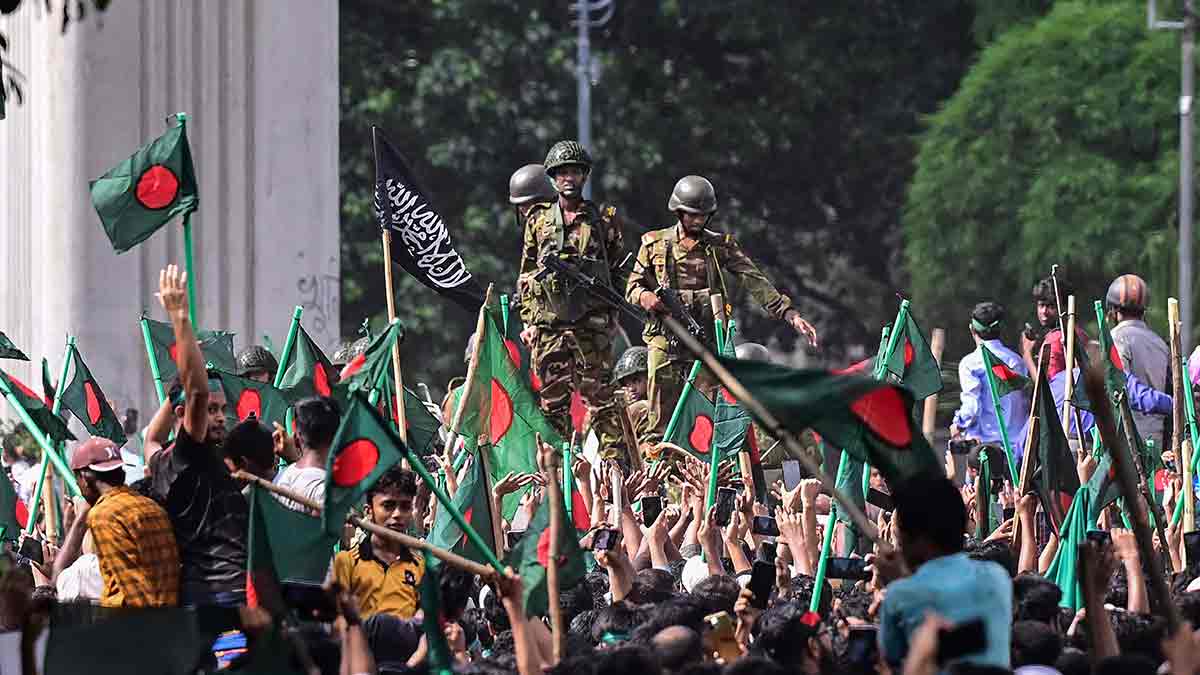
ON AUGUST 5, 2024, Bangladesh hovered on the edge of civil war as protesters surged towards Gono Bhaban, the prime minister’s residence. The police system had broken down, streets were ruled by anger and violence spread faster than any order from above. In that moment of collapse, the Bangladesh army made two decisions that would define the day. It refused to fire on the protesters and it moved Sheikh Hasina out of the country to safety before announcing her resignation and the formation of an interim government.
Since then, the army’s role has been fiercely debated. Many Bangladeshis are angry that the same institution which refused to protect citizens from state violence in July now protected the prime minister as she fled. Others argue that in the chaos of that day, preventing her assassination was the only way to avoid an even bloodier spiral of revenge. The debate is not merely emotional. It goes to the heart of what kind of political actor the army wants to be in the new Bangladesh now struggling to emerge.
Here, history matters. Bangladesh is a country where the killing of heads of government is not theoretical. Sheikh Mujibur Rahman, the founding president, was assassinated with most of his family on August 15, 1975. Only his two daughters, Sheikh Hasina and Sheikh Rehana, survived; they were abroad at the time. A few years later, president Ziaur Rahman, the founder of the Bangladesh Nationalist Party (BNP), was murdered in a military mutiny in Chittagong in 1981. These memories are not distant; they shape every elite calculation about regime change and personal safety in Bangladesh.
Seen from that angle, the decision to let Hasina leave the country alive, rather than be dragged out of Gono Bhaban by an enraged crowd, was not a small thing. It limited the risk of Bangladesh adding a third political assassination to its already heavy history. It also created the conditions for a more orderly transfer of power to an interim government headed by Nobel laureate Muhammad Yunus, appointed just two days later.
Of course, saving Hasina’s life did not, and should not, erase questions of accountability. A UN-backed fact-finding report and Bangladesh’s own tribunals now speak of between 800 and 1,400 people killed during the July–August crackdown on protesters. Hasina herself has since been sentenced to death in absentia for crimes against humanity. The fact that she is alive and sitting in India does not protect her from legal scrutiny; it simply avoids turning justice into revenge. From a democratic standpoint, that distinction matters.
The central political question today is, therefore, not whether the army escorted her out. It is what the army has done since. Did it behave like so many militaries before it, using a moment of civilian collapse to seize power? Or did it try to act as a temporary referee, helping to manage an unavoidable transition and then stepping back?
To answer this, we have to look at the longer pattern of civil-military relations in Bangladesh. There are, broadly speaking, two traditions. The first is the seizure of power by uniformed rulers. General Hussain Muhammad Ershad, then army chief, ousted president Abdus Sattar in a bloodless coup in 1982, imposed martial law and ruled as a military dictator until he was forced to resign in 1990.
The second tradition is quieter but no less important: moments when the army refuses to be the regime’s last line of defence, yet does not itself turn into the new ruler. In 1990, during the mass uprising against Ershad, the then army chief, Lieutenant General Nuruddin Khan, declined to back the dictator’s attempt to crush the protests. Instead, the military signalled that Ershad had to go and a neutral caretaker arrangement under Justice Shahabuddin Ahmed was created to organise the 1991 election that restored parliamentary democracy.
The events of 2024-26 sit within this second tradition. General Waker-Uz-Zaman became the chief of army staff in June 2024, just weeks before the uprising reached its peak. General Zaman is Sheikh Hasina’s cousin-in-law. At the time of his appointment, many accused him of benefiting from nepotism and assumed he would continue supporting his relative and her rule. However, it appears that the general has remained professional and fulfilled his role as army chief rather than acting as Hasina’s cousin-in-law. On August 5, the army chief did not declare martial law. Instead, he publicly confirmed Hasina’s resignation and pledged support for an interim civilian government. Since then, the army leadership has repeatedly insisted that elections must be held within a clear timeframe and that it has no intention of ruling the country. In an interview in September 2024, the army chief publicly backed the interim government, saying he would “stand beside it, come what may”, and, for the first time, suggested that the transition to a democratic government should be completed within about 18 months.
At the same time, the army has been blunt with the Yunus government. It has warned that keeping soldiers on the streets indefinitely is bad for both democracy and the military itself. Long deployments in internal security roles, generals know from experience, breed corruption, human rights abuses and political temptation. That is why General Zaman has overseen the forced retirement or dismissal of several senior officers accused of past abuses and handed over a group of officers to face charges over enforced disappearances. For a force once seen as untouchable on such issues, this is not cosmetic. It is a signal to both rank-and-file soldiers and civilians that the old culture of impunity cannot simply continue under a new banner.
Yet the picture is not simple and it would be naive to romanticise the army’s role. The same institution that refused to massacre students in August had been deployed across the country since July, after the police effectively collapsed, and there are credible allegations that soldiers stood by while violence took place in some localities. The longer the military is entangled in day-to-day law and order duties, the harder it becomes to maintain the line between ‘guardian of stability’ and ‘arbiter of politics’.
The regional context adds another layer of complexity. After Hasina fled to India, and especially following the assassination of student leader Sharif Osman Hadi last month, anti-India sentiment surged in Bangladesh. Attacks on Indian-linked institutions, such as the Indira Gandhi Cultural Centre, and on media outlets like the Daily Star and Prothom Alo followed. Some groups openly called for confrontation along the India-Bangladesh border. Here, too, the army sits in a delicate position. It must manage genuine security concerns and cross-border tensions while resisting the temptation to ride a wave of nationalist anger.
Looking beyond Bangladesh helps clarify what is at stake. In Tunisia in 2011, the army’s refusal to shoot at protesters forced Zine El Abidine Ben Ali from power and allowed for a real, though fragile, move towards democracy. In Egypt, the army let Hosni Mubarak fall but later took control again, with General Abdel Fattah al-Sisi ushering in a new period of military rule. Sudan offers an even starker warning. The military removed president Omar al-Bashir in 2019 after mass protests, only to stage another coup and plunge the country into war.
These cases show that a military’s first decision not to shoot can be heroic, but it is never the last decision. The real test comes later: will generals accept a loss of influence when civilians argue, quarrel and sometimes mismanage the transition? Or will they decide, once again, that only they can ‘save’ the nation?
Today, Bangladesh’s army stands at a crossroads. On the positive side, it has followed the Nuruddin Khan example rather than the Ershad one: refusing to be the regime’s last defender, supporting an interim civilian government, pushing for elections within a clear timeline and beginning to confront its own human rights record. On the negative side, the army still wields immense power. Politicians seek its input on almost every major decision. Once a military grows accustomed to being the final judge, it is difficult to accept the disorder of real democracy, where leaders make mistakes, protests erupt and outcomes are rarely tidy.
For citizens, the goal is not simply to support or oppose the army. It is to set clear expectations that, after a fair election, the armed forces must return fully to their professional duties under civilian control. Anything less risks repeating the cycles that have plagued the country since 1975.
The July uprising opened a narrow and costly window for Bangladesh. Students and ordinary citizens took enormous risks to force that space open. The army’s choice not to crush them, and not to seize the state for itself, helped prevent total breakdown. That deserves recognition.
Asif Bin Ali is an Atlanta-based geopolitical analyst and doctoral fellow at Georgia State University.
