


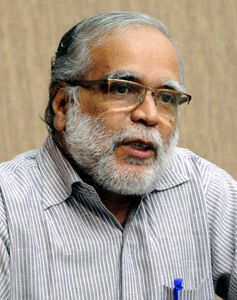
 A.K. Ramakrishnan
WHEN ALI SHAMKHANI, the head of Iran’s negotiating team in the nuclear talks with the United States, was targeted, though unsuccessfully, along with the killing of military leaders, nuclear scientists and civilians in the first set of Israeli missile strikes in Iran, we knew that the diplomatic path to a negotiated settlement of the nuclear issue had also been killed by Israel. President Donald Trump said “the persons I was dealing with are dead”. Iran abandoned the nuclear talks in Oman once the Israeli attacks intensified and it began counterattacks. The Israeli political leadership, Prime Minister Benjamin Netanyahu in particular, wanted a direct military confrontation with Iran and knew very well that Trump would ultimately come around.
Trump was consulted by Israel before launching the air campaign against Iran, and it has become clear that he gave the nod. Netanyahu’s genocidal military campaign in Gaza was dragging on without any foreseeable end. War, to him, had become a means of conducting everyday politics. He did not want Iran to undertake any level of nuclear enrichment, nor did he entertain any possibility of a negotiated settlement between the US and Iran. For Netanyahu, the military option against Iran was not just about the nuclear issue but also about dismantling Iran’s military and political leadership. The regime change agenda with respect to Iran was stressed by him in the initial statements following the missile attacks. This is where, strategically, no end point seems to be in sight. To achieve any of these objectives, the involvement of the US becomes necessary.
Israel has long nurtured a nostalgia for its military success in 1967, when it defeated neighbouring Arab armies and captured large swathes of their territories: the Sinai Peninsula of Egypt, the Golan Heights of Syria, the West Bank, Gaza Strip and East Jerusalem, all in six days. Israeli leaders and citizens have also taken great pride in the state’s defence capabilities and security apparatus. Taking advantage of the context of the nuclear negotiations between Iran and the US, Israel was able to bring the element of surprise to its attack on Iran. Iran seemed unprepared. But the expectation of a quick success evaporated when Iran regrouped and launched counterattacks on Israeli targets within a day. The intensity of the Iranian response, using drones and long-range missiles, shook the notion of the invincibility of Israel’s defence system.
The very idea of regime change and its past implementation in West Asia have had huge consequences. Not only does it challenge the foundational principles of the Westphalian sovereignty-based international system, it also propagates the myth that a foreign intervention can fundamentally alter a political system and take away the agency of citizens to determine their future. There has been genuine opposition in Iran to the government on several issues related to the economy, women’s rights and more. People have expressed their political opinions in various elections as well. Netanyahu’s call to remove Supreme Leader Ayatollah Ali Khamenei, or the threat by Israeli Defence Minister Israel Katz that “Khamenei will have the fate of Saddam Hussein”, is actually a challenge not just to the Iranian regime but also to the political will and acumen of the Iranian people. Israel and the US somehow believe that eliminating the leadership will destroy long-standing structures and institutions of power.

Trump posted on his social media handle immediately after returning from the G7 summit in Canada that “we now have complete and total control of the skies over Iran”. Strangely, he claimed such control even before formally entering the conflict that Israel had initiated. He was also calling for everyone in Tehran to evacuate immediately. The point here is the synchronisation of Israel’s actions with those of the United States. Trump seems to be shedding his initial reluctance to join Israel’s military adventure.

The Trump administration could project a credible and well thought-out strategy with respect to Iran. But Trump’s personality and the unpredictable nature of his decision-making make it difficult to discern any consistent pattern in US behaviour. What is emerging now is a reactive rather than proactive American stance on developments in West Asia. The pulls and pressures from Trump’s own MAGA circles on the question of entering another war, combined with lobbying from strong pro-Israeli groups and many Republicans, complicate the formation of a policy that weighs both short-term and long-term implications of US involvement.
There are many things the Trump administration must consider before involving itself in Iran. It is not only the violation of his campaign promise not to pursue wars abroad, but also the economic consequences of a conflict spilling into the Gulf oil fields and shipping lanes that his administration must account for. It was Trump’s unilateral withdrawal in 2018 from the Iran nuclear deal that cost the US a significant opportunity to resolve the nuclear issue with Iran. The American and British role in overthrowing the elected Iranian government of Mohammad Mosaddegh in 1953 continues to have lasting consequences. In this context, the memory of the far-reaching implications of the Iranian Revolution of 1978–79 and the hostage crisis should also serve as a cautionary reminder to the United States before it fully commits to military confrontation with Iran.
The author was professor of West Asian Studies, Jawaharlal Nehru University, New Delhi.