


CAN FRIEDRICH MERZ, the new German chancellor, spark a ‘Sputnik’ moment in Europe? In 1957, the Soviet Union launched the world’s first earth-orbiting satellite, shattering the US grandeur of tech supremacy. American president John F. Kennedy immediately mobilised his “moonshot” programme, which culminated in the US landing on the moon in 1969. A “giant leap” indeed for mankind.
Few expect Merz, 69, to lead Europe to such glory. But there is anticipation that he may herald a significant turning point in the continent. His very first proclamation after the election victory portends the winds of change: “Europe has to be independent of the United States,” he declared. The bombshell made headlines because he—and Europe—have consistently been pro-America. Says political analyst Nahal Toosi, “Merz’s attitude now is ‘How can we punish the United States?’”
Merz’s about-turn was provoked by President Donald Trump who peppered Europe with insults and snubs, and threats to impose tariffs, seize Greenland, ditch Ukraine and meddle in elections. Trump’s destabilisation of the world order undermines the European Union’s geopolitical status, economic interests and social cohesion. European Commission President Ursula von der Leyen observed, “The west, as we knew it, no longer exists.”
Though Merz’s conservative Christian Democratic Union and its ally Christian Social Union won the elections in February, Merz was appointed chancellor only in May because the complicated coalition formation negotiations dragged on for months, which is typical in Germany. But even as chancellor-in-waiting, Merz backed his call for independence from the US with historic action.
After the 2009 financial crisis, Europe had restricted government loan-taking to 0.35 per cent of GDP to control debt. With impressive determination and speed, Merz shepherded through the parliament a massive €1trillion financial stimulus package to revamp infrastructure and defence. “This sends a clear message: Germany is back,” he proclaimed triumphantly. Says Mohamed El-Erian, leading economist and president of Queens’ College, Cambridge, “This change in funding is a potential ‘Sputnik moment’ in Europe.”
Like the US in the 1960s, Merz says Europe must awaken from its complacency and regain its self-reliance and independence to achieve its rightful destiny in the world. He says there must be an assertive “European voice” speaking the “language of power”.
But power usually flows from the barrel of the gun. After WW2, Europe transformed from a shattered military-industrial complex to a “lifestyle superpower”. Relying on US protection, Europe ignored defence and invested in welfare policies to achieve peace, progress and prosperity.
But this reliance cemented Trump’s loathing of Old Europe—France, Germany, the UK and Spain—as “pathetic, freeloaders”; a view trumpeted by his advisers. Trump displayed his contempt for Europe by excluding it from the Russia-Ukraine talks, insinuating he might not defend European countries if Russia attacked and showing willingness to recognise Russian sovereignty over Crimea. Under Trump, European borders suddenly seemed vulnerable. Merz explained the €1 trillion financial bazooka would counter deteriorating relations with the US and a menacing Russia on its border.
Merz now strives to cobble European unity to face international threats. But even achieving national unity is tough. The 2025 polls—a historic election at a historic time—revealed the fragmentation of the liberal-conservative polity that had shaped Germany’s post-WW2 shared vision and consensual decision-making process. At 84 per cent, voter turnout was the highest since the 1990 East-West German reunification. Securing a pitiful 16 per cent of votes, the outgoing liberal Social Democratic Party (now a junior member of Merz’s coalition) suffered its worst defeat since its founding in 1863.
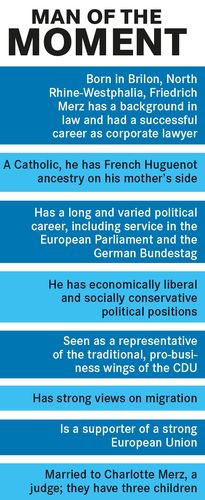
A feisty lawyer and fiery orator, Merz entered politics in the 1970s, determined to become chancellor one day. But he was outwitted by his party colleague Angela Merkel, who was chancellor for 16 years. Of their rivalry, Merkel said candidly in her memoir: “He always wanted to be boss. There was one problem. So did I.” Frustrated, Merz quit politics, joined the investment company BlackRock, made millions, shopped luxuries including a private plane and returned to politics after Merkel quit.
Symbolising a seismic shift in voters’ mood was the far-right AfD (Alternative for Germany) winning 21 per cent of the votes. German establishment’s firewall prevents the xenophobic AfD’s inclusion in ruling coalitions. But, as the second largest party, it now leads the opposition. The far-left and far-right together command a third of parliamentary seats. They can block constitutional procedures. Adding to Merz’s headaches, both groups are Eurosceptic, anti-immigration, anti-woke, pro-Trump and pro-Putin.
The AfD attracts voters, especially the youth, who distrust the government. It is the refuge of neo-Nazis, extremists, anti-vaxxers and other conspiracy theorists. The rise in immigrant crime doubled the party’s vote share in four years. Its distortions of history matter little. Co-leader Alexander Gauland dismissed Nazi atrocities as “just bird shit”. Contradictions matter even less. The misogynistic, homophobic party that virtue-signals “real families” comprising father-mother-children is led by a lesbian, Alice Wiedel, married to Sarah Bossad, a Sri Lanka-born film producer, who lives with their two adopted sons in Switzerland with an in-house Syrian refugee who Wiedel claims is a “guest”, not migrant worker. A former investment banker, Wiedel has a Hitler-appointed Nazi judge grandfather, who was dragged out of the family closet only recently.
After its electoral win, the hard-right AfD has become harder. It inducted into its parliamentary group several rabble-rousers and street fighters, including Matthias Helferich, the self-described “friendly face” of Nazism. He refers to immigrants as “beasts,” reminiscent of Trump’s description of migrants as “vermin”. Another one, Maximilian Krah, who underplayed Gestapo crimes, was embroiled in a scandal over receiving payments from Russia and China. Dario Seifert, a former member of a notorious extremist party’s youth wing, won Angela Merkel’s seat. Calls to ban AfD renewed this week after Germany’s domestic intelligence classified the AfD as “extremist” for violating the constitution by “encouraging prejudice”. Far-right groups in Germany, France and the UK are fanned by Trump, his advisers J.D. Vance, Elon Musk and Steve Bannon. “The AfD is becoming more extreme than it was even three years ago,” says political scientist Benjamin Höhne.
Merz’s anti-Russia rhetoric annoys left and right-wing sympathisers, but mainstream voters appreciate that he “speaks understandably”. Research institute Forsa’s poll, however, shows two-thirds of voters find him “untrustworthy”. They disapprove his flip-flops—he crossed the red line to vote with the untouchable AfD to crackdown on immigrants; broke his campaign promise of financial restraint to leverage €1 trillion. Ever since he voted in 1997 against liberalising abortion and criminalising marital rape, Merz has been unpopular with women voters. Still, in these uncertain times, his “Forward Again” slogan promising stability, economic growth and a stronger role for Germany in the EU contributed to his election victory. But since February, his party’s low popularity ratings have gone even lower, stalling at 24 per cent—the same as AfD.

Fuelling AfD’s rise is German economic and security anxieties. Covid slowdown, sanctions against Russia that deprived Germany of cheap Russian oil and gas (which had lubricated its export-oriented economy for decades), inflation, low-priced Chinese imports and Trump’s tariffs undermine the manufacturing heft of Europe’s biggest economy. It makes tanks and missiles, but its conventional military is understaffed and underequipped. People worry Trump may withdraw the 35,000 American troops stationed in Germany. In the past, Russia would not dare to attack, knowing the US would defend Europe. Now nobody is sure. France and the UK are nuclear powers, Germany is not. Merz explores the possibility of French and British nuclear umbrella for Germany to replace US nuclear guarantees. Clever idea, but time-consuming and complex to execute, involving issues of capabilities, command and control.
Fear-mongering aggravates nervousness. Nato secretary general Mark Rutte warned, “I am telling you very clearly: we must prepare for war.” Carsten Breuer, the German chief of defence, warned the Russian threat was “deadly serious”. Denmark’s Defence Intelligence Service claimed Russia would be able to move against another neighbour within six months. Germany’s interior ministry is drawing up a list of bunkers that could provide emergency shelter for civilians.
The EU sees augmenting its defence as integral to its security, especially because it has prickly relations with Russia, China and now the US. Merz intends to thwart Trump from diminishing Europe into a sideshow, a bystander that gets squeezed in the US-China collision. He asks voters: “Do we want to keep playing in the lower leagues, or be in the Champions League and play a role in the world?” Last time, that quest ended in catastrophe. But post WW2, contrition and renunciation of war has served Germany well, especially economically.
Now Germany is determined to reclaim its military might. Repurposing a train factory to produce parts for Leopold tanks and infantry vehicles is an example of Germany’s military-industrial tilt, away from its faltering manufacturing sectors of automobiles, machinery, and chemicals that have shed 2,50,000 jobs since the pandemic. But military manufacturing is sustainable only if wars continue, an uncomfortable thought yet to gain traction.
For years, Europe talked about ‘strategic autonomy’ but cradled into strategic US reliance. Forced to yank its head from under the sand, Europe scans the terrain, spotting both dangers and opportunities. Decisive German leadership can strengthen Europe militarily and economically. Cherrypicking is not EU-style, but plucking low hanging fruit is. A mere 2.4 per cent increase in intra-EU trade can make up for a 20 per cent fall in exports to the US. Defence collaboration with Nato-member Britain can increase, so can trade by smoothening Brexit frictions. Measures can be implemented to enhance Europe’s competitiveness.
Despite its reputation as a soft power, Europe commands significant hard power. With 450 million citizens, the European Union is the world’s largest market, bigger than America’s 340 million. It is a world leader in good governance, regulatory frameworks, democratic credentials, welfare policies, independent institutions, liberal values, sophisticated products and work-life balance. Now, the rearmament programme resurrects its military industrial complex.
Dramatic election defeats of Trump-like politicians in Canada and Australia prove that Europe is not alone. Says British economics journalist Martin Wolf, “Biden may be old. But Trump is crazy. Alas, he is not amusingly crazy, he is dangerously crazy.”
Experts agree Trump’s decisions have hurt US stocks, bonds and currency, jeopardising global stability and fomenting a vacuum. “The free world needs a new leader. It is up to Europeans to take up the role,” says EU’s representative for foreign affairs Kaja Kallas.
Merz seems ready for the challenge. He promises the financial package will achieve several goals—make Germany strong, strengthen its role in Europe, build a new European defence community, deter Russia, stimulate the economy and create jobs. Merkel was a clever, soft-spoken facilitator, appropriate for her time. Sharp-tongued Merz is different. Says Herfried Münkler, a political scientist at Berlin’s Humboldt University, “Merz is rougher and bossier.” He is the man of the hour. It may or may not be Europe’s Sputnik moment. But it certainly is Merz’s.