


London-based artist Stuart Robertson was feeling like a bridegroom at an Indian wedding when I spoke with him over Zoom. All around him there was the chaos of artworks getting packed and moved in preparation for his exhibition at Bikaner House earlier this month. “Everyone’s running around while I’m just sitting here like a stuffed shirt,” he smiles. “Indians really know how to organise a function. It’s amazing how they take over. I feel like I’m caught up in a tidal wave. Or an Indian wedding.”
It all began a few years ago when Robertson sold two large watercolours to an eye surgeon working at Dr Shroff’s Charity Eye Hospital in Delhi. When he gave the proceeds of the sale back to the hospital, he was invited to spend time there interacting with the doctors, nurses, patients and support staff. This turned into an 18-month residency in the hospital when Robertson witnessed a kaleidoscope of emotions—anxiety, fear, compassion—on a scale he had never before. “Someone told me that working in an eye hospital cannot have been very dramatic. But let me tell you—when you witness someone who can’t see suddenly see for the first time in their lives, it is pretty dramatic,” says Robertson.
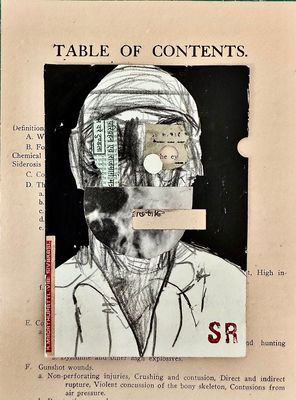 An artwork based on an old surgical book from the hospital.
During the residency, he produced around 280 pieces of art, most of which were exhibited at Bikaner House. Initially, he would observe people before drawing them. The first few drawings were “absolutely awful”, he says. But he found his feet. When Robertson showed his collection to Dr Umang Mathur, CEO of the hospital, the doctor suggested that the works be exhibited in a show. “I just walked into Bikaner House—a highly sought-after venue—and showed my work,” says Robertson. “They felt it was unusual, because no one does a residency in a hospital in India.”
The exhibition—with photographs, drawings, bronze sculptures and cyanotype or sun-developed images—was curated by Ashish Sahoo and Zaarya Chaudhari. Everyone, from the surgeons to the gardeners and security guards at the hospital, became grist for Robertson’s lens. Many of the drawings were done on site, like the one about a man who lost his sight when he was six months old. Now he sits in the hospital and teaches braille. “He was delightful, always smiling,” says Robertson.
He also extends his practice into the surrounding regions of Daryaganj and Chandni Chowk, capturing a mood, a clamorous stillness, that pervades not just the hospital, but Old Delhi at large. Much of the exhibition positions the hospital like a clockwork system, with the “surgeons as its engine and heart, nurses as the lifeblood, guards watchful yet relaxed, trainees intent and hopeful”. In a way, the exhibition was a family affair, with Robertson’s son working on a blog about his stint at Dr Shroff’s and his two daughters helping edit a film that is being exhibited.
Robertson has learnt much during his time in the hospital. “When you look at someone who is going to lose their sight in a few moments and then you go outside and see someone complaining that their car’s been scratched—there’s a life lesson there for sure,” he says. He used to walk around his house sometimes with one eye closed. It was “extremely difficult because you lose depth of field straightaway”.
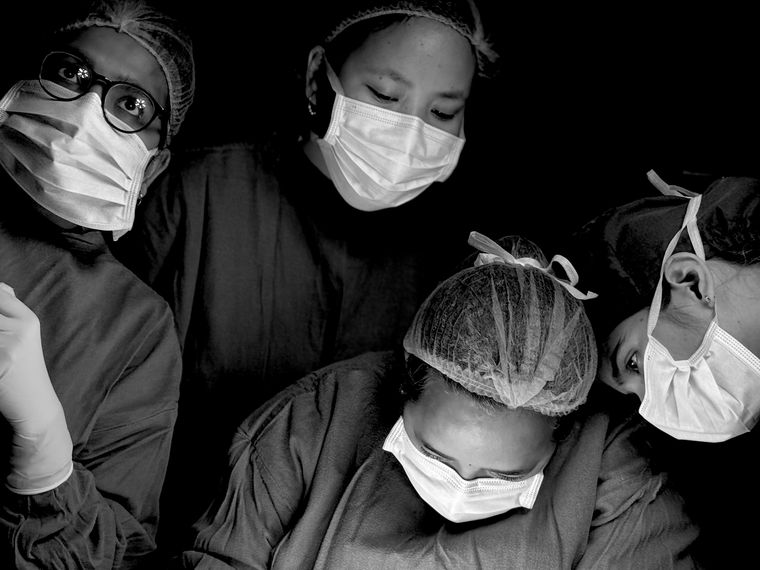 Medical staff in the operation theatre.
He recalls the times he saw surgeons working in the operating theatre. “Sometimes, a person has to be deprived of sight because of cancer or some other disease,” he says. “The surgeon has to cut off the optic nerve, which is only a fraction of the size of a straw. The moment when she is about to cut it is so dramatic, because there is no going back after that.”
Two days into the exhibition, I spoke with him once more. By then, he had sold 50 artworks, with all the proceeds going to the hospital. He turned the camera to show me a group of women in lavender uniforms walking out of the exhibition. “They are from Daryaganj and they work in the hospital,” he says. “Many of them have never been to an art exhibition. It is people like them who quietly run the hospital.” This air of quiet efficiency goes right up the hierarchy to Mathur, the CEO. If Mathur had been rude or reticent, Robertson would not have stayed for so long, he says.
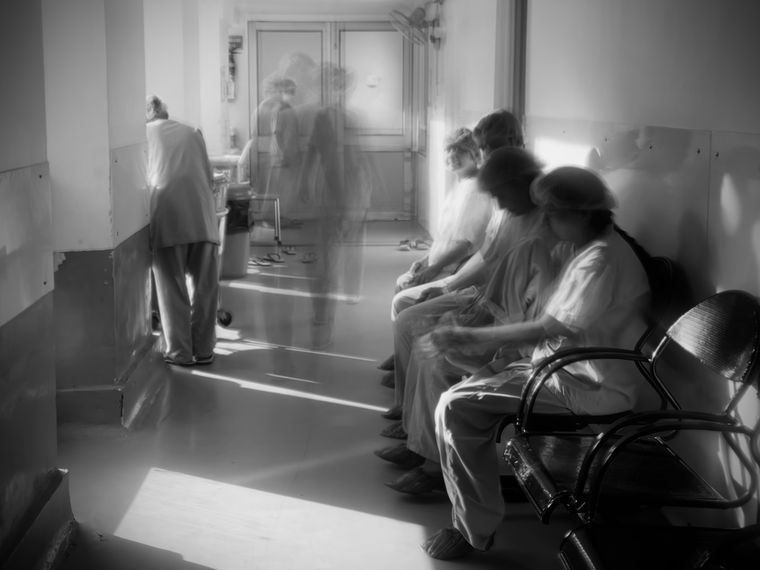 Patients in the waiting area
The feeling is mutual. “[The exhibition] is, for me, as much about friendship as it is about art,” says Mathur. “Stuart first came to us as a donor, but very quickly became something far more special—a friend who chose to observe and to immerse himself in seva…. Through Stuart’s lens, the hospital is not just a building, it breathes, drawing energy from the life around it and giving back in equal measure. This exhibition is his gift back to us.”
Robertson was born in Kent in 1962 and moved to London in 1981. He studied at both Maidstone and Wimbledon Schools of Art and worked as an illustrator for Penguin Random House, The New Scientist, and The Times publications. “I have been painting since I was four years old,” he says. “As a child, I would stop in a park to observe the formation of leaves and flowers while my friends walked on. They used to find me a little weird.”
That is why he is in love with India. “The country is so visual it is like it is on steroids,” he smiles. His association with India goes back a long way, when he lived and worked here as head illustrator for The Times of India for a few years from 1989. During this period, he had three solo shows at the British Council and the Art Today Gallery, beginning a love affair with the country that would go on long after he returned to the UK. “Indians are not frightened of colour at all,” he says. “Visually, it is an assault on your eyes. There is so much of diversity here—the saris, the architecture, even the posture of people is different from Europe or America.”
But this residency was special. It gave him a new appreciation for sight as an artist, and the unique ways in which sight and art interact. The resulting artworks do not just play with forms and shapes, but bring them together in a way deeply reflective of the artist’s compassion and complexity. The art of observing sight becomes as fascinating as the art of seeing itself.