


It was 4pm on a sweltering April afternoon in Delhi—an hour better suited for a nap than a lecture. But inside the Civil Lines Social in Delhi, the room was packed. This wasn’t a cricket screening or your usual high-octane event more suited for a bar setting. People had gathered for a lecture on ‘What Does Loving the Wrong Thing Say About You?’ by Prerna Subramanian, professor at O.P. Jindal Global University, organised by unLecture.
Over the next 45 minutes, the lecture moved across uneasy cultural terrain—from J.K. Rowling’s continued popularity despite her anti-trans views, to broader questions of whether art can, or should, be separated from the artist. References ranged widely, touching on figures like Noam Chomsky, with debates around contemporary cinema and politics. The audience followed closely, some taking notes, others listening over drinks.
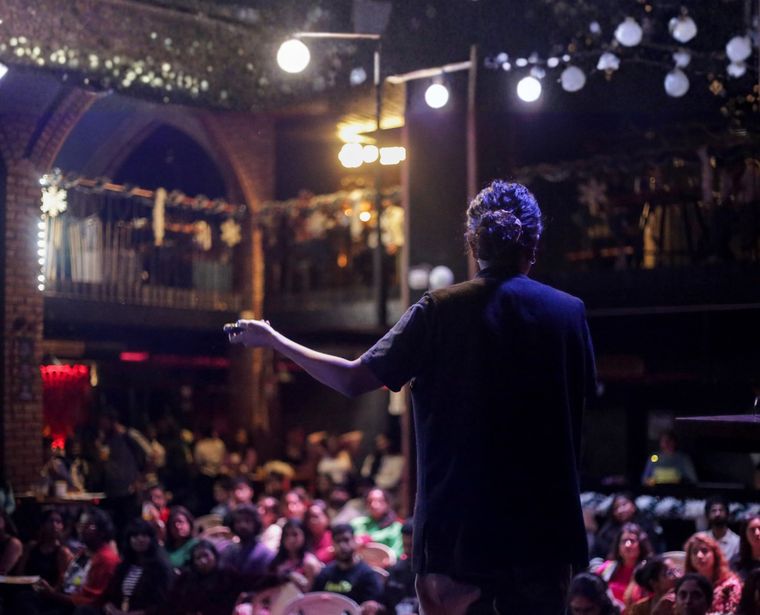 Drink & learn: Lectures at pubs organised by Pint of View | Instagram@pintofview.club
With platforms like unLecture, Pint of View, and Nerd Nite, bars seem to be no longer a place for unwinding. They are instead doubling up as lecture halls, and people are turning up in droves. The attendees comprised a mix of students and working professionals.
Sneha, 21, an economics student at Delhi University’s Hindu College, was attending her first such lecture. “Although I attend lectures all day in college, this feels different,” she said. “It is the environment—you meet like-minded people, and there is no pressure of an exam at the end. Also, 21 feels like a transitional age. Many of my friends have taken up jobs or are pursuing post-graduation. It’s just nice to meet new people.”
Deinstitutionalising knowledge
Founded last August by Bengaluru-based Harsh Snehanshu and Shruti Sah, Pint of View has quickly expanded its lecture-in-a-bar format to cities like Goa, Pune, Jaipur, Mysuru, and Nagpur, apart from the metros.
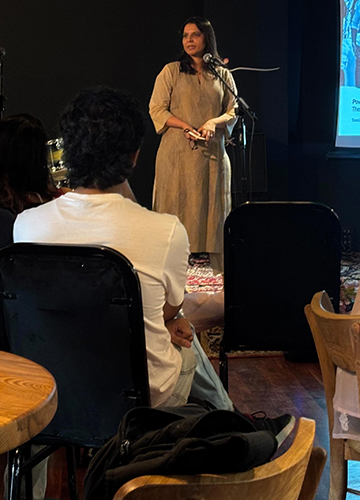 Cheers to studies: Sessions organised by unLecture | Instagram@theunlecture
As the founders of Cubbon Reads, which ushered in the reading-in-the-park gatherings across India, the two are no strangers to building such offline communities. Having seen the popularity of similar formats abroad—Lectures on Tap in the US and Pint of Science in the UK—they set out to build something similar in India.
At its core, the idea is simple: take knowledge out of institutions and place it in more accessible, everyday spaces. “There is an enormous amount of high-quality research and thinking locked inside institutions, often physically and socially inaccessible. By moving lectures into public spaces like bars, we make that knowledge approachable. It breaks the hierarchy and rigidity of classrooms,” said Snehanshu.
The setting of a bar matters here. “First, it removes the intimidation that often comes with formal academic spaces and relaxes the atmosphere. And second, it turns the lecture into an experience rather than an obligation,” said Sah.
Subramanian, who goes by doctorofpopculture on Instagram, says the shift from classroom to bar is more than just a change in setting. “A college classroom carries built-in hierarchy, evaluation and institutional discipline, and there is also a sense of predictability. In a bar or salon format, those codes loosen. People often ask questions more freely and seem less worried about sounding ‘correct’ or being graded,” she said.
That ease also shows in the range of topics such sessions attract—from ‘Why Are Women Shut Out of IITs?’ and ‘Martian Tales From a Former NASA Engineer’ to ‘The Ethics of Love: Desire, Inheritance and Survival’. “There is also curiosity across disciplines. People who studied science want to explore the arts, and vice versa. And even within their own fields, they want to engage with ideas at a deeper, more current level,” said Sah. “The engagement is real.”
The leisure paradox
According to a recent EY report, Indians spend an average of five hours a day on their phones. Doom-scrolling oneself to sleep is no longer unusual, nor is ‘bed-rotting’ through the weekend, framed as a form of rest. But this version of rest comes with its own side effects, accompanied by the exhaustion of being constantly reachable.
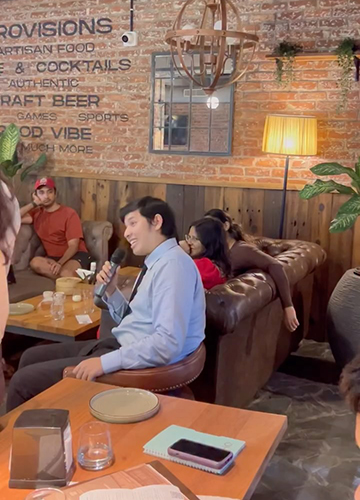 Cheers to studies: Sessions organised by unLecture | Instagram@theunlecture
At the same time, there is a noticeable shift in how urban Indians are choosing to unwind. The rise of sip-and-paint evenings, pottery workshops and similar activities points to a desire for leisure that is both relaxing and engaging. Parallelly, clubs centred around running, cycling, chess, reading and board games are gaining traction, suggesting that people are not just seeking better downtime, but also more intentional ways to connect.
This comes against the backdrop of growing digital fatigue. While social media once enabled connections, it now often causes a sense of burnout. The result is a paradox: hyper-connectivity on one hand, and rising loneliness on the other.
A report by the WHO Commission on Social Connection notes that one in six people globally experiences loneliness. In India, a 2021 Ipsos survey found that 43 per cent of urban Indians aged 18 to 34 report feeling frequently or always lonely, an especially striking figure in a country associated with close-knit family structures. Increasingly, there is pressure to prioritise achievement over building support systems.
The lecture-in-a-bar format sits neatly within this shift. It offers a space for passive unwinding while still engaging the mind, and creates opportunities for connection without the pressure of performance. “Not everyone wants to constantly speak, network or engage in visible ways. A lecture allows for quiet participation. You can just sit, listen, think and leave. That makes it especially appealing to people who want intellectual stimulation without social pressure,” said Snehanshu.
Who gets to belong?
The core of the format is pretty simple: serious ideas in a casual setting. As Snehanshu put it, listening to a lecture over a drink can feel like a quiet protest against the rigidity of formal learning spaces. It also opens up access, allowing people to continue conversations and engage with speakers in ways that are rarely possible within institutional settings.
“The appeal is real,” said Subramanian. “People are tired of the bureaucratic stiffness of institutional life and often want intellectual stimulation in spaces that feel less surveilled by official academic codes.”
But the informality of such settings should not be mistaken for inclusivity. “A bar is not automatically a more democratic classroom,” she cautioned. As she pointed out, cafés, clubs and similar venues often occupy a grey zone—appearing public, but remaining privately governed and accessible only to those who can afford, reach and feel at ease in them. “In India, class never arrives alone,” she said, noting its entanglement with caste, language, aspiration and mobility.
So while the appeal is real, it also begs a harder question: even as these events move intellectual life out of institutions, do they genuinely widen access? Or, “are they simply relocating intellectual life into another selective social world, one that is less institutional on the surface but still structured by class, caste, language, and mobility?” asked Subramanian.