


If Indian politics had a category for ‘widely liked without trying too hard’, Atal Bihari Vajpayee would top it. Vijay Goel’s coffee table book, Atal Bihari Vajpayee: The Eternal Statesman, leans into that image, and the nostalgia largely holds up.
The coffee table book brings together photographs and anecdotes to build a portrait that feels personal without becoming excessive. Goel, vice chairman of Gandhi Samriti and a former minister in the PMO, writes as an insider. He has marked each of Vajpayee’s birthdays with cultural programmes, and that 50-year-old association shapes the tone.

The photographs do much of the work. Mostly in black and white, they suit Vajpayee’s personality. There is no visual excess. The images are restrained and effective, capturing the essence of the former PM’s multifaceted persona.
The book is strongest in its attention to detail and anecdotes, like Vajpayee enrolling for postgraduate study at DAV College, Kanpur, only to find his father studying alongside him, sharing his hostel and classes.

Vajpayee’s arrest during the Quit India Movement of 1942 and his 24-day detention are noted without embellishment. The political journey is familiar, but clearly narrated—his early years in the Bharatiya Jana Sangh under Syama Prasad Mukherjee, his association with Deendayal Upadhyaya, and his gradual rise to leadership after Upadhyaya’s death.
The partnership with L. K. Advani is given due space. Together, they expanded the BJP’s reach. Vajpayee’s remark that he would not have become prime minister without Advani is included, offering balance. Prime Minister Narendra Modi’s long association with the leader is acknowledged in photographs and text. There are also moments from across party lines. His support for Indira Gandhi during the 1971 war with Pakistan is cited as an example of political conduct that is rare today.

Some of the most captivating parts are the smaller anecdotes, like Vajpayee cooking khichdi for J. Jayalalithaa during a dinner in 1999. It is a minor detail, but it reflects the leader’s ability to lower tensions. Another is an account involving former president Pranab Mukherjee. For a time, both were neighbours in Delhi’s Lutyens’ area. Once, Vajpayee was bitten by Mukherjee’s dog during a walk. When Mukherjee enquired about his bandaged hand in Parliament, Vajpayee smilingly replied, “It was your dog who was to blame.”
The section on personal preferences adds texture. Vajpayee liked fish, Chinese food, khichdi and malpua. Favourite haunts ranged from Paranthe Wali Gali to a south Indian restaurant in Delhi. He had a fondness for the music of S.D. Burman, Mukesh and Lata Mangeshkar. Favourite films included Devdas (1955), Bandini (1963), Teesri Kasam (1966), The Bridge on the River Kwai (1957), Born Free (1966), and Gandhi (1982). It builds a picture of a leader who was culturally refined, reflective and introverted at heart—a loner who transformed before crowds.
The oratory, predictably, gets attention—his pauses, his timing and the ability to switch between Hindi and English. The book argues, correctly, that he was as much a listener as a speaker. That part tends to get ignored because speeches are easier to remember than silences.
His years as prime minister are suitably outlined—the 13-day government of 1996, the 1998–1999 term with Pokhran-II, and the 1999–2004 period with infrastructure expansion and diplomatic efforts. There is little critical engagement, which is consistent with the book’s intent. As is the limitation of coffee table books, Goel’s closeness to Vajpayee results in an admiring tone. Even so, its central claim is clear. Vajpayee was a leader who remained acceptable across political divides. Atal Bihari Vajpayee: The Eternal Statesman works as a visual and personal account. It does not aim to be definitive, but offers a curated glimpse of his life and does so effectively.
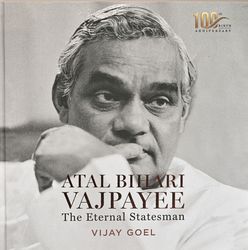
ATAL BIHARI VAJPAYEE: THE ETERNAL STATESMAN
By Vijay Goel
Published by Heritage India Foundation
Price Rs4,000; pages 312