

How did a civilisation with deep cultural continuity and intellectual achievement fail repeatedly to secure itself strategically? This is the question senior bureaucrat Shashi Ranjan Kumar examines in The Decline of the Hindu Civilization: Lessons from the Past. The book offers a balanced, analytical examination of India’s historical vulnerability and highlights ancient India’s intellectual and cultural achievements through comparisons with other civilisations.
Kumar, an IIT Delhi alumnus and 1992-batch Tripura-cadre IAS officer, is now secretary of the Union Public Service Commission. His training is evident in the book’s structured, evidence-driven method, avoiding rhetorical flourish and ideological assertion.
The book reflects a broader trend: authors outside academic history are engaging seriously with India’s past. While not formally trained historians, they approach historical questions with rigour and curiosity, signalling renewed interest in India’s civilisational experience beyond conventional historiography.
The book’s narrative places India within a long history of invasions, beginning with Alexander’s fourth-century BCE campaign. Early invasions, Kumar argues, were destructive but short-lived, as invaders were absorbed after adopting local customs. This pattern broke with eighth-century Arab invasions. For the first time, India encountered a world-view unwilling to assimilate and determined to impose itself, by force if necessary.
The author argues that Bharatvarsha represents civilisational continuity rather than a recent construct.
A central clarification in the book is there was never a time when Hindus did not resist. Resistance took many forms. Conventional warfare was pursued when possible; otherwise, non-conventional means were adopted. There was never psychological acceptance of foreign rule. Survival, however, should not be mistaken for success.
The core argument concerns the absence of sustained strategic thinking. Kumar suggests Hindu society remained inward-looking with limited interest in studying the outside world. While travellers like Megasthenes, Xuanzang, Al Biruni, Marco Polo and Ibn Battuta came to observe and document India, India produced few equivalents who systematically studied rival powers, their military methods or political systems.
This inwardness had consequences. Military tactics sometimes remained unchanged for centuries despite defeats. The book highlights continued use of war elephants. At the Battle of Hydaspes in 326 BCE, Alexander neutralised King Porus’s elephants using fire and cavalry. Nearly nineteen centuries later, invaders used superior artillery to counter larger forces reliant on elephants.
Geography, potentially advantageous, was often used more effectively by invaders. Rivers like the Jhelum and Indus were crossed by invading armies to achieve surprise. Indian commanders rarely employed such strategies. Planning and adaptation lagged behind courage and numbers. Kumar questions why powerful empires like the Mauryas and Guptas never conceived large defensive structures like the Great Wall of China, built by their Qin dynasty contemporaries. This, he argues, reflects lack of long-term strategic planning.
The book points to gradual neglect of realist statecraft traditions found in texts like the Arthashastra. Concepts of intelligence gathering, deception and strategic flexibility faded. Instead, rigid ethical warfare codes and, at times, excessive reliance on astrology and omens caused debilitating defeats.
By contrast, China and Japan viewed external powers with suspicion, regulated foreign contact and undertook deliberate self-strengthening when faced with western expansion.
The author avoids extending his argument into present-day politics or policy. Yet the implications are difficult to ignore—the narrative invites reflection on how modern India understands strategy, power and its place in the world.
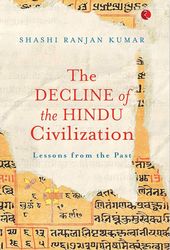
THE DECLINE OF THE HINDU CIVILIZATION: LESSONS FROM THE PAST
By Shashi Ranjan Kumar
Published by Rupa Publications
Pages: 362; price: Rs995