

The last person you would expect to write a book on palliative care is the author who had earlier shot to fame with a bestseller on the Bollywood star known by her single, unforgettable name—Helen. Delving into the guilty delights of watching a cabaret artiste sizzle on screen hardly qualifies a writer to handle a deeply sensitive medical and sociological subject. But, Jerry Pinto, known to pull off surprises, has pulled off yet another with A Good Life: The Power of Palliative Care.
Most of us have hazy notions of palliative care. It is a chapter in medical care that we quietly skip. Such indifference has bred idle and unfounded speculation. Palliative care has to do with slow and lingering death, doesn’t it? Actually, the opposite is true, and that’s what makes A Good Life such a significant book. It tells us, palliative care is, in fact, life-affirming.
The book is also important because it highlights a point that is becoming lost in these days of ‘friendship recession’. The author argues that human beings “are evolutionarily ill-equipped to face the world independently. We have survived and even achieved dominance because we learned how to work together”. Iconic anthropologist Margaret Mead is quoted to have said that she saw the first historical sign of civilisation when she found a healed femur. Else, broken thigh bones would have been common back in the day. But someone had paused, cared and tended to a wounded fellow being. And he/she started the timer on our civilised world.
The book has real-life stories from across the country—from Mumbai, where India’s first hospice came up in 1986, to Thiruvananthapuram, Guwahati, Pune and Hyderabad. There are stories of patients, caregivers and doctors. Different streams flowing in, to add to the body of the river.
Over the years, the horizons of palliative care have been stretched by trailblazing doctors. New concepts recognise that physical pain is only one part of the problem; financial distress, social discomfort and the psychological suffering arising from both are equally significant.
Given the volume of information conveyed, you would expect the book to end up as a mound of data. But the stories are as delicately strung as a web. Jerry’s narration is as usual masterly. He is not a writer as much as a figure-skater on ice—light, fast and arrestingly beautiful.
Reading him, one could be lulled into believing that palliative care is turning life into paradise. But uncomfortable reality stares us in the face. If everything is working well and everybody is as kind as Jerry makes them out to be, why is there still so much suffering in the world? Statistics show that worldwide only 14 per cent of the people who need palliative care receive it. Still, it seems churlish to deny Jerry his truth. One can’t deny that a lot is being done across our country by brave and dedicated people, and if their numbers grow, life will certainly be better.
Decades ago, Malcolm Muggeridge turned from hard-nosed satirist to high impact follower of Mother Teresa. He came up with Something Beautiful for God. Jerry’s offering could come close: ‘Something Beautiful for Those in Distress’. And that includes us all, for who among us is not under some kind of stress?
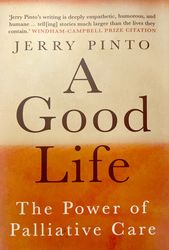
A GOOD LIFE: THE POWER OF PALLIATIVE CARE
By Jerry Pinto
Published by Juggernaut
Price Rs699; page 252