



Nothing exists in isolation, more so in history. A case in point is the ongoing Russia-Ukraine conflict—it has its roots not only in recent developments but also in the past.
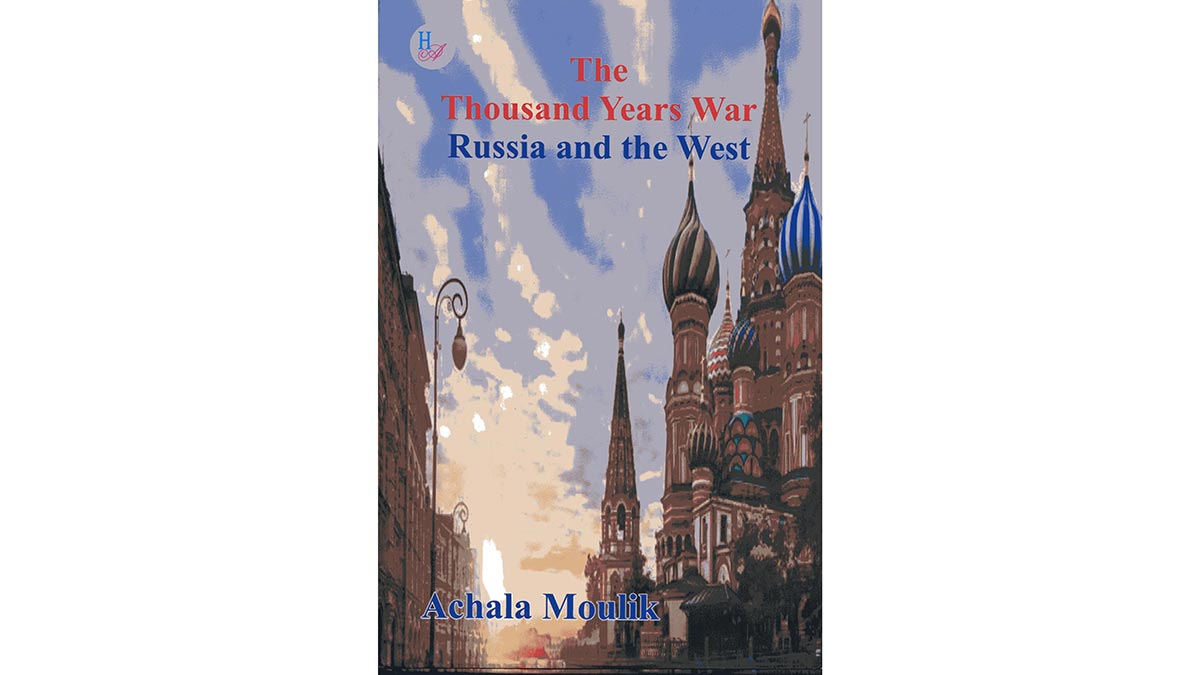
Pushkin Medal recipient Achala Moulik puts the Russian perspective in focus, placing contemporary events in the backdrop of a west-Russia conflict over 10 centuries. Hence the title of her book—The Thousand Years War: Russia and the West. If anything, the book helps understand the raging conflict in Ukraine.
Russians have had a unique and troubled relationship with the west. They are Europeans and Eurasians at the same time, which has led to a civilisational conflict. Parallelly, there was the clash between the Roman Catholic Church and the Greek Orthodox Church, as also the political-economic contradictions between capitalism and communism.
Tsarist Russia had recurring conflicts with other imperialist powers—Britain, France, Ottoman Turkiye and Austria-Germany. The invasions by the Vikings, Napoleon Bonaparte, Adolf Hitler and later on the power play by the US and NATO only continued the thread.
Moulik writes in her prelude: “Unable to defeat Russia in a direct armed confrontation, the west waged proxy wars against nations friendly to Russia, which would draw Russia into conflicts. This inflicted irredeemable damage on the hapless pawns in the game—Afghanistan, Iraq, Syria and now Ukraine.”
There were economic reasons, too. Russia was home to 28 per cent of the world’s natural and mineral resources. So it has been a conflict not just for power and influence but also natural riches and territories.
The book, which can be blamed for its overwhelming Russian point of view and for being over-simplistic, is also a commentary on Russian resilience, underlining the victories against the invading Swedes, French and Germans.
Nine of the book’s 38 chapters are articles by other writers. Moulik’s final chapter expresses hope of a multipolar world, “where the weak are defended, the poor are aided, the humiliated are respected, where might is not right and where justice and equality for all are not empty pledges, and where powerful states cannot destroy those who oppose them”.
The book also has mentions on the elephant in the room, China, and the rising giant, India. “Now we can assume that the massive emancipation of mankind from western control is of central importance, the most important factor of which is the growth of China’s economic and political power,” writes Moulik. “If China itself, as well as India and other major states outside the west, cope with the task entrusted to them by history, in the coming decades the international system will acquire features that were completely uncharacteristic before.” Given their growing importance, India and China deserved a little more space in the book.
Nonetheless, The Thousand Years War: Russia and the West will go down as an important view of an outsider, with the Russia-Ukraine conflict providing the perfect setting.
THE THOUSAND YEARS WAR: RUSSIA AND THE WEST
By Achala Moulik
Published by Har-Anand Publications Pvt Ltd,
pages 296, price Rs999
