


Filmmaker Mari Selvaraj’s heroes freely roam his home. Visionaries like Karl Marx, B.R. Ambedkar and Periyar wink at me from photographs in the front hall. On the opposite wall is a bevy of writers—Fyodor Dostoevsky, Leo Tolstoy, Maxim Gorky, Gabriel Garcia Marquez and Ismat Chughtai—comfortably perched within black-and-white frames. On the mezzanine floor is a bookshelf spilling with biographies, novels, poetry and short story collections. The way to Selvaraj’s mind is surely through his home.
Clad in a black T-shirt and trousers, Selvaraj emerges from his office. “Vanakkam,” he says with folded hands, giving me an insider view not just of his home, but also of his thoughts, his politics, his childhood, and the making of his movies. By now, Selvaraj is firmly enshrined in the pantheon of Kollywood greats, with each of his five films in seven years being a masterclass in restrained but powerful storytelling. Elaborating on the lives of the oppressed, of the fight for land and rights, of the atrocities of caste—they educate without moralising, entertain without trivialising. His latest, Bison Kaalamaadan, narrates the struggles of a kabaddi player from rural Tamil Nadu.
Writer J.R.R. Tolkien of The Lord of the Rings fame once said that the best stories emerge from the “leaf-mould of the mind”. They come out of “all that [one] has seen or thought or read, that has long ago been forgotten, descending into the deeps”. It is from these leaf-moulds—of his childhood in Puliankulam, a backward village in Tamil Nadu’s Thoothukudi district; of the abuses hurled at him; of the caste discrimination he faced—that his stories emerge. Born in a farming family, Selvaraj was never interested in studies like his three brothers and elder sister. When they went to school, he would while away his time watching kabaddi matches. Even later, while studying law, his passion was movies; he wanted to act and dance in them. In 2006, at the age of 22, Selvaraj left his village without telling anyone. He abandoned law to come to Chennai to pursue a career in films. After a long stretch of doing odd jobs around film sets, he got to work with director Ram in three of his films. That was when he realised that his calling lay behind the camera and not in front of it. Twelve years later, he made his directorial debut with Pariyerum Perumal, an autobiographical film about a law student who battles oppression. It was an instant success, winning several awards and later being remade in Hindi as Dhadak 2 (2025). All four films that followed were successful, with each bearing an autobiographical imprint. He puts himself, says Selvaraj, at the centre of his scripts.
Although he prepares a screenplay for each film, his imagination is at its most fertile while shooting on ground, and he often has to change the script to accommodate fresh ideas. For example, initially the dog Karuppi played a minor role in Pariyerum Perumal. But when a friend from his village came with his dog to watch the shoot, Selvaraj changed the script to broaden Karuppi’s role. She became the film’s soul—a metaphor for caste-based killings—accompanying the protagonist Kathir wherever he went. If it was a dog in Pariyerum Perumal, it was a donkey in Dhanush’s Karnan (2021) and pigs in Udhayanidhi Stalin’s Maamannan (2023), all of whom symbolise power hierarchies in Indian society. “I do not include these scenes as metaphors deliberately,” he says. “I only want to frame my world of cinema and it is for the audience to interpret it the way they want.”
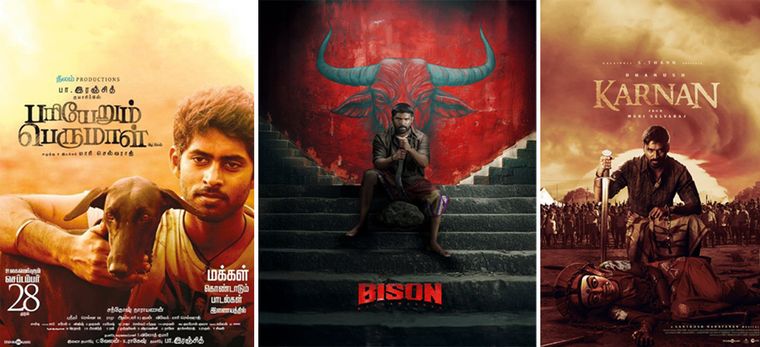 Poster perfect: (From left) Pariyerum Perumal, Bison Kaalamaadan and Karnan.
Selvaraj has a compelling way of making his point obliquely, like in how he depicts caste discrimination in Bison Kaalamaadan. As the hero Vanaththi Kittan goes for his kabaddi training, colourful wristbands are shown being cut off. These wristbands, says Selvaraj, are a symbol of caste identity in the districts of Thoothukudi and Tirunelveli, where he hails from. “It might seem like a 10-15 second visual, but if at least one person cuts off a wristband as a result of watching the film, I will consider it my victory,” he says. “I may not witness it in person, but it will happen.”
Ask him why the women in his films are always older than the protagonist and he has a striking answer. “How do you make your women bigger?” he asks. “Society does not take it in the right sense when I say that the woman is more educated than the man, or that she is highly knowledgeable. So I show them as older.” In fact, he has a high regard for the women in his life, be it his sister, mother or wife Divya, whom he married after a seven-year affair and much opposition due to caste barriers. In the end, when they got married, Selvaraj got Pablo Neruda’s words printed on his wedding invite: “You can cut all the flowers, but you cannot keep spring from coming.”
His films also feature a strong older sister, who eggs on her brother, the hero, to fight his battles while herself remaining in the shadows. Selvaraj says these characters were inspired by his own sister, who always encouraged him to reach for the stars. He says he has never told any story from a woman’s perspective because he is not familiar with their thoughts. Even while he could roam around his village after dark as a schoolboy, stand on the railway track while a train approached, watch wrestling matches and play in the rain, his sister never had any of these freedoms. “My films describe how I look at the world,” he says. “Although my sister inspired me to pursue my dreams, I never knew what was going through her mind.”
Even as he kneads his life into his stories, he seasons them with his heroes’ writings. He cannot remember the number of times he has read Vennira Iravugal, the Tamil translation of Dostoevsky’s White Nights. Every time he reads it, he gets a different perspective on love and relationships. Gorky’s writings inspired his socialism, Basheer’s Mathilugal touched him deeply, and Tolstoy’s last novel, Resurrection, resurrected his narrative skills. The works of these writers are mired deep in the “leaf-moulds” of his subconscious, lending strength and steel to his films.