


Interview/ Sundaram Tagore, gallerist
In an America that is increasingly insular and inward-looking, Sundaram Tagore, an Indian immigrant from Kolkata and great-grandnephew of Rabindranath Tagore, celebrates diversity and global culture through art in New York. An Oxford-educated art historian, gallerist and award-winning filmmaker, this year Sundaram marks 25 years of promoting east-west dialogue among artists, art lovers and nations.
Sundaram’s father, Subhagendranath (Subho) Tagore, was one of India’s first modernist painters, a poet and a magazine publisher. His art magazine was called Sundaram, and he named his son after it. Subho left the family home in Jorasanko at 26, later forming the Calcutta Group in 1943 with other young artists like Nirode Mazumdar, Gopal Ghose and Kamala Das Gupta.
Born to an Assamese mother and having lived in eight countries, Sundaram says his global exposure and Indian heritage have profoundly shaped his outlook. He opened his first gallery in SoHo, New York, in 2000, to showcase artists engaged in cross-cultural explorations. It is now in the chic new art district of Chelsea. There are no borders at the eponymous gallery, for on its walls you’ll see the work of artists from countries as far apart as South Korea, Morocco, Iran and the US. Sundaram currently has two galleries in New York, and galleries in Singapore and London.
To mark the 25th anniversary, the Sundaram Tagore Gallery in Chelsea has mounted an exhibition featuring more than 30 artists. Events are to follow in Singapore as well as the gallery reopening in London in a new location in the spring.
Sundaram is also an avid writer and filmmaker, known for The Poetics of Color, Louis Kahn’s Tiger City, and his current project Art Matters starring Nandita Das and Linus Roache.
Excerpts from an interview:
Q / How important has Tagore’s legacy been in your life?
A / Rabindranath Tagore’s legacy has had a profound and deep personal influence on my life, not just through the artistic and literary genius, but through the broader cultural, philosophical and ethical questions that he raised, which shaped family for generations, and the fact that he always talked about social responsibility. Not to just function in isolation but always consider the disadvantaged.

This has been a deeply influential thought process throughout the family, even now. The story of the legacy doesn’t begin with Rabindranath alone. It goes back to his grandfather (Dwarakanath Tagore), one of the earliest Indian industrialists and financiers, who laid the foundation for modern banking and railway and shipping in India. He was a visionary ahead of his time, an entrepreneur, philanthropist and cosmopolitan, who built bridges between east and west at a time when such exchanges were rare.
So, as you can understand, Rabindranath, in many ways, was a synthesis of this lineage of his grandfather and his father (Debendranath), who was a deeply spiritual being. So, the Tagore household was an extraordinary environment, a place where east and west, tradition and modernity, art, literature, music and social reform thrived.
I was born in the 60s, so it was my father who was essentially the last of the Tagores to grow up in that house. And being a rebellious individual, he had many interactions with Rabindranath Tagore—some confrontational.
Q / Can you share any anecdote?
A / One interesting story that I know from my father.... He had just come back from England and bought this car called Lancia Lambda, and he would speed through the streets. [Once], his car wasn’t functioning, so directly below the main house where all his cousins and friends and family members gathered he was banging away at the car to try and fix it. Rabindranath Tagore opened a window and said, “Who is making that racket?” Once he shut the window, my father told Rathindranath Tagore, Rabindranath’s son, “At least I managed to stop the old man from writing another epic!” That story makes me laugh because it shows no matter who you are or how important you are, family dynamics are as they are.
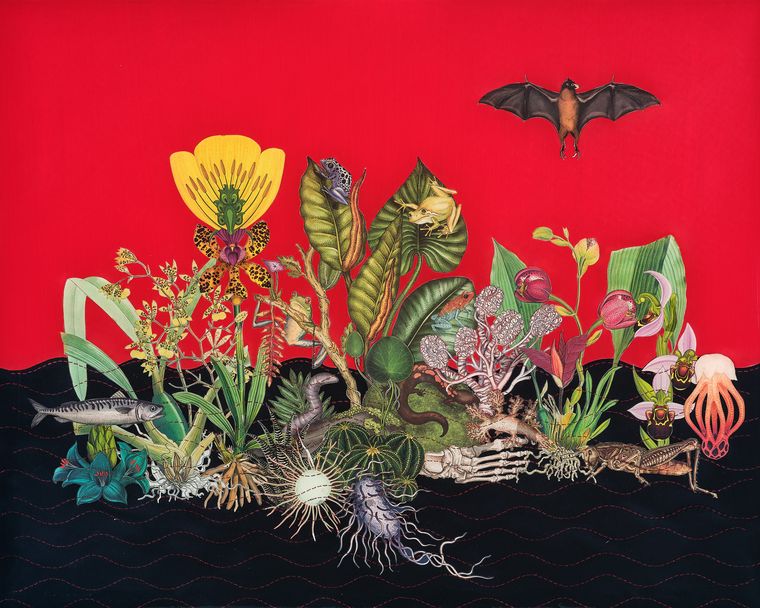 Anila Quayyum Agha’s Rising Waters and a Hungry Bat (Human fragments, plants, land & sea creatures), which is also on display | Courtesy Sundaram Tagore Gallery
But in all seriousness, our family has never focused on wealth accumulation. They had a lot of wealth at one point, but they have always emphasised social regeneration, believing in the imperative to uplift the underprivileged and serve a greater collective purpose.
Q / How did your father continue Tagore’s legacy?
A / That spirit was embodied in many ways by my father, Subho Tagore, the founder member of the Calcutta Group, which was India’s first collective. And this was formed soon after he returned from England after interacting with some of the folks from the Bloomsbury Group in London. My father was an artist, a poet, a bohemian, who continued the Tagore legacy in its commitment to humility, accessibility and social conscience. In short, Rabindranath Tagore’s legacy is not just historical, it’s lived, felt and practised in our daily lives.
Q / You are that rare Indian gallerist who promotes not only Indian art, but also global artists and sculptures, and you celebrate life and Indian spirit. How did that come about?
A / I would say it stems from the understanding that the Indian identity at its core is inherently pluralistic and deeply cosmopolitan. If you look at Indian history, from the ancient Aryans to the Greeks and Scythians and Central Asians and Arabs, and later the Europeans, such as the Dutch, the Danes, the Portuguese, the French and the English, all have been part of India in some form. India has always been a crossroads of cultures. So, miscegenation, both genetics and culture, has been the norm, not the exception. We have not only absorbed external influences, but we have also enriched and transformed them. India has long been part of a global dialogue, trading ideas, aesthetics and philosophies across continents. So, in that context, what I’m doing as a gallerist, in a small way, is nothing radical. It’s just a natural extension of that tradition unfolding.
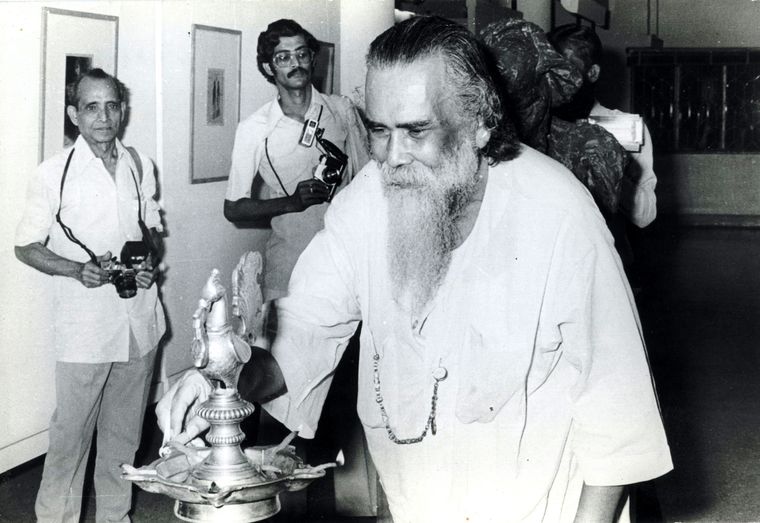 Lasting legacy: Sundaram’s father Subho Tagore, a pioneering modernist painter.
Q / What has been the biggest challenge of operating international galleries promoting diverse artists and marching to your own drummer?
A / One of the biggest challenges has been navigating the tension between artistic vision and the commercial realities of global art market when you’re committed to promoting culturally diverse, often under-represented voices and creating a space for genuine cross-cultural dialogue, you’re often going against the grain of what is considered marketable or fashionable in the mainstream art world, especially at the top end, where it can be very trend-driven.
There’s often pressure to conform to established taste or represent artists that cater to a narrow collector demographic, but I’ve always chosen to champion artists whose work has cultural, philosophical or historical depth, even if they don’t fit neatly into the market. Prioritising can be a tough road financially and logistically, especially when operating across multiple countries with vastly different audiences, economies and regulatory systems.
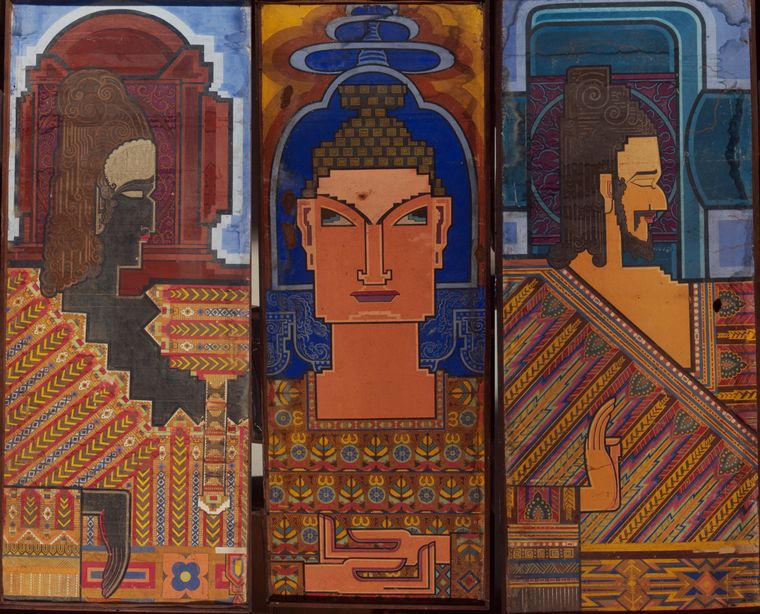 The Trinity by Subho depicting Shiva, the Buddha and Christ.
There’s also the challenge of educating audiences or indigenous communities, and in some ways, it can be a challenge staying true to a vision that’s not defined by market forces. That requires resilience. There are moments of doubt, there are definitely financial pressures, but I believe that art has a role far beyond decoration or investment. It is a tool for dialogue, for empathy, for expanding the way we see the world, and that belief continues to guide everything we do at Sundaram Tagore Gallery.
Q / So, at a time when America is closing its doors and becoming more inward looking, you are celebrating diversity and openness.
A / Yes, and I see that as not just a choice, but a responsibility. At a time when the divisiveness, nationalism and fear of ‘other’ are rising globally, not just in America, it becomes even more essential to create spaces that celebrate the differences, fosters dialogue, and reminds us of our shared humanity.
Lavina Melwani is a New York-based journalist for several publications and blogs at Lassi with Lavina.