


A sanyasi meditating under a tree. A yogi contorting his body into difficult poses. A monk in maroon playing the traditional Nga, the Tibetan drum. A qalandar sitting at a dargah in deep devotion. A gurmukh doing seva. A saffron-robed monk imparting wisdom on Instagram, and another leading India’s most populous state.
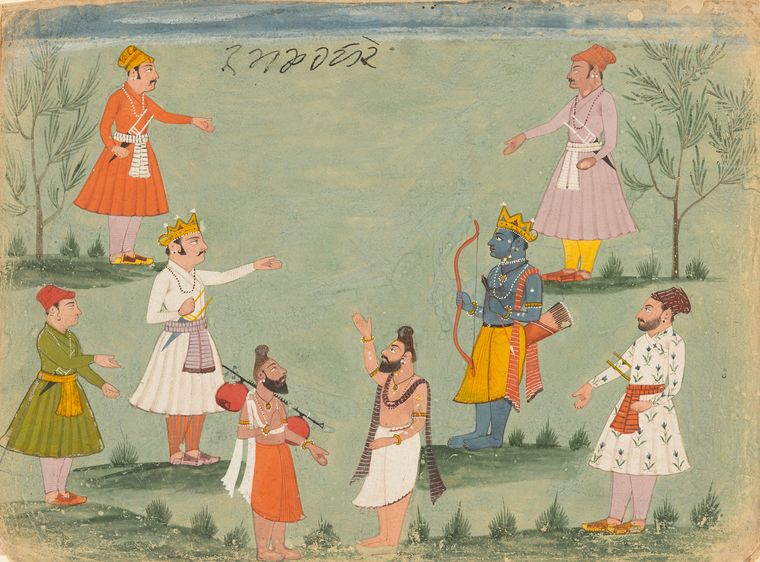 An Illustration from a Ramayana Series, Depicting Rama and Bharata Meeting in the Forest, with Two Sadhus and attendants - Pahadi artist (miniature painting) Natural pigment on wasli paper, late 19th century–early 20th century
While India has witnessed the rise and fall of empires, new religions mushrooming and others getting space and even refuge, colonialism, independence and a modern, capitalist society taking shape, the ascetic has been a constant. They are those who chose foregoing over amassing, discipline over comfort and devotion over convention. They have been reclusive figures, spiritual guides but also teachers, rebels, fighters and even political figures. They are mysterious despite being in plain sight, and revered but also suspected.

And that contradiction was on display at the Delhi Art Gallery, or DAG, at the exhibition titled ‘The Body of the Ascetic’.
“While the sadhu/monk has been an important catalyst in the Puranas, popular mythology, Indian history, and even rebel movements, there is little analysis about his role, how he fashions his identity, and the extent of the power that he wields,” says Gayatri Sinha, art historian and curator of the exhibition. “This is especially true of art, where the sadhu appears in a continuous stream of image-making, from the period of the Ajanta caves to the present, but is not historicised or studied in the way that the gods, the kings and queens were.” The display, she adds, “provided the opportunity to partially isolate this figure and read how different artists had treated it over the past 300 years or so”.
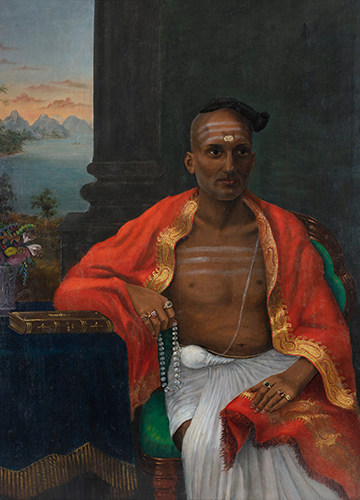 Portrait of Subramanyan Namboothiripad of Akavoor Mana, Cochin - Attributed to Madhava Warrier Oil on canvas, early 20th century
Austere and controversial
And it is a juxtaposed depiction of the Indian ascetic.
In a striking frame by an unidentified photographer, a ‘fakir’ is seen sitting on a spiked bed, displaying the sheer austerity associated with ascetic life. In another, a Kalighat Pat by an unidentified artist, an ascetic is suckling at a woman’s breast, depicting a more controversial image of the figure.
“In [works of] artists like Devyani or Kanwal Krishna or Bireswar Sen, who travelled into the high Himalayas, the sadhus and monks that they encountered were holy renunciates to be revered. In Altaf or Amit Ambalal, the religiosity of the sadhu is in serious doubt, and we see an ambivalent even satirical view,” says Sinha.
Reclusive and exotic
One could find different depictions of the sadhu not just as a theme but also in treatment. This was starkly felt in the case of colonial painters, who brought their European sensibility, especially realism, into the picture but also saw the Indian ascetic as a subject, and from a distance. A photograph that stood out was by Englishman Willoughby Wallace Hooper—of a typical Hindu ascetic with a big beard and hypnotising eyes. The ascetic is quite often seen as a singular figure, away from the space he inhabits, such as in ‘A Shaivite Priest in Meditation’, ‘Mendicant’ and ‘Shiva Worship’. But there was also Austrian painter Ludwig Hans Fischer’s ‘A Priest And Two Ascetics on the Ghats at Varanasi, India’, which gave an impression how certain places in India also carry the ascetic’s character as much as the ascetic himself. This was also evident in Kanwal Krishna’s ‘The Holy Walk’ and ‘The Holy City of Haridwar’.
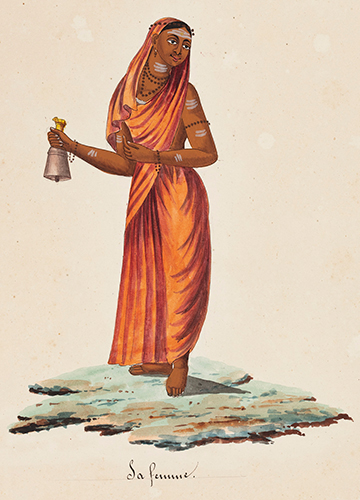 Sa Femme (His Wife) - Madras Artist (Company School) Opaque watercolour on paper, c. 1800
Plain and prosperous
And while the ascetic has often been shown as a mendicant, the exhibition also had on display more prosperous looking figures, such as the ‘Portrait of Subramanyan Namboothiripad of Akavoor Mana, Cochin’. “The Namboodiris as Kerala’s priestly class were both patrons of the Mana, or consecrated site, with its temple and extensive lands, as well as officiating priests. They were scholars, wrote kathakali plays and owned substantial lands as well—not all priests were renunciates. We see how the gosains of Nathdwara are also depicted as prosperous-looking figures,” explains Sinha.
Also, while there were artworks that are plain, there were others more ornate, as if reflecting upon the various shades of an Indian ascetic. Take, for instance, ‘A Jain Pilgrimage Map of Satrunjaya’, a large textile artwork depicting Rishabhdev, the first Jain Tirthankara, giving a sermon. There were also colourful and ornate Thangka paintings, depicting the various elements of Tibetan Buddhism, placed near a photograph of a Tibetan mendicant, bringing out the contrast in full display.
An inclusive figure
While Hindu, and at times, Buddhist and Jain monks have been, in a way, the postcard image of India, there is also the ‘Portrait of Mian Mir and Mulla Shah’, of the Qadiri Sufi order, and a miniature painting of ‘Guru Nanak in Conversation with Two Muslim Holy Men’—also a reflection of the composite culture that has existed since centuries.
There were artworks of Raja Ravi Varma, Nandalal Bose, M.F. Husain and F.N. Souza on display, showcasing how the Indian ascetic has a striking portfolio of artists across forms of painting. There is Kabirdas and Mirabai of the Bhakti Movement, and Swami Vivekananda and Ramakrishna Paramahansa, but also Vinoba Bhave and even Mahatma Gandhi, depicting how an Indian ascetic himself has been an inclusive figure.
Women saints: Far and few
While there were artworks on women saints on display, one could not help but notice how they were few, and understandably so, because renunciation for women can only be a far more radical act than their male counterparts. Notably, while there were depictions of Mirabai, Andal and Akka Mahadevi, women were often shown as a distraction for male renunciates. For example, ‘Temptation of Buddha’ by M.V. Dhurandhar showcases a beautiful, naked woman around Buddha, who sits in deep devotion.
“Women sadhvis have always been numerically fewer than men, although there are celebrated figures like Akka Mahadevi, Lal Ded, Karaikal Ammaiyar and even Andal,” says Sinha. “Yoginis, especially in the Shaiva tradition, may not have been organised as women renunciates are in the akhadas of today, but they have been represented on glass paintings, Pahadi and Deccan miniatures.”
The exhibition beautifully displayed the various spaces the Indian ascetic continues to inhabit, from the Himalayas to the beaches of Puri, and from secluded places to even that of politics and power. Despite being a constant, the Indian ascetic remains mysterious and understudied.