


Elizabeth Gilbert makes a bold claim in her new book, All the Way to the River. “This book,” she writes, “will set you free.” Free from what? Before she answers that, she wades into turbulent waters—of love, grief, addiction, recovery and the thin line between devastation and redemption.
Gilbert, best-known for Eat Pray Love (which was adapted into the eponymous drama starring Julia Roberts) and Big Magic, is at her rawest in her latest work. All the Way to the River is framed around Gilbert’s relationship with her partner Rayya Elias, who died of pancreatic and liver cancer in 2018. She reconstructs their life together with brutal honesty: the joy, rage, addiction, relapse and, most of all, the love that threaded through it all.
The addiction is not just to alcohol or drugs. One of the book’s most striking sections is Gilbert’s own confession: “Hi, my name is Lizzy, and I’m a sex and love addict... a romantic obsessive, fantasy and adrenaline addict, a world-class enabler and a blackout codependent.” Sobriety, to her, means stepping away from romantic entanglements, infatuations and all forms of distraction. The book insists that addiction is not an aberration, but merely an exaggeration of what many experience: a desperate desire to anaesthetise life through substances, behaviours or people. By re-framing addiction as an extreme version of human yearning, she universalises the experience, reeling the reader in. The effect is one of radical empathy, for “even the strongest of us, even the bravest”.
One of the triumphs of the book is the insight with which Gilbert depicts Rayya, as both dazzling and destructive. If her prose is confessional when it comes to her, it is incandescent while describing Rayya, almost assuming a mythical quality. We see Rayya as an artist, musician and performer, but also as someone ravaged by insecurity, drug addiction and relapse. Gilbert neither exalts nor diminishes her, instead capturing in high definition a life that is luminous not despite, but because of its flaws.
The book is not structured in a linear manner; it is a collage of journal entries, poems, letters, sketches. In the poem ‘Powerless’, for example, Gilbert is at her most lyrical.
“Someday all 10,001 of us will laugh about this together— once you have finally learned how to careen into my arms on the glorious wings of failure.”
Grief, Gilbert suggests, is not a neat arc, but a jagged mosaic—half memories, half prayers, stitched together with words. She resists tidy conclusions, instead showing the messy, often contradictory reality of grief and love. “We’re both walking a brave path here,” Rayya had once told her. “I have to be brave enough to die, and you have to be brave enough to live.” The looseness of form—fragmented, uneven—may frustrate some readers used to the more structured narrative of Eat Pray Love. At times, the intimacy can seem almost invasive, as though we are reading something extremely private.
So, does the book deliver on its promise that it will set you free? Not in a prescriptive sense—there are no 10 steps to healing here. Instead, it frees by reminding us that suffering is not an anomaly. Freedom, according to Gilbert, is not escape, but surrender. All the Way to the River is Gilbert at her bravest. It is equal parts memoir and spiritual manual, not always comfortable, but always honest. For readers willing to enter its fractured form, it offers something rare: the sense of being less alone. It may not set every reader free, but it will remind them that freedom is possible. And sometimes, that is enough.
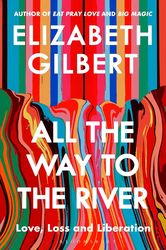
ALL THE WAY TO THE RIVER
By Elizabeth Gilbert
Published by Bloomsbury
Price Rs699; pages 400